
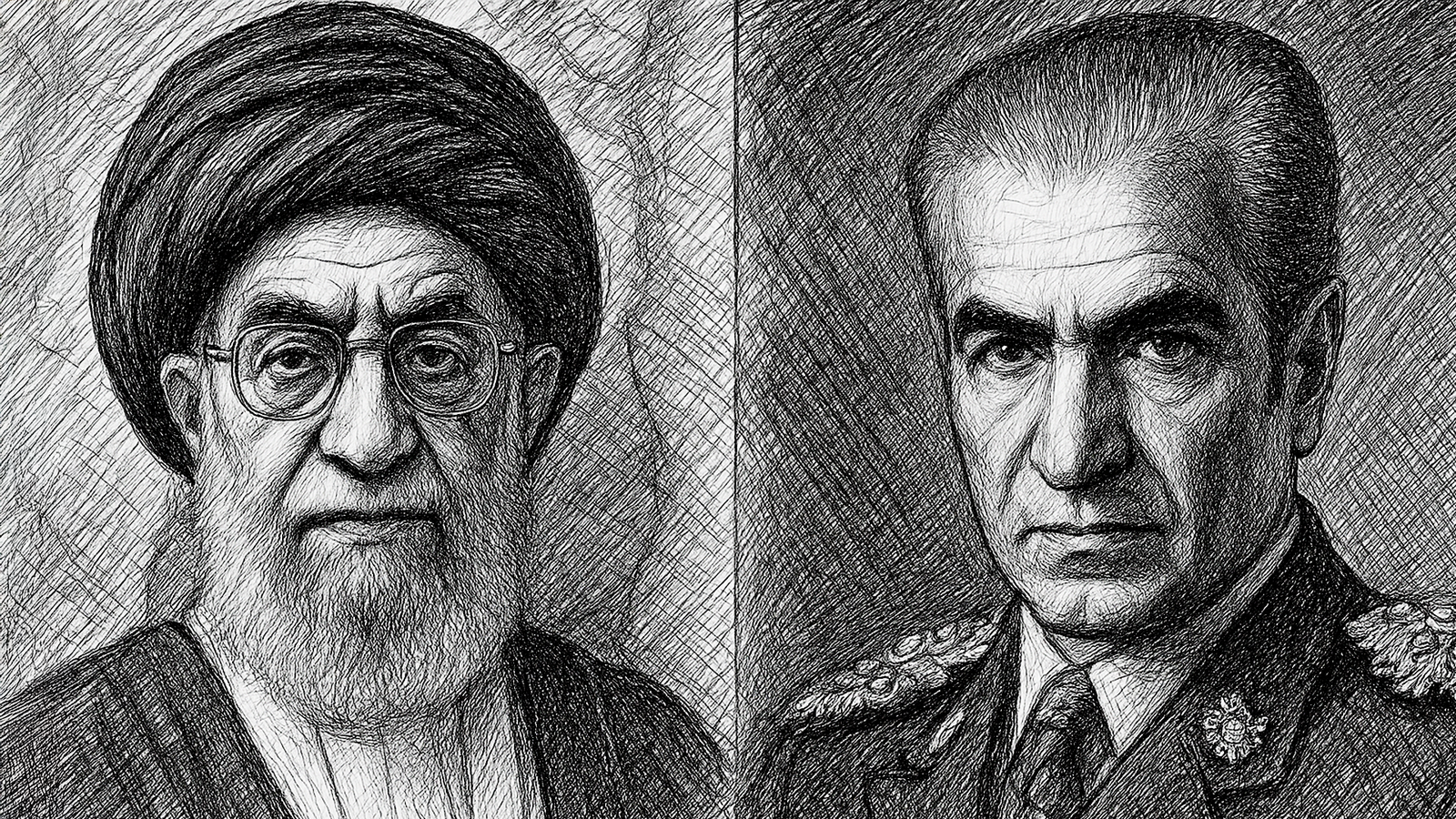
The Shah’s Government vs. the Islamic Republic’s Government
Iranian presidents under Ali Khamenei, since his rise to Supreme Leader in 1989, have always operated within a complex dynamic — balancing their declared executive role on one side, and a deeply rooted shadow structure of power within the state on the other.
According to researcher Mohammad Said Rassas in an article on the Kurdish Center for Studies website, Khamenei’s selection as Supreme Leader came through a political understanding led by Hashemi Rafsanjani. Some at the time thought that placing a weak figure in the top post would allow for easier control of the republic’s direction. However, later developments proved that Khamenei successfully reshaped the power balance within the regime in his favor, primarily through his alliance with the Revolutionary Guard, which today holds sway over key sectors of the economy, security, governance, and culture.
Since then, the position of president has been largely limited in influence, lacking actual control over strategic decision-making, except in occasional cases. One such exception was the presidency of reformist Mohammad Khatami (1997–2005), which Rassas references. Despite Khatami’s sweeping electoral victory, he remained marginalized throughout his term — especially after the large student protests of the summer of 1999, when Khamenei acted decisively as the ruling leader, drawing inspiration from Deng Xiaoping’s handling of Tiananmen Square.
With the election of Mahmoud Ahmadinejad in 2005, it became clear — according to Rassas — that the Supreme Leader preferred a president more closely aligned with the “deep state.” The events surrounding the 2009 election and the subsequent mass protests — known as the Green Movement — again confirmed that Khamenei retained final authority over how the regime would handle social unrest, as demonstrated by his Friday sermon delivered just days after the protests erupted.
During the presidency of Hassan Rouhani, who campaigned on a reformist platform, the office of the presidency was allowed relatively more space — particularly following the 2015 nuclear deal. As Rassas observes, Khamenei at that stage sought to balance temporary openness to the West with preserving the internal rules of the game.
However, the Trump administration’s withdrawal from the deal tipped the scales toward hardline positions, reinforcing Khamenei’s conviction that agreements with Washington were no longer a safe bet.
It was in this context that Ebrahim Raisi was promoted as the preferred presidential candidate in 2021. According to Rassas, this was no random choice — Khamenei intended to prevent the emergence of an “Iranian Gorbachev” who might dismantle the regime from within, as Gorbachev had done in the Soviet Union.
In a phase marked by an aging leadership, it has become clear that foreign policy successes alone are not enough to address the simmering domestic crisis in a youthful society yearning for a deeper transformation of power structures.
In this context, many misconceptions persist regarding state institutions — including the role of the prime minister. As noted on the Islamic Knowledge Network, some critics still insist on portraying the current system as a mere replica of the Shah’s regime, with only the names changed. But the reality is quite different from this superficial view.
A comparison of the conduct of today’s top officials with that of prime ministers who served under the Shah reveals vast differences. As the Islamic Knowledge Network points out, the current lifestyle of government ministers is fundamentally different from the wealth-hoarding practices of the Pahlavi era.
Today’s officials live modestly and work long hours in service to the public — far removed from the extravagance that once prevailed. It would thus be unfair, according to this analysis, to compare figures such as Mr. Rajai with the likes of Bakhtiar or Azhari — both key figures in the Shah’s repressive governments — and claim that today’s prime ministers are merely a continuation of the old regime under new labels.
The difference between the Islamic Republic and the Shah’s regime is not merely cosmetic — it lies in the nature of the relationship between state and society and in the absence of systemic looting and repression. While clear shortcomings remain, and a gap persists between public expectations and actual achievements, the claims of some nostalgic for the return of the old order lack factual basis and ignore the genuine efforts being made to address long-standing crises.
In this picture, Iranian presidents under Khamenei continue to operate within a space defined by the Supreme Leader’s authority — expanding when political flexibility is needed, as with Rouhani, and narrowing when ideological consolidation is prioritized, as with Ebrahim Raisi. In between, the future of the Islamic Republic remains tied to the ongoing balance of power between the country’s deep-state institutions and the largely symbolic presidency, within a political system now far more cautious about any reckless reformist adventures.
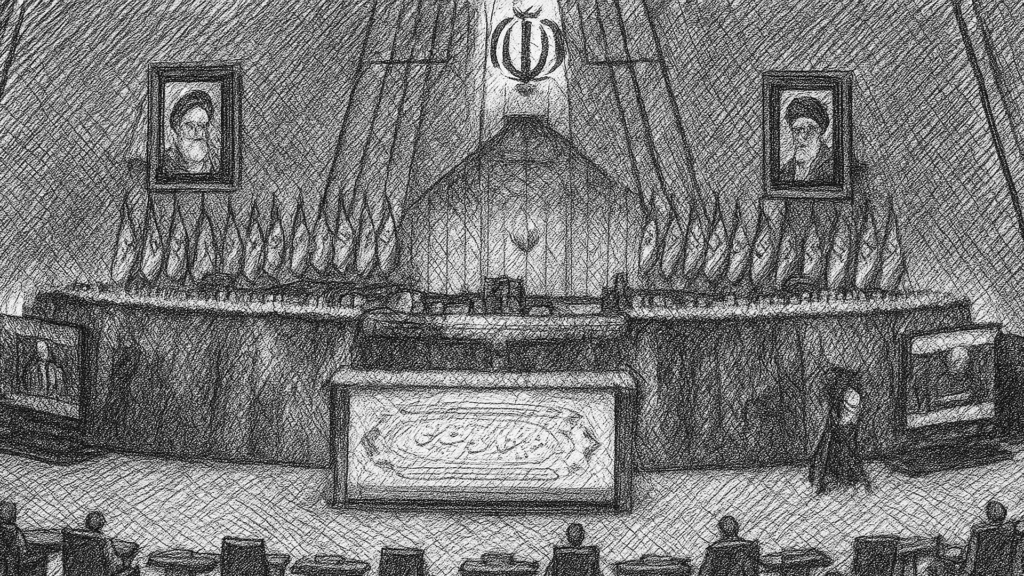
The Shah’s Parliament vs. the Parliament of the Islamic Republic
During the Shah’s era, Iran’s political system was a disguised absolute monarchy — ruled by the king with no real opposition. The National Consultative Assembly (lower house) and the Senate (upper house, established in 1949) formally represented the legislative authority, but in reality, both bodies lacked true independence.
According to Ervand Abrahamian in his book Iran Between Two Revolutions (1982), the parliament became a palace-dependent institution after the 1953 coup that overthrew Prime Minister Mossadegh and restored Mohammad Reza Shah to power. Parliamentary elections were no longer free or fair but were conducted under the supervision of SAVAK, the Shah’s secret police. MPs were pre-selected from among aristocrats, large landowners, businessmen connected to the regime, and individuals close to the royal court — turning parliament into a symbolic body representing the ruling elite rather than the people.
Legislation during the Shah’s time did not originate from parliament — most laws were drafted within government or palace circles and merely passed through parliament for rubber-stamp approval, giving a constitutional facade to what was essentially autocratic rule.
Parliament had no real power to hold ministers accountable. The prime minister was not responsible to parliament but to the Shah himself. Core laws regarding the economy, foreign policy, oil relations, and even social policies were imposed from the top down.
The composition of parliament remained elitist. As Abrahamian explains, most members came from the landowning class or Tehran’s business elite. Even those presented to the media as independents or moderates were in fact part of the system. Opposition figures were barred from running, arrested, or exiled. The parliament served as political window dressing for an undemocratic regime.
After the Islamic Revolution in 1979, the power structure was altered. The Senate was abolished, and the Islamic Consultative Assembly (Majles) was established under the constitution of the Islamic Republic as the sole parliament.
As noted by the Islamic Knowledge Network, the new parliament emerged as a product of the people’s sacrifices during the revolution. Members of the Majles are elected by popular vote. The Speaker of the Majles is no longer an aristocrat or royal appointee but is chosen from among elected deputies who represent broader segments of society.
Parliamentary elections take place within a constitutional framework and under the supervision of the Guardian Council, which oversees election integrity and candidate qualifications. This means that while the parliament is popularly elected, its composition is shaped within the boundaries of the regime’s official ideology — excluding opponents of the religious system or radical critics. Similar practices can be seen in many other political systems; for example, it would be unthinkable for a communist party to run in U.S. elections or for a Nazi-affiliated party to compete in Germany.
Nevertheless, as Ali Gheissari and Vali Nasr point out in their book Democracy in Iran (2018), today’s Majles enjoys far more political space than its counterpart under the Shah. It is an arena for competition between various political currents — conservatives, reformists, and independents — and has witnessed genuine political struggles that have enriched and influenced the country’s political life.
Ali Hashem, in an article titled The most important things he’s done since his founding How did the Assembly of Experts elect Khamenei as Iran’s leader? on the Al-Jadidah website, notes that after the 1988 elections, the Majles gained a more coherent role as the sole legislative body following the abolition of the Senate. Over time, the Majles has become a forum for clashes between different factions, particularly conservatives and reformists. The current Majles also plays a relatively active supervisory role — questioning ministers and participating in the legislative process far more dynamically than in the Shah’s time.
The fundamental difference between the two parliaments is that the Shah’s was a symbolic institution loyal to the royal court, whereas today’s Majles is an elected body — albeit subject to religious and political oversight — that reflects, to some degree, evolving dynamics within Iranian society.
While the Shah monopolized both legislative and executive power, the Supreme Leader of the Islamic Republic holds top constitutional authority but does not directly manage the parliament. Instead, he influences the process through institutions like the Guardian Council. Although legislation is initiated in the Majles, it undergoes religious-constitutional review.
Thus, as Abrahamian observes, the legislative system under the Shah was mere window dressing for an absolute monarchy, while the current system has a more complex institutional structure that allows for a degree of constrained pluralism. Despite the dominance of religious authority, today’s Majles represents a political space that plays a role in balancing power within the regime.
The Shah’s Judiciary vs. the Judiciary of the Islamic Republic
During the Shah’s era, Iran’s judiciary was a body fully subordinate to royal authority, with no real independence — as explained by Ervand Abrahamian. Despite Reza Shah’s attempts in the 1930s to modernize the judicial system along European, especially French, lines, it remained under palace control, particularly in political cases, which were mostly referred to military courts where verdicts were dictated by SAVAK (the security services) and the Shah himself.
Judges had no independence — their appointments and promotions were based on their loyalty to the regime. At that time, the judiciary was a tool of repression, not a means for achieving justice. The Shah personally intervened in the appointment of top court presidents, while the Ministry of Justice functioned as a bureaucratic body with no autonomy.
There was even a legal duality: civil courts based on modern laws coexisted with religious courts that handled personal status cases. In all cases, however, judges functioned more like state employees than independent judicial authorities — as noted by the Islamic Knowledge Network, the judiciary in that era was simply an arm of the Shah’s regime and a tool of autocratic rule.
After the 1979 Islamic Revolution, the legal landscape changed. A new judiciary was established based on Islamic Sharia law, creating a different structure and ideology. As Shaimaa Ali writes in her article Iran’s Judiciary: The Unreformable Institution (published on the Gulf House for Studies and Publishing website), Mohammad Beheshti, one of the chief architects of the new constitution, led the effort to rebuild the Islamic judiciary. He recruited his students and young clerical aides — among them Ebrahim Raisi and others who would remain influential in the judiciary for decades.
During this transformation, many laws were merged with Islamic Sharia, including clauses that have been heavily criticized in the West — such as stoning for adultery or amputation for theft.
From the outset, the judiciary in the Islamic Republic has been linked to the religious authority: under the 1989 amended constitution, the Supreme Leader directly appoints the head of the judiciary.
Although the judiciary is, in theory, a constitutionally independent institution, this direct link to the Supreme Leader has made it more of an arm of the highest authority. As the Islamic Knowledge Network explains, there is a significant difference between judges under the Shah — who often came from aristocratic backgrounds or the regime’s inner circles — and those trained after the revolution, who largely belong to the revolutionary movement and the religious establishment.
However, this does not negate the existence of deep structural problems. As Shaimaa Ali points out, the judiciary has seen successive leadership figures: Abdolkarim Mousavi Ardebili, who later clashed with revolutionary courts and opposed some mass execution rulings in 1988; then Mohammad Yazdi, whose tenure was marked by peak chaos and corruption. Yazdi strengthened Khamenei’s control over the judiciary and purged judges appointed by Khomeini, replacing them with a more loyal class aligned with the new Supreme Leader.
These problems persisted under Hashemi Shahroudi, who attempted reforms but faced resistance from entrenched networks of influence — and under Sadeq Larijani, who further politicized the judiciary and turned it into a tool of internal political conflict.
Even under Ebrahim Raisi, despite anti-corruption slogans, the judiciary remains far from fully independent and continues to operate under the Supreme Leader’s control. As a result, political executions, protest repression, and selective anti-corruption efforts persist.
In comparison, as confirmed by the Islamic Knowledge Network, the judiciary in the Islamic Republic — despite its shortcomings and flaws — is not the same as the Shah’s judiciary. Its identity has changed, the composition of judges is different, and Sharia is now the highest legal reference.
However, as Shaimaa Ali’s analysis shows, despite these structural changes, the core common feature of the judiciary in both eras remains the lack of full independence. The source of interference, however, has shifted: under the Shah, it was the royal palace; today, it is the Supreme Leader who holds ultimate authority.
Additionally, repression under the Shah was primarily directed at nationalists and the left-wing opposition, whereas in the Islamic Republic, it targets a broader spectrum — including dissenters within the regime itself, reformists, and civil society actors.
In the end, the Iranian judiciary has changed in form and reference since the revolution, but as Shaimaa Ali states, “it enjoys no real independence and remains merely one link in the chain of state institutions used to manage the country and consolidate the ruling political authority — under the control and supervision of the Supreme Leader.” Thus, while different from the Shah’s judiciary, it remains an instrument of power rather than an independent authority.
In the end, the Iranian judiciary has changed in form and reference since the revolution, but as Shaimaa Ali states, “it enjoys no real independence and remains merely one link in the chain of state institutions used to manage the country and consolidate the ruling political authority — under the control and supervision of the Supreme Leader.” Thus, while different from the Shah’s judiciary, it remains an instrument of power rather than an independent authority.
Related Articles
Arab Despotism: Between Israel’s Democracy and Hamas’s Shura
18 August 2024
Iranian Constitution and Presidential Vacancy: Who Will Replace Raisi?
25 May 2024
Effectiveness of Parliamentary Oversight over Authorities and Institutions in Qatari Legislation
8 July 2025