At the heart of the modern legal system, public authorities and institutions represent one of the most prominent tools the state uses to implement its policies and achieve its service, economic, and social objectives. These entities, which grow on the edges of central administration, are not created arbitrarily; rather, they embody the principle of administrative [...]
At the heart of the modern legal system, public authorities and institutions represent one of the most prominent tools the state uses to implement its policies and achieve its service, economic, and social objectives. These entities, which grow on the edges of central administration, are not created arbitrarily; rather, they embody the principle of administrative decentralization and serve as a mechanism for the state to overcome bureaucratic delays and distribute public functions more efficiently.
At the same time, they are not merely bureaucratic establishments; they are legal personalities with distinct positions within the state’s structure, unique legal characteristics, and complex relationships with both the executive authority and parliamentary oversight.
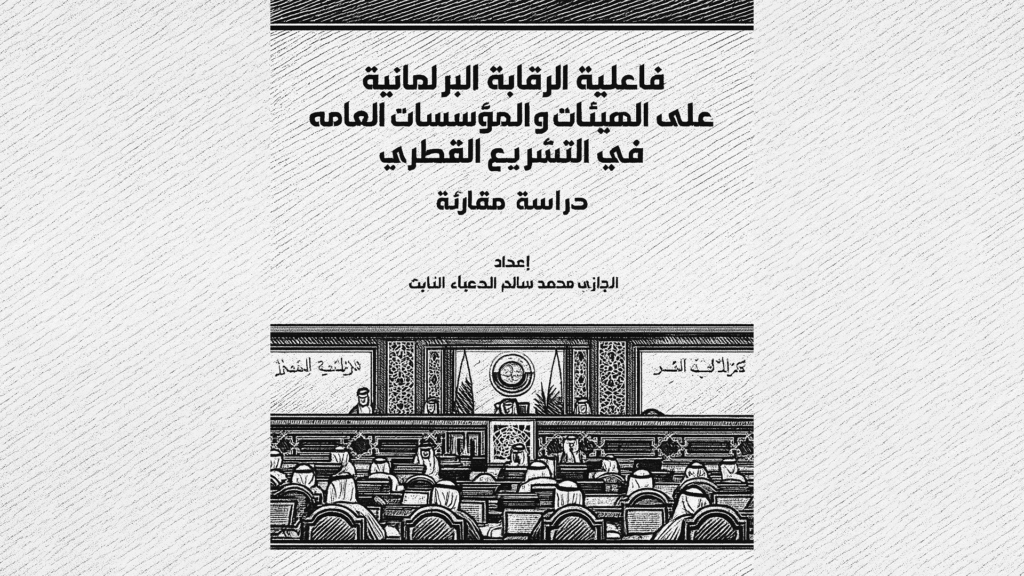
In her 2024 study, Effectiveness of Parliamentary Oversight over Public Authorities and Institutions in Qatari Legislation, researcher Al-Jazi Mohammed Al-Dabaa Al-Nabit explores the nature of these entities and their legal concept by examining their definitions, functions, and legal status in light of jurisprudence, legislation, and Qatari court rulings.
The researcher begins with the perspective that these entities represent a form of administrative decentralization adopted by the state to relieve the burden on central administration and empower public institutions to achieve their goals with greater efficiency and flexibility.
Al-Nabit describes public authorities as: “Decentralized public legal persons, established by law or pursuant to law, tasked with managing non-economic public utilities with the aim of providing public services without seeking profit.” She highlights their unique feature of administrative and financial independence while still being subject to executive authority oversight.
According to Law No. (22) of 2004 on the Issuance of the Civil Code, legal persons are juridical entities granted legal personality by law, which allows them to acquire rights and bear obligations just like natural persons. In other words, they are not real individuals but legal entities such as companies, associations, institutions, and even the state itself, all of which enjoy a separate legal identity.
However, this independence is not absolute—it is functional and regulated. It allows the authority a degree of operational freedom within its area of specialization while maintaining the state’s higher-level oversight.
In this context, the researcher cites the definition provided by the Qatari legislator in Law No. (2) of 2015 on the State Financial System, which states: “A public authority is a legal public person tasked with managing a non-economic public utility or aiming to provide a public service.” This type of authority is exemplified by entities such as the Charity Affairs Regulatory Authority, which develops strategies for charitable work and monitors its performance without engaging in commercial or investment activity.
As for public institutions, they also fall under the category of public legal persons but differ in terms of their nature and purpose.
As Al-Nabit explains: “A public institution is managed on a commercial basis and aims to exploit a natural resource or participate in economic development,” and is granted a fully independent budget separate from the state’s general budget.
Such institutions may engage in industrial, agricultural, financial, or commercial activities, making them more aligned with the logic of the market and production, despite their public sector affiliation.
In this regard, the researcher also relies on the definition offered in the same financial law, which describes a public institution as: “A legal public person responsible for managing an economic public utility or aiming to exploit a natural resource or participate in economic development.”
Among the most prominent examples she refers to are QatarEnergy and the General Electricity and Water Corporation, each representing a model of an economic public institution that is administratively linked to the state but operates according to its own economic rationale.
Regarding the importance of these public authorities and institutions within the state’s administrative structure, Al-Nabit describes their role as essential in relieving the central governmental apparatus, allowing the state to distribute functions flexibly and avoid bureaucratic sluggishness. She adds that this administrative model achieves both efficiency and adaptability in the management of public services, thus enabling the state to respond swiftly to citizens’ needs without constantly referring back to central administration.
The researcher also underscores the significance of financial independence, viewing it as a core factor in: “Enhancing transparency, regulating revenues and expenditures, and enabling a more realistic evaluation of performance.” She further observes that public institutions allow the state to attract conditional donations and grants—something that would be difficult under a traditional governmental structure.
When analyzing the legal framework of public institutions, it becomes clear that good administrative and organizational intentions are not enough. What is truly needed is a legislative reference that defines the framework, unifies the approach, and ensures oversight and accountability.
From this perspective, the Qatari Constitution emerges as the supreme legal foundation from which all subsequent regulations should be derived. Article 121 of the Constitution grants the Council of Ministers the authority to propose, establish, and organize government agencies and public institutions. However, this authority is explicitly conditioned by the phrase “in accordance with the law.”
In her interpretation of this phrase, Al-Jazi Al-Nabit points out that what is meant is not simply the existence of subsequent legislation, but rather: “The necessity of a prior law that includes the general provisions upon which any proposal to establish a public authority or institution must be based.” This, she argues, is the heart of the issue—since this law ceased to exist following its repeal in 2004, the phrase “in accordance with the law” has lost its practical effectiveness, despite its continued presence in the constitutional text.
Historically, there was indeed such a law. Law No. (26) of 2004 concerning public authorities and institutions served as a unified legal framework, organizing these entities in terms of definitions, establishment, subordination, budgeting, and powers.
However, this law was later repealed by Decree Law No. (14) of 2013, without being replaced by a new comprehensive statute. Al-Nabit remarks with clear concern:
With the absence of a unifying law, decree-laws emerged as an alternative legislative tool. However, as Al-Nabit emphasizes, they are exceptional instruments that should only be used under specific conditions explicitly stated in the Constitution. She enumerates these conditions, noting that: The Constitution requires that the Shura Council not be in session, that there be an exceptional situation that cannot be delayed, and that the decree-laws be presented to the Shura Council at its next session for approval or rejection.
Upon examining Amiri decisions, it appears that they are used as regulatory tools when there is no need to issue a law or a decree-law. These decisions are issued by the Emir based on a proposal from the Council of Ministers.
While Amiri decisions may seem flexible and expedient, Al-Nabit argues that they are insufficient to structure a broad and complex institutional system like a public authority—particularly in the absence of a clear legal framework supporting them.
She points out that relying on such decisions without a unified law may further deepen the legal disparity between institutions and lead to inconsistencies in the level of oversight exercised over them.
Moreover, the absence of a unified law following the repeal of the 2004 law did not only lead to regulatory fragmentation, but also made it more difficult for the Shura Council to exercise its oversight role, especially over institutions that do not fall under the authority of any minister.
Parliamentary oversight, as stipulated in the Constitution, is exercised on ministers, not on independent legal entities. This leaves several public institutions outside the scope of political accountability.
This disparity, as Al-Nabit describes it, “Has produced a turbulent legal environment marked by inconsistency between public institutions, weakening the effectiveness of administrative and financial oversight, and complicating the relationship between the executive authority and the Shura Council.” In this way, the absence of a unified law becomes not just a technical gap, but a structural flaw that threatens the principle of separation of powers and undermines transparency in the management of public services.
When examining the mechanisms through which the executive authority supervises public authorities and institutions in Qatar, a clear tension emerges between the demand for administrative independence of these entities and the need for effective government oversight to ensure their alignment with the state’s general policies.
As Al-Jazi Al-Nabit explains, most public authorities and institutions in Qatar are administratively affiliated with a specific minister, and this affiliation is not merely symbolic—it constitutes a primary channel through which the government exercises its oversight over these entities’ performance.
The competent minister is not just a nominal figure; rather, he is responsible for proposing the budget, submitting periodic performance reports, and ensuring that the institution’s activities align with national policies. This relationship establishes a form of administrative oversight that preserves the institution’s executive independence while keeping it under political accountability.
Supervision, however, is not limited to the role of the minister. It extends to the Ministry of Finance, which exercises technical oversight over budgets, whether they are independent or annexed. Al-Nabit clarifies that: “The preparation and submission of budgets to the concerned authorities serve as an indirect means of oversight, enabling the state to remain informed about allocations and appropriations.” She adds that although this oversight is technical in nature, it plays a significant role in defining the financial boundaries within which a public institution can operate.
On the level of internal institutional structure, the researcher points to the executive authority’s role in appointing boards of trustees or boards of directors. While this may seem procedural, she argues that: “Such appointments ensure continued governmental guidance and compel these boards to operate within the general frameworks set by the state.” This appointment process does not negate the institution’s independence, but it does grant the state a degree of influence over its internal strategies.
In this context, periodic reports submitted by institutions to the Council of Ministers or relevant ministers become a central tool of oversight. Al-Nabit emphasizes that: “These reports, which include financial and administrative performance, challenges facing the institution, and the extent of its implementation of annual plans, represent a foundational element in monitoring the efficiency of public institutions and their responsiveness to state directives.”
The researcher also highlights an important legal dimension of oversight, which lies in the subjecting of public institutions’ decisions to legal review by relevant authorities, most notably the Administrative Control and Transparency Authority. She stresses that this legal oversight is not theoretical—it can lead to actual accountability in cases of violations or breaches of legal regulations.
Despite the diversity of these mechanisms, Al-Nabit notes a significant disparity in how institutions are subject to oversight, particularly those that are directly affiliated with the Emir or lack clear ministerial subordination.
These institutions, as she describes, “Operate in legal grey areas and are not subject to the same tools of oversight and supervision,” which results in an oversight vacuum that may undermine the effectiveness of these bodies and expose them to a lack of accountability.
When addressing parliamentary oversight, which is considered one of the pillars of the modern democratic system and a manifestation of the balance of powers within the state, it becomes clear that parliaments possess a set of tools and mechanisms to monitor the actions of the executive branch and hold it accountable. This is done with the aim of ensuring compliance with laws, serving the public interest, improving governmental performance, and guiding public policies within a framework of transparency and accountability.
This definition is not merely a technical description of oversight; rather, it reflects a philosophical vision of the parliament’s function as the true representative of the nation’s will.
For this reason, Al-Nabit argues that parliamentary oversight is not a secondary or incidental task of the parliament. It is, in fact, one of its core functions, no less important than legislation—it complements and rectifies the latter. As she puts it, the mission of parliament is not only to pass laws, but also to ensure their implementation, and to make sure the executive authority neither deviates from its objectives nor oversteps its powers.
From this perspective, parliaments are equipped with various tools to exercise oversight effectively, including parliamentary questions, requests for clarification, interpellations, votes of no confidence, expressions of opinion (non-binding recommendations), and the formation of fact-finding committees. These are not merely procedural formalities, but genuine instruments of political pressure and institutional correction.
Moreover, these tools are not exercised arbitrarily, but in the name of the people, since parliament embodies the popular will. Its oversight of the executive branch is essentially an extension of the nation’s oversight over those who govern on its behalf.
Yet, the researcher also acknowledges that parliamentary oversight does not take a uniform shape across all political systems. Its scope and effectiveness vary depending on the constitutional and political nature of the state.
In some parliamentary systems, oversight is strong and direct, extending to the point of withdrawing confidence and toppling governments. In contrast, in presidential or monarchical systems, oversight may be more symbolic or limited, serving more as a means of moral accountability than a tool for political change.
It is important to emphasize that parliamentary oversight is not a tool for conflict or score-settling. At its core, it is a mechanism for maintaining the balance of powers, and a means to enhance the principle of separation of powers, without negating cooperation and integration between the branches of government.
Oversight should not be perceived as a restriction on governmental work, but rather as a guarantee of good governance, and a bridge of trust between the citizen and the state.
Thus, the concept of parliamentary oversight emerges not merely as a procedural tool, but as a comprehensive intellectual framework that safeguards legitimacy, reinforces transparency, and solidifies balance—without falling into conflict with the executive branch. It is a form of oversight that stems from the conscience of the nation, striving for a society governed by efficiency, accountability, and justice.
At this point, it becomes clear that while the Qatari constitutional legislator has, in theory, established clear rules for organizing the oversight function of the Shura Council, the legal and organizational framework for public authorities still suffers from gaps, which render oversight more of a procedural matter than an effective practice.
Referring to Law No. (7) of 2021 regarding the Shura Council, which grants the Council three core functions — “The Council assumes legislative authority, approves the state’s general budget, and exercises oversight over the executive authority, as specified in the Constitution, this law, and the internal regulations”.
Al-Nabit views this provision as a direct foundation for the Council’s right to monitor government performance. She argues that parliamentary oversight is no less important than legislation; rather, it is its natural extension in a state governed by the rule of law. However, according to her analysis, it is not the text itself that restricts this extension, but the way it is structured and applied.
Article (111) of the Constitution states that “each minister is responsible to the Shura Council for the affairs of his ministry,” which the researcher considers an explicit provision assigning political responsibility to ministers before parliament.
Nevertheless, this text contains a significant limitation — a vote of no confidence in a minister is only possible after questioning and with the approval of two-thirds of the Council members. This makes the accountability process complex in its conditions, even if it is legitimate in principle.
Regarding the Prime Minister, the researcher notes that while the Constitution does not assign political responsibility to him before the Council, it does allow questions to be directed to him, thus opening a narrow channel for interaction — but not rising to the level of interrogation or a confidence vote.
Al-Nabit affirms that this arrangement reflects the boundaries of parliamentary oversight in the Qatari system, especially since the Amir, as Head of State and head of the executive authority, is immune from questioning or a confidence vote.
Thus, parliamentary oversight remains limited to the ministerial circle, without extending to the highest executive decision-making centers, as she describes.
Yet the deeper issue, according to Al-Nabit, lies not so much in the constitutional text itself, but in the lack of solid legal grounding for this oversight.
She concludes that although the constitutional and legal frameworks recognize — both implicitly and explicitly — the oversight role of the Shura Council, they suffer from practical deficiencies that hinder effectiveness. Chief among them are: the absence of a unified law, the diverse legal affiliations of institutions, and the fact that parliamentary oversight is restricted to ministers only, excluding other executive actors.
These gaps do not merely weaken parliamentary oversight — they drain it of its institutional substance, reducing it to symbolic performance rather than meaningful accountability.
For this reason, Al-Nabit calls for the enactment of a new, unified law on public authorities and institutions in Qatar, which would serve as a standard reference when the executive branch establishes any public entity. She believes this law should contain general provisions and affiliate existing public authorities and institutions with the minister closest to their area of activity, ensuring that they fall under the Shura Council’s oversight and restoring the balance between administrative independence and parliamentary accountability.
In her view, the absence of such a unified law has enabled the establishment of public entities without a clear framework, resulting in operations outside the scope of parliamentary oversight — a situation that, in her opinion, contradicts the principles of transparency and the requirements of the Constitution.
Accordingly, the issuance of such a law would help eliminate inconsistencies in supervision and oversight, affirm the principle that every public institution is politically accountable, and ensure each has a ministerial authority that can be questioned by representatives of the people.
Al-Nabit has effectively identified the root of the problem, and has proposed a constitutional and legislative remedy that would not only reorganize public institutions, but also restore the Shura Council’s oversight role as a legislative authority. This, in turn, would enhance public confidence in state institutions, remove them from the realm of exception, and place them under the umbrella of the law — as it should be.
Al-Nabit has effectively identified the root of the problem, and has proposed a constitutional and legislative remedy that would not only reorganize public institutions, but also restore the Shura Council’s oversight role as a legislative authority. This, in turn, would enhance public confidence in state institutions, remove them from the realm of exception, and place them under the umbrella of the law — as it should be.