





Amid global economic fluctuations, Gulf countries continue to strive for balance between revenues and expenditures in their public budgets — and Qatar is no exception. According to data released by the Ministry of Finance, the State’s general budget recorded consecutive deficits in the first and second quarters of 2025. However, the deficit remained limited and was covered without compromising development plans or the State’s core commitments.
According to the official statement issued by the Ministry of Finance, the deficit for Q1 2025 amounted to 500 million QAR (approximately 137 million USD), which was covered through debt instruments. The Ministry noted that no changes were made to spending policy, with total expenditures reaching 49.9 billion QAR, distributed across salaries and wages, current expenses, and major and minor capital expenditures.
In Q2, the deficit rose slightly to 800 million QAR (about 219.7 million USD), despite a significant increase in revenues compared to the previous quarter, reaching 59.8 billion QAR.
This deficit was attributed to increased public spending, which reached 60.6 billion QAR, marking a 5.7% increase compared to the same period in 2024.
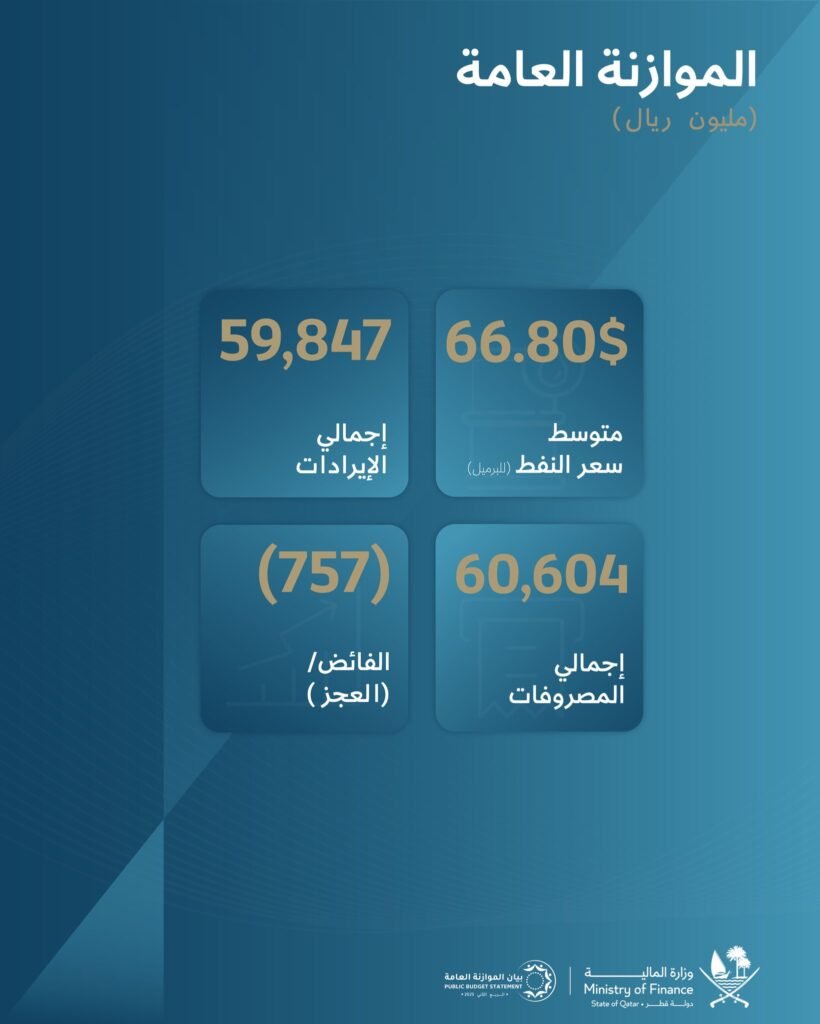
What stands out in these figures is the balanced distribution of expenditures, with over 18 billion QAR allocated to salaries and wages, and 21.9 billion QAR to current expenditures — figures that reflect the government’s sustained commitment to essential public services despite temporary fiscal pressure.
This quarterly performance falls within the framework of the 2025 state budget, approved under Law No. (20) of 2024 and ratified by His Highness Sheikh Tamim bin Hamad Al Thani, the Amir of the State.
The budget estimates total revenues at 197 billion QAR, against 210.2 billion QAR in expenditures — resulting in a projected annual deficit of 13.2 billion QAR, which will also be financed through local and foreign debt instruments as needed.
The government’s conservative fiscal stance is evident in its adoption of a 60 USD per barrel average oil price for the budget, aiming to maintain financial flexibility and policy stability — a precautionary approach that has helped Qatar navigate previous global market crises.
The budget also earmarks 41.4 billion QAR for the health and education sectors, representing 20% of total spending, alongside increases in allocations for wages and capital expenditures — underscoring the State’s commitment to human capital development, infrastructure, and sustainable growth.
Despite the recorded deficits in both quarters, the continued implementation of government contracts — particularly the 50% rise in contracts with foreign companies — signals economic vitality and the government’s commitment to advancing strategic projects.
Observers of Qatar’s public spending understand that this fiscal deficit is not necessarily a negative indicator, but rather a reflection of prudent financial management that balances developmental demands with economic stability. Between conservative revenue estimates and carefully measured expenditure, Qatar continues its path toward sustainable development that leaves no one behind.


