





In a time when barriers pile up and travel laws grow ever more complex, traveler Khalid Mohammed Al-Jaber appears before us on his motorcycle—not merely as an adventurer chasing thrills, but as a human voice slipping from one continent to another, overcoming hardships and sharing stories and experiences across borders, in a narrative where sovereignty blends with values, maps with tales, and law with human moments.
Al-Jaber’s journeys began at a young age, moving between Cairo, Berlin, and Tokyo. Never having tasted the comfort of stability, he eventually settled in Doha—only to find restlessness creeping in. He soon decided to set off again, this time by choice. His motorcycle became his compass, geography his path, and borders his harbors.
In his Milh Al Kalam episode, Al-Jaber explains that his journeys require physical, mental, and spiritual fitness. He cites boxing training as an example—helping him sharpen his reflexes and prepare his mind for unexpected situations on the road. Even his stomach, he says, must be ready to handle Peru’s rich cuisine atop the Andes mountains. In his view, a true traveler is an athlete with a sharp mind, strong body, and composed spirit—alert to emergencies, unlike the passive tourist who consumes sensory delights without awareness.
Though he embraces technology, Al-Jaber admits his concern over people’s overreliance on map apps. He believes there’s no harm in getting lost once in a while—because getting lost creates stories.
He recounts getting lost in Chengdu, China—a city designed like overlapping onion rings. He wandered in circles trying to reach his lodging, with no clear path or readable map. Yet in hindsight, the memory gave way to a story, and a funny one at that. For him, mistakes are the raw material of storytelling.
But the greatest challenges are not deserts or jungles—they are border crossings. Laws show no mercy to adventurers, and systems do not account for the traveler’s intentions.
In Georgia, for instance, a border officer refused him entry because his passport appeared damp, even though legally he didn’t need a visa. Al-Jaber stayed calm and confidently requested contact with the Qatari embassy. The officer realized he was honest and her attitude shifted instantly.
Al-Jaber notes that demeanor is the key to crossing borders. Yet he doesn’t deny that some checkpoints reveal faces harsher than the law itself—like in Turkmenistan, where he was interrogated about his sect, prayers, and stance on jihad, merely for being a bearded Arab.
Discussing the strangest laws he encountered, he shared his experience entering Mexico by land. There was no clear border post to stamp his passport. Determined not to be labeled an intruder, he searched for the immigration center—15 miles from the customs point—to get the proper stamp. One of his friends, unaware of this rule, was deported a month later.
In contrast, Al-Jaber was also met with great kindness—like on the UAE-Oman border.
On the brink of heatstroke one day, the border officers treated him with compassion, allowed him to pass, and later guided him to a place where he could get his passport stamped. To Al-Jaber, this moment was a triumph of humanity over rigid protocol.
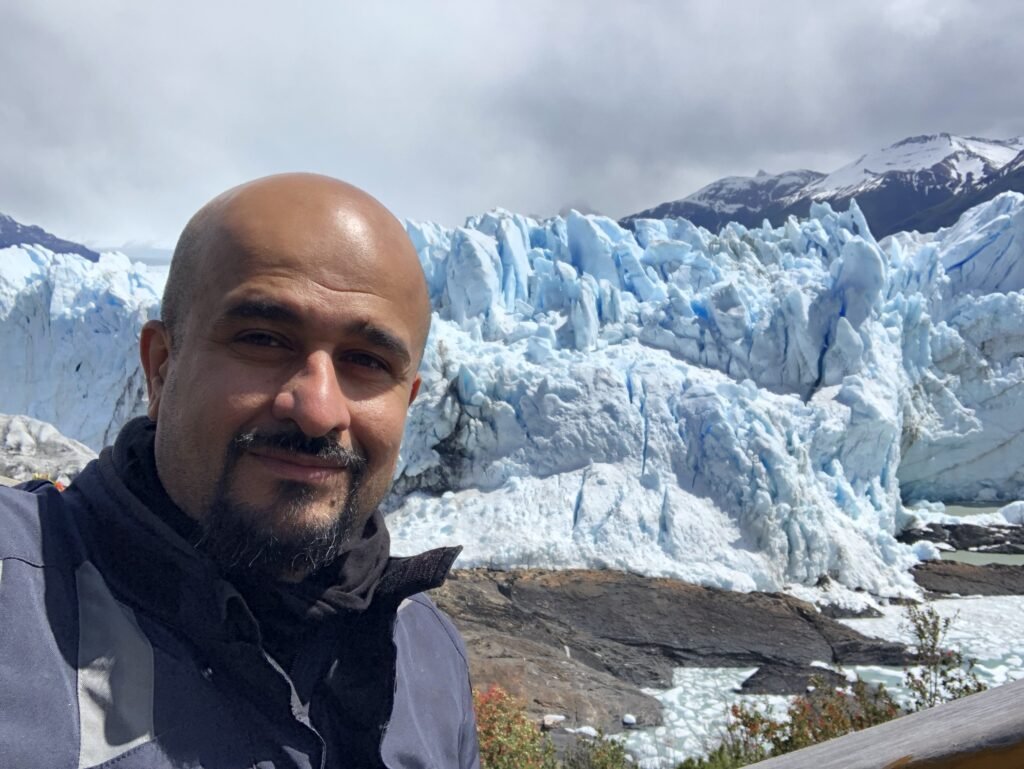
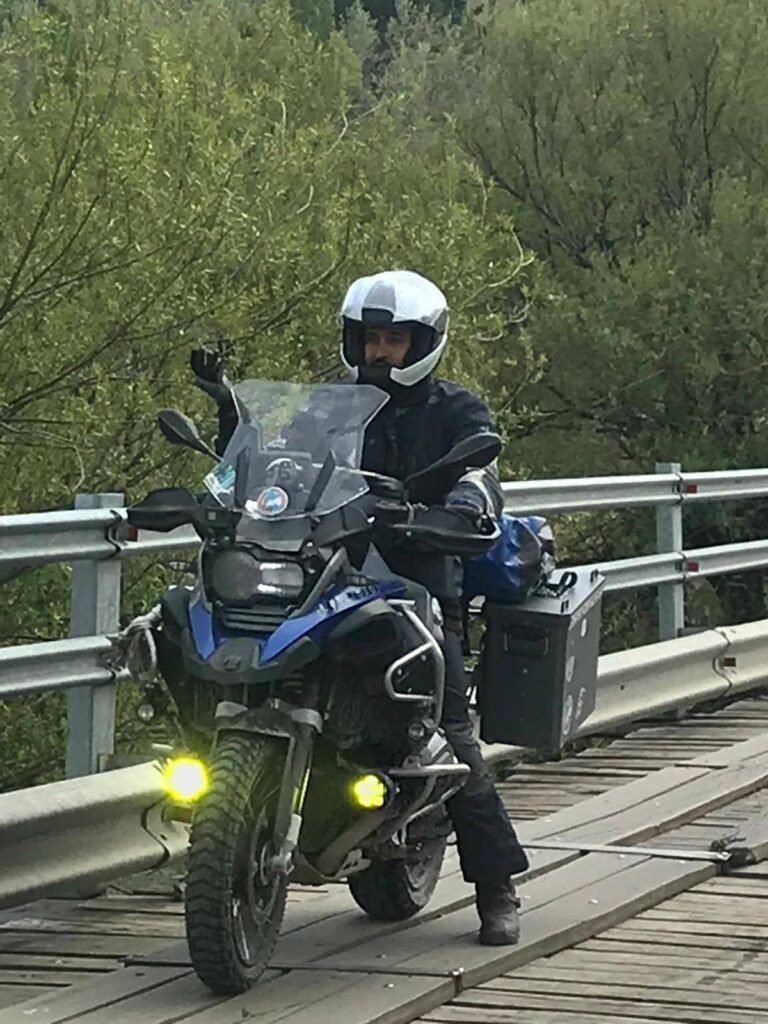
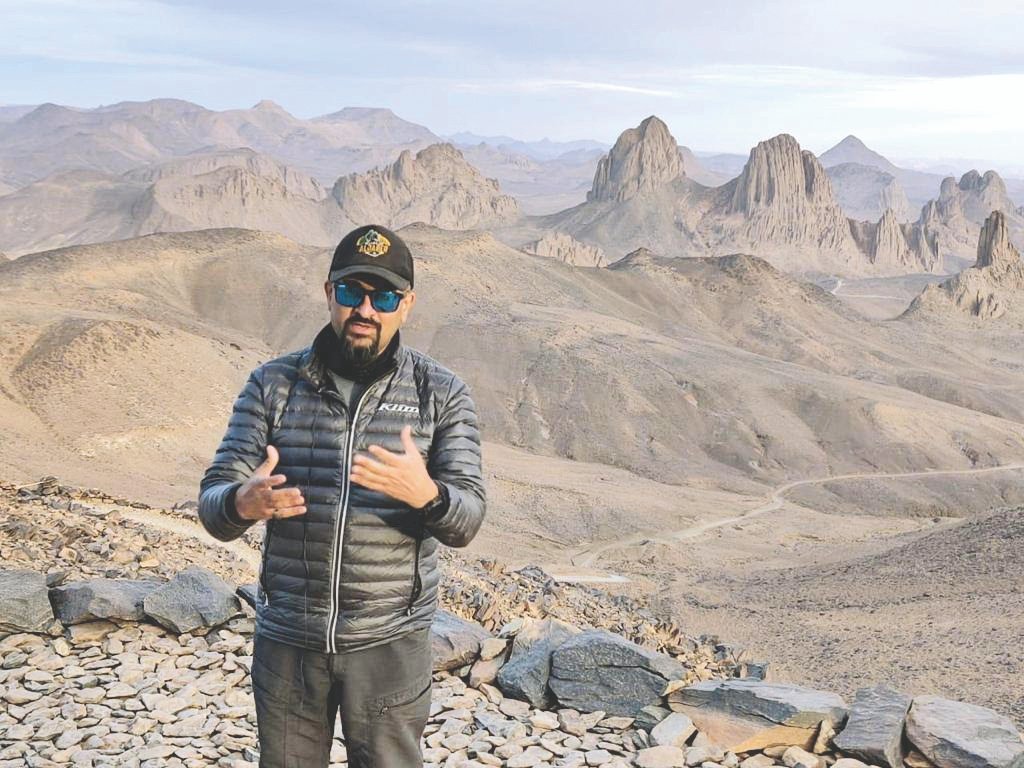
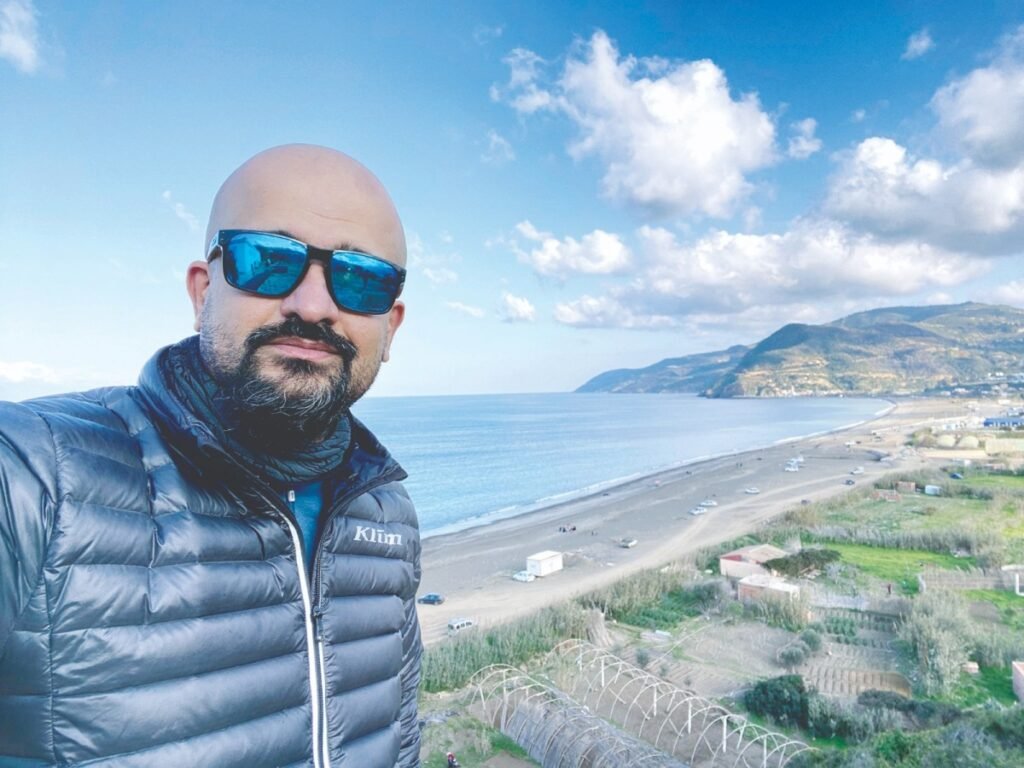

One of the most striking incidents that highlight the importance of diplomatic support happened to Khalid Al-Jaber in Panama, where he had to wait nearly 14 hours because the State of Qatar was not listed in the customs system. A customs officer suggested that he register himself as an Emirati, Saudi, or Palestinian in order to be allowed entry—which he eventually did.
Al-Jaber had to notify the Qatari embassy in Panama to address this oversight, and the Panamanian Ministry of Foreign Affairs later apologized for the error. As Al-Jaber said, “I only turned to the embassy after exhausting all other options,” stressing his effort not to burden embassies with nonessential requests, unlike others who seek special treatment.
His adventures aren’t without danger—one of the most intense incidents occurred in Colombia, when he approached a man who had taken his spot at a gas station and knocked angrily on his window. The man stepped out of his luxury car and pointed a gun at Al-Jaber’s head. In that instant, he realized death was only a second away, but he managed to defuse the situation with a clever trick and a sense of humor—and walked away unharmed.
Among the strangest traffic laws he encountered was in China, where he was asked to obtain a temporary Chinese driver’s license, register his motorcycle with Chinese plates, and even wash the entire bike himself before being allowed entry.
It wasn’t just a border crossing—it was entry into a tightly regulated legal system that allowed no exceptions. Every foreign vehicle was treated as local, and cleaning it in front of watchful eyes was mandatory. Although initially overwhelmed by what seemed like exhausting bureaucracy, he complied, seeing it as a reflection of Chinese discipline and affirming that respecting a country’s laws is an essential part of a traveler’s ethics.
Al-Jaber explained that his recent decision to settle in Germany stems from the fact that it is the “Hollywood of motorcycles” and a gateway to global adventure. For him, riding is not a luxury but a lifestyle.
In this spirit, Al-Jaber seeks media sponsorships to give his travels a professional edge. Sponsorship is not just financial support—it also places upon him the responsibility of representing the sponsor honorably, motivating him to maintain proper appearance, behavior, and published content.
He affirms that sponsorships help cover the high costs of travel, but in return, they require a clear agreement with specific terms. He advises that clauses related to penalties be reviewed carefully to ensure a balanced relationship that protects both parties and shields him from liability in case of a breach.
Al-Jaber’s journey is existential, human, and legal. He doesn’t merely cross borders; he reveals what lies beyond them, navigating tangled and sometimes conflicting laws, and encountering a range of human emotions—from compassion to suspicion. Above all, he believes that one must be worthy of responsibility to truly represent their faith, homeland, and values when the moment comes to prove one’s right to passage.
As Al-Jaber reminds us, it’s not just about documents and visas—appearance and conduct matter too. A true adventurer doesn’t only carry a passport, but a message. Countries don’t just open their gates for travelers; they open them to those who carry respect for the nation, a commitment to its laws, and the ability to smile even at a stern-faced officer.
In a world where borders are rising and space is shrinking, travelers like Khalid Al-Jaber remain bridges on two wheels—reminding us that the world is one, and that with courage, knowledge, and humility, a person can embrace the globe quietly, without banners or noise, simply by knowing that every journey, no matter how far, begins with a conscious step.


