





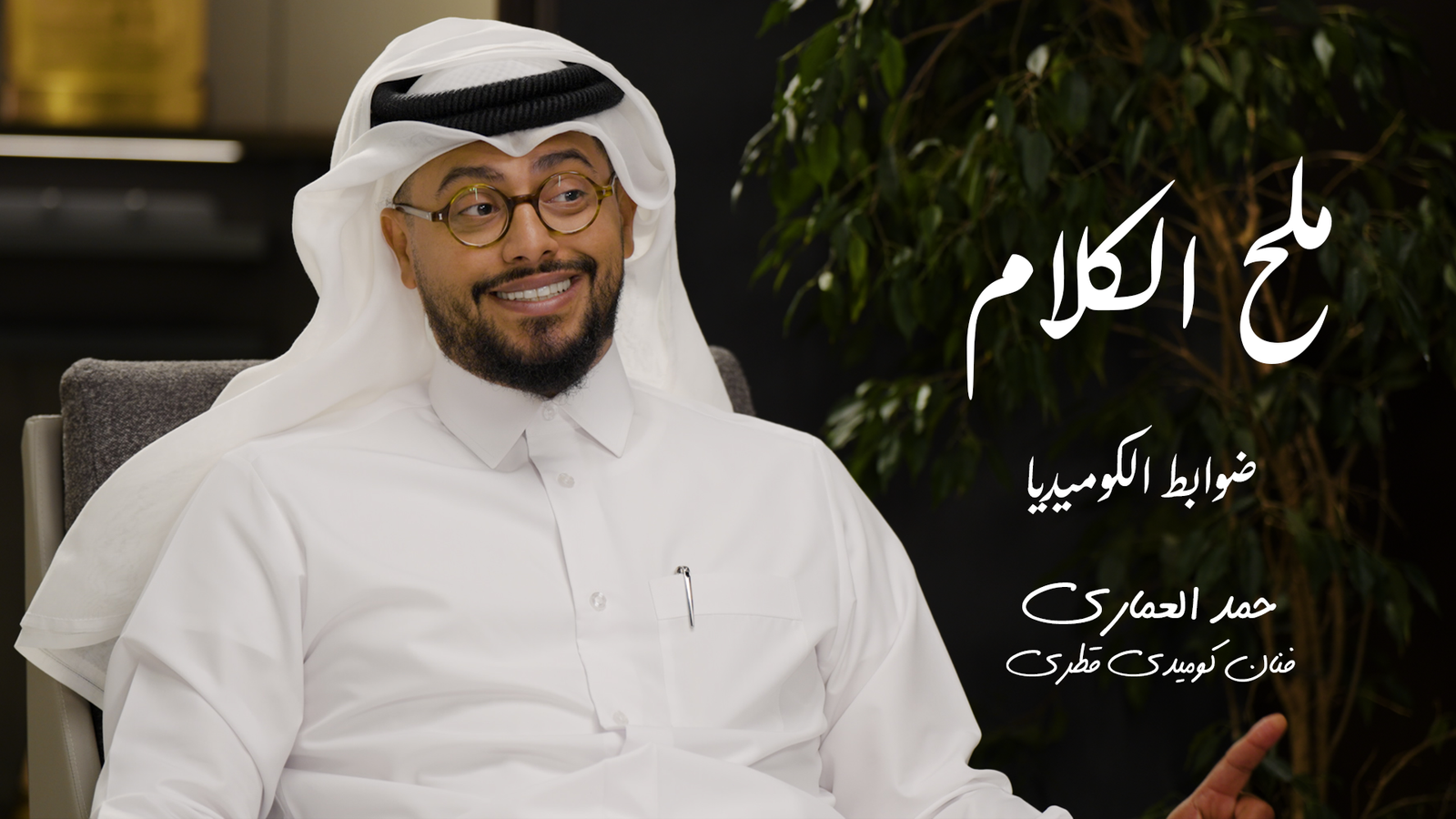
In a rich and thought-provoking episode of Melh Al-Kalam (Salt of Speech), media host Huda Mohamed welcomed the Qatari comedian Hamad Al-Amari, who presented himself in a new light—as a comedian, yes, but also as a thoughtful human being, a voice that sees satire as a tool for thinking and a means to express what lies within.
Al-Amari shared his view on satire, emphasizing that its highest purpose is not to provide answers, but to raise questions and open the audience’s mind to perspectives they hadn’t considered. In this context, he stressed that a true artist does not seek applause but impact, and that being on stage doesn’t always imply agreement—it can, at times, be a witty form of dissent.
Speaking about freedom, Al-Amari expressed his belief that voicing one’s opinion must come from a place of responsibility and belonging. He explained that love for one’s country isn’t measured by how much praise one gives, but by the ability to point out shortcomings with the intention to improve.
Al-Amari does not seek to please everyone, nor does he hide behind neutral positions. Instead, he expresses what he truly believes in, as long as it stems from his respect for his society and his belief in the need for progress.
The interview also touched on Al-Amari’s personal transformations in recent years. He noted that experiences reshape a person and make one’s voice more mature. For him, change is not a contradiction to the self, but a natural response to time, knowledge, and reflection. He believes that the closer an artist comes to their authentic self, the closer they become to their audience.
Regarding his relative absence from the theater scene, he attributed it to a desire to pause and choose the right moment for return. He affirmed that true presence is not measured by frequency of appearances but by the depth of one’s ideas and the strength of the message. For Al-Amari, artistic work should not be a performance for the sake of spectacle, but rather an open dialogue—with others and with oneself.
Al-Amari sees digital platforms like YouTube and social media as having opened doors for him and others to express themselves in ways that were previously unavailable. These platforms have become a space where he can shape his art and convey his messages to the audience with a degree of freedom not found in traditional media.
At the same time, he does not treat these platforms as free-for-all arenas, but as spaces that require an understanding of their policies. Content creators, he argues, should respect intellectual property rights—not out of fear of censorship, but out of professionalism and ethical responsibility.
Al-Amari offers a model of the intelligent artist operating in a context of restrictions: he doesn’t withdraw, nor does he clash. Instead, he navigates with art, crafts his critique within national and humanistic contexts, chases not after trends but after inner convictions, and leaves it to the audience to read between the lines.


