Here, a single soul is equal to all of humanity, and all of humanity is no greater than a single soul.
Also available in:العربية
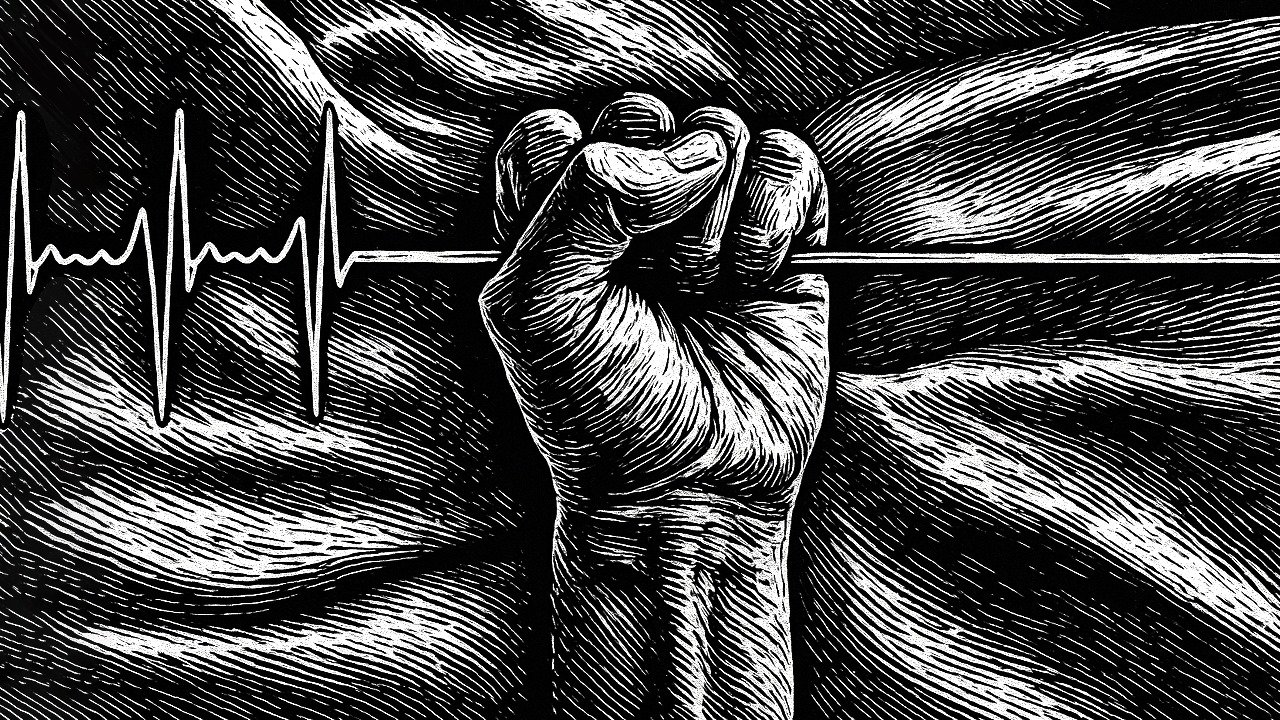
In the material view of life, a person sees himself imprisoned within his body, unable to escape his own skin, unable to break free from the limits of his matter. Everything around him appears as mute walls of instincts and needs, and everything before him appears as shackles enclosing him within the bounds of time and mortality.
But in the Islamic view, the scene changes entirely, and veils are lifted to reveal a deeper value. The person no longer sees himself as captive to a perishable body, but rather as entrusted with a mount to ride upon in the ascent of elevation, clinging to the rope of God that raises him from earth to heaven.
How vast the difference between one who sees himself a prisoner in a cage whose door leads only to the grave, and one who sees himself bound for a meeting with a Paradise as vast as the heavens and the earth.
It is narrated that one of the righteous men was bald-headed, leprous in body, blind in both eyes, and paralyzed in his hands and feet, yet he would constantly say: “Praise be to God who has spared me from what He has afflicted so many of His creation with, and has favored me with great favor.”
A man passed by him and said: “From what has He spared you? You are blind, leprous, bald, and paralyzed, so from what has your Lord spared you?”
He replied: “Woe to you, man. God has given me a tongue that remembers, a heart that is grateful, and a body that endures affliction with patience.”
Among the most human and personal of questions is that of the ethics of life and death, and the choices we make as human beings when faced with pain and suffering. The question may appear to be a matter of academic or philosophical debate, but in truth it touches us all, knocking at the doors of our hearts when we see a dying patient, or hear the story of a person begging for deliverance from an incurable pain. It is a journey that carries us through profound philosophies, divergent laws, and deeply rooted religious and moral beliefs—a journey that reveals the eternal tension between the love of life and the fear of death, between the desire to continue and the search for meaning, between mercy and sanctity.
For thousands of years, philosophers have asked: what does it mean to live a good life? Is goodness found in a life full of pleasure and joy, or one filled with purpose and duty? Is it enough to feel happiness, or must our happiness be real and connected to reality? We long to live, we cling to life with all that we are, and yet we dread its end.
This conflict always places us in a tense space: do we strive to prolong our lives at any cost, or do we seek to end a suffering that has no purpose? Here emerges the hardest question of all: what is it that makes life valuable?
Let us begin with a thought experiment presented by the American philosopher Robert Nozick in his essay Anarchy, State, and Utopia. He imagined the existence of a machine that anyone could connect to, which would grant them a complete sensation of any experience they desired: writing an immortal novel, achieving a great athletic victory, living the perfect friendship, or enjoying endless pure pleasure. But there was one condition: it was all an illusion. You would be nothing more than a body floating in a tank of fantasies, while your mind lived in simulation.
The question arises: would you choose to enter? Nozick predicted that most people would refuse, but why?
Because we want more than just sensations. We want to feel the actions we ourselves perform, not to be mere spectators of illusions. We want to achieve accomplishments, not just imagine them. We want to live in a real world, not in a simulation.
For Nozick, entering the machine is a form of spiritual suicide, because it erases the authenticity of existence.
On the other hand, the philosopher Chris Heathwood offered a much simpler perspective: the good life is simply to attain what you desire, with no need to speak of authenticity or truth—the important thing is the fulfillment of desires.
Yet this view faces a problem: what if our desires are ignorant, evil, or short-sighted? This led Heathwood to develop what became known as the Ideal Desire Theory.
This theory holds that what truly benefits a person is what he would choose if he were rational, fully informed of all the facts, and deeply aware. In other words, goodness is not found in every desire, but only in the desire that passes through the gateway of reason and knowledge.
Here, Heathwood indirectly intersects with Islamic thought, which maintains that life-defining decisions are not to be based on ignorance or whim, but on complete awareness—while acknowledging that perfect awareness is impossible, for the unseen and ultimate truths rest with God alone.
Researcher Jean Cazas offered yet another dimension, arguing that the good life does not rest solely on desires or feelings but on fundamental objective needs: autonomy, meaning that a person shapes his life through his own decisions rather than being merely subject to constraints; a stable form of happiness rather than fleeting pleasure; self-expression that enhances respect and esteem; and morality, which grants life meaning and dignity.
These elements strikingly align with the objectives of Islamic law, as outlined by Imam Abu Hamid al-Ghazali, namely the preservation of religion, life, intellect, lineage, and property as the foundations of any dignified human existence.
Here we leave the world of philosophy and enter the arena of practical ethics, listening to James Rachels, who presented what is known as the Argument from Mercy. He reflected on the suffering of a man named Jack, who endured terminal melanoma despite high doses of painkillers, and who wished he were a dog so that he might be granted euthanasia. Jack considered that animals are treated with greater mercy than humans, for we relieve the pain of sick animals by putting them down, while we leave humans to suffer.
Rachels argued that if pain becomes futile and unbearably harsh, then killing, in his view, may be an act of true mercy that preserves the dignity of the patient and eases the suffering of loved ones.
Yet the philosopher John Harris presented a radical hypothesis known as the Survival Lottery. He imagined that the value of survival could be reduced to a mathematical equation, where two people could be saved by sacrificing a healthy individual—killing him and using his organs as spare parts.
His reasoning was that the difference between killing one person to save two, or letting the two die, is an illusion, since the outcome in both cases is the death of innocents. Here the clash becomes clear between the logic of mercy, which seeks to alleviate suffering, and the cold logic of numerical calculation, which places numbers above feelings.
Yet within this materialistic framework there remains a space for passive euthanasia, that is, halting futile treatment with no hope of benefit, if physicians deem it appropriate. Here the tension emerges between preserving the sanctity of life and showing mercy to the patient.

When we place these debates alongside the Islamic perspective, a fundamental difference emerges. Islam regards life as a trust granted by God to humankind, not as the property of the individual. For this reason, scholars categorically reject active euthanasia, considering it deliberate killing or suicide, regardless of the intention of mercy.
Al-Bukhari narrated in his Sahih from Abu Huraira that the Messenger of God ﷺ said: “Whoever kills himself with an iron weapon will come on the Day of Resurrection with the weapon in his hand, thrusting it into his belly in the Fire of Hell, abiding therein eternally. And whoever kills himself with poison, his poison will be in his hand, sipping it in the Fire of Hell, abiding therein eternally.”
With the emergence of the medical concept of brain death, while the heart still beats, Islamic juristic councils became divided. Some considered it a valid form of death from a jurisprudential perspective, permitting the removal of life-support machines from the patient, while others insisted that death is determined only by the cessation of heartbeat and breathing. This division reflects two views: one sees placing or removing the machines as interference in God’s decree, while the other sees their removal as ending a futile and meaningless suffering.
This perspective is reflected in Qatari Penal Code No. 14 of 1971, which does not differ much from most other Arab countries’ laws. Article 150 intensifies the penalty for intentional murder in cases such as premeditation, brutality, or killing a public employee in the course of duty. Article 151 prescribes the death penalty for intentional murder but leaves a margin of mercy through pardon or blood money, which reduces the punishment. Article 152 imposes life imprisonment for intentional murder in non-aggravated cases, with the possibility of reduction if blood money is accepted.
Articles 153 and 154 cover cases of unintentional and accidental killing and prescribe lighter penalties, while Article 155 considers a human being alive and their blood inviolable as soon as they emerge from the mother’s womb alive.
There is also Penal Code No. 11 of 2004, which stipulates punishment for attempted suicide with imprisonment not exceeding six months, or a fine not exceeding three thousand riyals, or both, on the basis that the person “has committed an act that ordinarily leads to death.”
These provisions show that Qatari law strictly protects the sanctity of human life and criminalizes euthanasia, but at the same time provides avenues of mercy such as pardoning the killer or accepting blood money.
When we step outside the Arab world and look globally, we see different pictures noted by Sarah Young in an article titled The Legal Status of Assisted Dying in Different Countries on Reuters. She pointed out that euthanasia or physician-assisted dying has been legalized under strict conditions in Switzerland, the Netherlands, Belgium, Spain, Germany, France, Ireland, Canada, Australia, and some U.S. states, while the United Kingdom is still in the midst of social and legislative debate about allowing it under strict regulations.
Switzerland, a pioneer of assisted suicide among its scenic hills, permits assistance in suicide if carried out by the person themselves, and even allows it for children provided there is parental consent. Australia and New Zealand, meanwhile, have passed laws permitting those suffering from incurable diseases to end their lives medically.
These legislations are rooted in the principle of individual autonomy and the right to choose one’s end, while Islamic jurisprudence—as reflected in Qatari law—takes a different stance, viewing life as a sacred trust that an individual has no right to terminate by their own will.
Federica Marisi wrote in an article on Al Jazeera English titled UK Parliament Approves Assisted Dying Bill: How Would It Work? that British politician Kim Leadbeater supported a bill called The Dying Adults and End of Life Bill, giving the green light in Parliament for accepting euthanasia under certain conditions.
This bill allows mentally competent adults suffering from terminal illnesses expected to result in death within six months or less, and residing in England or Wales, to choose to end their lives with medical assistance.
What struck me, however, is the strange contradiction in the stance of secular states that still criminalize euthanasia or tightly restrict it, yet at the same time have no qualms about supplying their healthy intelligence agents with highly toxic cyanide capsules, so they can commit suicide if captured by the enemy. Here, suddenly, euthanasia becomes permitted without restriction, as long as the state itself has an interest in it.
The true value of human life in materialistic systems is measured only by the revenue it brings to the state’s treasury. Such systems have no objection to the early burial of patients with no hope of recovery, unproductive sufferers of depression, or captured prisoners, under the pretext of supposed compassion for their condition—unlike Nazism, which, with all its ugliness, was at least more honest about its brutality.
Meanwhile, the Most Merciful of the merciful says in His Noble Book, in Surat al-Ma’idah: “…Whoever kills a soul unless in retribution for another soul or for corruption in the land—it is as if he has killed all mankind; and whoever saves a life—it is as if he has saved all mankind.”
Here, a single soul is equal to all of humanity, and all of humanity is no greater than a single soul.
Here, a single soul is equal to all of humanity, and all of humanity is no greater than a single soul.