

Insect-Based Food as an Alternative to Animal-Based Food
In the face of these challenges, the Food and Agriculture Organization of the United Nations (FAO) believes that there is an urgent need for new ideas and close cooperation between governments, international organizations, and farmers to adopt new dietary patterns.
But one of the most astonishing proposals to reduce methane emissions — which harm the climate — was one I came across in shock. An article on the FAO website titled Four Reasons Why Edible Insects Are a Promising Option for Food Security and Livelihoods stated that Thailand already sells edible insects in its local markets — such as bamboo worms and fried snails — served hot and crispy.
The article adds that more than 1,900 species of edible insects are consumed globally in many countries and that they already form a rich part of various diets. For example, in Asia, red palm weevil larvae are considered a delicacy in several nations.
In the Democratic Republic of the Congo, many members of the Ngandu tribe consume larvae during the rainy season. In Europe and North America, insect-based products rich in protein have begun to appear on store shelves. The European Union has even set standards for what it calls food safety for human consumption of insects.
According to the FAO, edible insects are nutritionally valuable and can serve as healthy dietary supplements. They provide energy, fats, proteins, and fibers and may be a good source of micronutrients such as zinc, calcium, and iron — qualifying them as an alternative to traditional meat-based protein.
When the FAO compared a beef meal with a worm-based meal, it found that worms contain comparable minerals and even higher vitamin content, though beef has a higher level of amino acids and fats. Moreover, insect farming has many environmental advantages: it emits significantly fewer greenhouse gases than animal protein sources, consumes much less water than livestock, and requires very little land area.
The FAO further cites that even crickets, for instance, need twelve times less feed than cattle to produce the same amount of protein — so much so that cricket farming has rapidly spread across Southeast Asia.
To ensure compliance with international food safety standards, the FAO, in collaboration with the Department of Entomology at Khon Kaen University in Thailand, published a manual titled Guidelines for Sustainable Cricket Farming: A Practical Guide for Farmers and Inspectors, aimed at bridging the knowledge gap between farmers and governments. This is especially important as the world’s population continues to grow, placing increasing pressure on natural resources and traditional agriculture to meet the demand for food and protein.
The organization therefore views insects as an underutilized resource that could help bridge the global food gap — while emphasizing that food safety and hygiene must remain top priorities. It published an analytical report titled Edible Insects: Food Safety Considerations , which reviews potential food safety risks associated with insect consumption and promotes good manufacturing practices.
The FAO’s position aligns closely with that of the European Union, which on January 20, 2025, issued an official authorization under European Commission Implementing Regulation No. 2025/89 allowing the marketing of ultraviolet-treated yellow mealworm powder as a novel food. The regulation permits its use in products such as bread, cakes, biscuits, pasta, dairy products, and more — for general consumer distribution.
To appease those uneasy about this decision, Article 3, Paragraph 1 of the regulation stipulates clearly that “the label must state explicitly that the ingredient is ultraviolet-treated yellow mealworm powder.”
The Ethical Dilemma of Modern Eating
Dr. Alastair Norcross presents a thought experiment in his paper Puppies, Pigs, and People: Eating Meat and Marginal Cases. Although the title may seem peculiar at first, it serves as a moral mirror that starkly reflects our modern food culture. Norcross pushes readers to confront a disturbing claim: that eating meat produced in industrial farms is not, ethically speaking, very different from the cruelty of torturing a puppy purely for pleasure.
In his hypothetical story, Norcross imagines a man named Fred who tortures a large number of puppies in his basement. He imprisons and abuses them for six months solely to extract a chemical he calls cocamone, which he believes enhances the flavor of chocolate. When his secret is exposed, the public is outraged — no one hesitates to condemn his actions, and his desire for a tastier treat is universally rejected as a legitimate excuse.
Norcross then asks readers to hold onto that sense of moral disgust, because in his next argument, he compares Fred’s fictional cruelty toward puppies with the very real suffering of billions of animals raised in industrial farms — confined, mutilated, and slaughtered simply to satisfy human taste preferences.
To highlight the moral inconsistency, Norcross invites us to imagine being offered a delicious piece of chocolate, only to learn that one of its ingredients came from cocamone — the chemical extracted through the torture of puppies. Naturally, anyone with basic moral intuition would refuse to eat it, even if they had no role in the cruelty itself. Consuming the product of such suffering would still feel wrong. Norcross then poses the question: what, really, is the difference between that and eating meat from factory farms? Especially when the scale and intensity of suffering inflicted on billions of farm animals far exceed the cruelty of Fred’s imagined story.
Norcross acknowledges that some people might argue their individual choices don’t make a difference. He rejects this defense, which he calls the “causal impotence” argument, likening it to a parent refusing to buckle their child’s seatbelt because car accidents are rare. A moral wrong remains a moral wrong, he insists, regardless of how small one’s contribution might seem. Individual actions, when aggregated, form collective behavior — and every single purchase of factory-farmed meat perpetuates demand for it.
In the end, Norcross leaves little moral refuge for meat eaters. If torturing a puppy is a horrific moral crime, then supporting industrial farming by consuming its products is no less reprehensible — indeed, it’s worse in magnitude. Hunger and culinary pleasure, when plant-based alternatives exist, cannot justify the systemic suffering of billions of sentient creatures.
From Norcross’s perspective, the issue is not merely about animal rights — it’s about the coherence between our dietary behavior and the moral principles we claim to uphold. Or perhaps, as he provocatively suggests, we are all living in an expanded version of Fred’s basement, silently complicit in the suffering we choose to ignore.
Food Ethics in Islam
At the heart of the Islamic discussion lies the concept of Khilafah—human stewardship of the earth granted by God. Some interpretations view this as divine authorization for human dominion over nature, while others emphasize the centrality of mercy, balance, and cosmic harmony in Islam.
Associate Professor Shawqi Al-Zahr of Qatar University writes in his book Regression in Islamic Thought and the Bible: Toward a Qur’anic Theory of Human Existential Function (2023) that animals are not merely resources, but an essential part of divine creation possessing intrinsic value that Muslims are obliged to respect.
Researcher Zeinira Sheikh, in her paper Innovation or Moral Imperative?, notes that the old image of small-scale family farming — producing limited amounts of meat, poultry, dairy, and eggs — no longer applies to the modern industrial system, where more than 70 billion animals and birds are slaughtered each year.
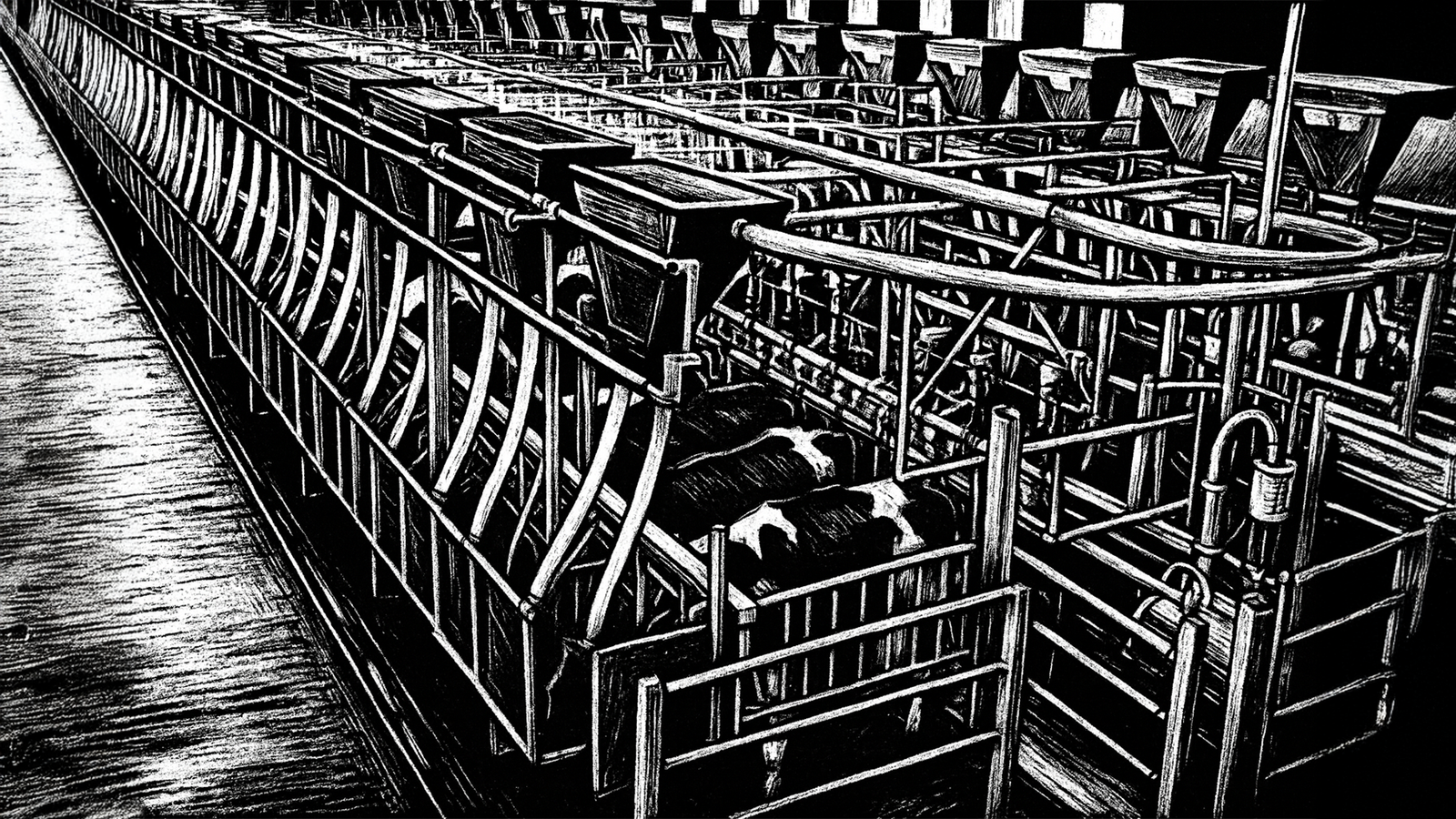
Today, chickens are crammed into tiny cages; male chicks are crushed alive; cows are subjected to continuous forced impregnation and have their calves taken from them immediately after birth; their udders are milked with suction tubes until they bleed. Even so-called “free-range” farms often conceal grim realities imposed by this ruthless industry, raising deep ethical and spiritual dilemmas.
Sheikh describes the harsh reality of modern animal, poultry, and fish farming, where over 70 billion land animals are killed annually for food. This massive scale necessitates merciless overcrowding and the use of antibiotics, along with brutal practices such as injecting poultry with hormones to double their weight in a short time while confined in tight spaces; imprisoning egg-laying hens in cages so small they cannot stretch their wings; grinding or suffocating male chicks because they do not lay eggs; and cutting beaks and wings without anesthesia. Dairy cows endure immense suffering through cycles of forced pregnancy, separation from their calves, and diseases like mastitis.
Sheikh also critiques what she calls the “Halal Bubble.” Instead of encouraging reduced consumption, some religious discourse focuses on improving technical conditions. Yet, she argues, applying the Prophet’s humane guidelines to massive industrial systems is practically impossible. Moreover, milk produced through the suffering of mothers, the separation of calves, and udder disease cannot be considered tayyib (pure or wholesome), especially given its potential health impacts on humans.
Her argument is rooted in the Maqasid al-Shari‘ah (higher objectives of Islamic law), which seek to preserve the welfare of all of God’s creation — human and non-human alike — and to promote benefit while preventing harm, protecting the environment, and avoiding corruption on earth.
She also notes that animal-based food security consumes enormous quantities of grain to feed livestock instead of people. If redirected toward direct human consumption in plant-based form, these resources could feed billions more of the world’s hungry.
In conclusion, Sheikh calls for a new Islamic ijtihad (scholarly re-evaluation) to reassess large-scale animal slaughter in light of historically unprecedented realities. She argues that the harm caused by meat consumption is no longer a matter of taste or luxury, but a direct contributor to climate change, food insecurity, and ecological collapse. Thus, Muslim consumers can no longer justify participation in this merciless system — instead, they bear a moral responsibility to abstain and pursue plant-based alternatives that are kinder to both creation and the earth.
If we reflect on the philosophy of food in Islam, we find that it carries deep ethical principles and manners that Muslims have inherited generation after generation, following the example of the Messenger of God ﷺ.
Among the well-known Islamic etiquettes of eating, still practiced socially across the vast Muslim world today, is the narration reported by Al-Bukhari in his Sahih:
ʺI was a boy under the care of the Messenger of Allah ﷺ, and my hand used to wander around the dish. The Messenger of Allah ﷺ said to me, ‘O boy! Mention the name of Allah, eat with your right hand, and eat from what is in front of you.’ From that time on, this became my way of eating.ʺ — [Narrated by ‘Umar ibn Abi Salamah]
Another prophetic teaching warns against excess in food and drink. Al-Tirmidhi reports in his Sunan that Al-Miqdam ibn Ma‘dikarib said:
ʺThe son of Adam fills no vessel worse than his stomach. It is sufficient for the son of Adam to eat a few bites to keep his back straight. But if he must, then one-third for his food, one-third for his drink, and one-third for his breath.ʺ
Humility before God’s blessings and gratitude for them profoundly shape Islamic manners of eating. The Prophet ﷺ advised licking one’s fingers after eating — a simple act that fosters humility and thankfulness. Imagine today a group of dignitaries or elites licking their fingers after a meal — could arrogance or vanity survive such a moment?
At this point, I recall a charming story with a Syrian friend who owns a film production company. We collaborated on several television reports about the 2022 FIFA World Cup in Qatar, one of which featured a German traveler journeying around the world on his bicycle.
This young German lived an adventurous life marked by simplicity and asceticism. He rejected the consumerist values of modern capitalism, sleeping wherever his travels took him, with no goal other than to wander across God’s vast earth. Doha was one of his stops during the World Cup.
After filming the episode, my Syrian friend invited us to a local restaurant to share a meal of Afghan-style lamb mandi with rice. We all sat on the floor, chatting about the traveler’s adventures. When we finished eating, my friend and I witnessed a sight we would never forget.
Our German guest left not a single grain of rice in his plate. The piece of meat was stripped down to a clean, smooth bone. Then, to our astonishment, he licked his metal plate until it gleamed as if washed with soap and water.
At that moment, I felt both deep admiration and sincere awe at his humility — and at the profound respect he showed for the blessings of God placed before us.
Today, the issue of food is no longer merely a matter of agriculture or trade — it has become an existential crisis that touches the climate, ethics, and the very future of humanity.
The connection between these issues and World Food Day, celebrated annually on October 16 by the Food and Agriculture Organization of the United Nations (FAO), is one of essence and substance. The celebration is not a formality or luxury — it is a cry against a reality that has strayed far from the principle that “food is essential for human survival and well-being and is a fundamental human right.”
Achieving the slogan “Hand in Hand for Better Food and a Better Future” has become increasingly difficult due to mounting environmental and ethical pressures. The planet is exhausted, threatened by global warming that weakens the soil, undermines agriculture, and renders food supply chains fragile.
In short, World Food Day offers an annual opportunity for a radical shift in how we perceive food — from a mere right we expect from governments to a moral and environmental responsibility borne by every consumer, to ensure a sustainable and just future for our planet.
In short, World Food Day offers an annual opportunity for a radical shift in how we perceive food — from a mere right we expect from governments to a moral and environmental responsibility borne by every consumer, to ensure a sustainable and just future for our planet.