In no circumstance can a person give something without expecting something in return, whether later or beforehand. Even love between two people cannot thrive unless both hearts burn equally with affection; and how miserable is one-sided love, where a person longs to be freed from the torment of emotional attachment and unhealthy dependence. Even volunteer […]
In no circumstance can a person give something without expecting something in return, whether later or beforehand. Even love between two people cannot thrive unless both hearts burn equally with affection; and how miserable is one-sided love, where a person longs to be freed from the torment of emotional attachment and unhealthy dependence.
Even volunteer work without material reward is not entirely free from expectation — the volunteer still hopes for moral appreciation, symbolic recognition, or public acknowledgment.
This return may come later, when one gives in hope of a promised reward or future compensation — and if it is withheld, resentment and hostility arise. Or it may come beforehand, when a person gives out of gratitude and acknowledgment, to avoid being ungrateful.
If one chooses the path of denial and ingratitude, eventually self-contempt overtakes them. And if one grows accustomed to taking without giving, they become like a thief who takes what is not rightfully theirs, always anticipating retribution.
The reason people expect compensation for their deeds lies in the instinct of self-love, which drives ambition, effort, and self-preservation — a lifelong pursuit of benefit and safety.
Yet the greatness of Islam lies in that it neither ignores nor suppresses human instincts. Rather, it disciplines and elevates them toward what is more beneficial. It teaches a person to channel their self-interest in a way that benefits both the individual and society — by aspiring not for fleeting worldly gains but for eternal reward. Thus, the ego’s instinct is refined, and the human gaze extends beyond material concerns, yearning for everlasting bliss that surpasses all worldly pleasures, no matter how great.
A sign of this divine elevation of the human being is that a Muslim’s faith is not complete until they love for others what they love for themselves — as expressed in the hadith narrated by Anas ibn Malik, where the Prophet ﷺ said: “None of you truly believes until he loves for his brother what he loves for himself.” (Bukhari)
Even the simple act of removing harm or dirt from people’s paths, without expecting anything in return, is a mark of faith. This is reflected in the hadith narrated by Abu Huraira, where the Prophet ﷺ said: “Faith has over seventy branches; the highest of which is the declaration that there is no god but Allah, and the lowest is removing harm from the road.”
And although Islam legislated retribution (qisas) through the judiciary, it also praises patience and forgiveness, teaching that repaying evil with goodness brings immense divine reward. Allah Almighty says in Surah Fussilat: “Good and evil are not equal. Repel evil with what is better; then the one between whom and you there was enmity will become as though he were a devoted friend. But none attains this except those who are patient, and none attains it except one having a great portion [of good].”
Reflect also on the gentle divine invitation for humans to overcome their selfish impulses that stand between them and the ultimate reward. Allah says in Surah Al-Balad: “But he has not attempted the steep path. And what will make you know what the steep path is? [It is] freeing a slave, or feeding on a day of severe hunger an orphan near of kin, or a needy person in misery. Then he was among those who believed and advised one another to patience and advised one another to compassion. Those are the companions of the right.”
And in another verse, God encourages humans to protect themselves from their own greed, saying in Surah Al-Hashr: “And whoever is protected from the greed of his soul—it is those who will be the successful.”
All five pillars of Islam are between a person and their Lord—except zakat, which stands between the Muslim and society. This unique pillar requires an authority to oversee its collection, distribution, and regulation, making it a political and economic responsibility with a religious foundation, one that rests on the shoulders of the head of the executive power.
The Arabic word māl (wealth) is derived from māla, meaning to incline toward, for the soul naturally inclines toward wealth. And if the Prophet ﷺ described prayer as “the pillar of religion”—as narrated by Al-Bayhaqi in Shu‘ab al-Iman from Umar ibn Al-Khattab, who reported that the Messenger of Allah ﷺ said: “Prayer is the pillar of religion”—he also described zakat as “the bridge of Islam.” Al-Tabarani narrated in Al-Mu‘jam Al-Awsat from Abu Al-Darda’ that the Prophet ﷺ said: “Zakat is the bridge of Islam.”
In Asas al-Balagha by Al-Zamakhshari, zakat linguistically means blessing, growth, purity, and righteousness, derived from the verb zakkā, meaning to grow and increase. In Islamic terminology, zakat is one of the great pillars of Islam legislated by Allah to purify the soul and wealth, and to establish solidarity among members of the ummah.
However, despite the divine wisdom and justice of this legislation, it also came to affirm the purity of the Prophet’s ﷺ message, free from any worldly motive or personal gain for himself, his family, or his descendants. Zakat was forbidden to the Prophet ﷺ personally, to his pure family, and to his descendants until the Day of Judgment—except in cases of dire necessity, as explained by scholars. This prohibition underscores that his mission was purely for the sake of Allah, seeking neither reward nor gratitude, but guidance for humanity and benefit in this world and the next.
Al-Bukhari narrates in his Sahih from Abu Huraira that the Prophet ﷺ said: “Al-Hasan ibn Ali (may Allah be pleased with them) took a date from the dates of charity and put it in his mouth. The Prophet ﷺ said: ‘Kikh! Kikh! Spit it out! Do you not know that we do not eat from charity?’”
After the death of the Prophet ﷺ, Lady Fatimah al-Zahra (may Allah be pleased with her) thought she had a right to inherit from her father, but the matter revealed a divine ruling specific to prophets—that they do not leave behind wealth or property to be inherited; rather, they leave knowledge and guidance. She was unaware that the Prophet ﷺ had said: “We, the Prophets, do not leave inheritance; what we leave behind is charity.” This hadith was narrated by Muslim in his Sahih from Abu Huraira.
History records, as narrated by Muslim from Abu Bakr al-Siddiq through Urwah ibn al-Zubayr, that Aisha (may Allah be pleased with her) said: “Fatimah (peace be upon her), the daughter of the Messenger of Allah ﷺ, asked Abu Bakr after the death of the Prophet ﷺ to give her her inheritance from what Allah had bestowed upon His Messenger—namely, the spoils of Khaybar, Fadak, and his charitable properties in Madinah. But Abu Bakr replied: ‘The Messenger of Allah ﷺ said: We [Prophets] do not leave inheritance; whatever we leave is charity.’ Fatimah became upset with Abu Bakr and did not speak to him until she passed away. She lived six months after the Prophet ﷺ.”
Aisha continued: “Fatimah used to ask Abu Bakr for her share from what the Messenger of Allah ﷺ left in Khaybar, Fadak, and his charity in Madinah, but Abu Bakr refused. He said: ‘I will not change anything that the Messenger of Allah ﷺ did. I fear that if I abandon any of his commands, I would go astray.’ As for his charity in Madinah, Umar handed it to Ali and Abbas. As for Khaybar and Fadak, Umar kept them and said: ‘They are charity of the Messenger of Allah ﷺ for his needs and public responsibilities, and their management belongs to whoever holds authority after him.’ And so they have remained so until this day.”
Zakat is not permissible to be given to anyone whom the Muslim is legally obliged to support, such as a wife, young children, or parents. The exception is a debtor (gharim): it is permissible to pay off his debt from the zakat of the person who is legally obliged to support him, because in this case the zakat serves to discharge his debt or part of it — for example, a debtor who is eligible for zakat — and this does not remove or reduce the ongoing duty of maintenance that the obliged person must continue to provide.
Conversely, a wife may give zakat on behalf of her husband if he is himself one of the zakat-eligible recipients, because she is not legally obliged to support him.
The difference between voluntary charity (sadaqa) and zakat is that voluntary charity is not obligatory, whereas zakat is an obligation that the ruler (or authority) may enforce if an individual neglects it. Zakat is one of the five pillars of Islam, and a person’s Islam is not complete in the strong sense unless its conditions are met. In the Qur’an, giving zakat is frequently mentioned in conjunction with establishing prayer.
Allah says, describing the attributes of the believers in Sūrah al-Mu’minūn: “Successful indeed are the believers — who are humbly submissive in their prayer; and who avoid vain talk; and who pay the zakat; and who guard their private parts — except from their wives or those their right hands possess, for then they are free from blame; but whoever seeks beyond that, they are transgressors — and who are faithful to their trusts and covenants; and who strictly guard their prayers; those are the inheritors — who will inherit Paradise; they will abide therein.”
The Qur’an has strongly emphasized the obligation of zakat and commanded its payment explicitly; it also threatened those who hoard wealth or withhold zakat with severe punishment. Because of the grave status of zakat in the religion, Abu Bakr al-Siddiq (may Allah be pleased with him) fought those who refused to pay zakat after the death of the Prophet ﷺ — demonstrating that neglecting it is not merely a lapse in worship but a breach of one of Islam’s five pillars.
Allah commanded His Messenger ﷺ to take zakat from those on whom it is due, saying in Sūrah At-Tawbah: “Take from their wealth a charity by which you purify them and cause them increase, and pray for them. Indeed, your prayer is reassurance for them. And Allah is Hearing and Knowing.”
Allah also warns those who hoard gold and silver and do not spend it in His cause of a painful punishment. He says in Sūrah At-Tawbah: “… And those who hoard gold and silver and spend it not in the way of Allah—give them tidings of a painful punishment. The Day when it will be heated in the fire of Hell and seared therewith will be their foreheads, their flanks and their backs. ‘This is what you hoarded for yourselves, so taste what you used to hoard.’”
The firm and decisive stance of Abu Bakr regarding those who withheld zakat after the Prophet’s death is recorded in Al-Bukhari from Abu Hurayrah: When the Prophet ﷺ passed away and Abu Bakr succeeded him, some Arabs apostatized. Umar said to Abu Bakr, “How can you fight the people? The Prophet ﷺ said: I was commanded to fight the people until they say: ‘There is no god but Allah’; and whoever says it, his life and wealth are protected except by right, and his account is with Allah.” Abu Bakr replied, “By Allah, I will fight them.” Abu al-Yaman said, “I will kill whoever separates prayer from zakat, for zakat is the right of wealth. By Allah, if they prevented me from a necklace that they used to deliver to the Prophet ﷺ, I would fight them over preventing it.” Umar said, “By Allah, when I saw that Allah had expanded Abu Bakr’s chest for fighting, I knew that he was right.”
Zakat in Islam is not an act of favor from the rich to the poor, nor a voluntary deed for which a person deserves praise. Rather, it is a mandatory right legislated by Allah upon the wealth of the rich for those entitled to receive it — a means to achieve justice and social solidarity within the community. It is a financial act of worship that purifies the soul from greed and restores balance among members of society.
It is both an obligation that Allah has imposed upon the giver and a right that He has affirmed for the recipient. Allah says in Surah Al-Ma‘arij: “And those in whose wealth there is a recognized right, for the needy and the deprived.”
Zakat is not due on debts owed by a debtor, according to the majority of jurists, because one of the conditions for zakat is ownership of the wealth. The debtor does not truly own the borrowed money; rather, he is obliged to return it to its rightful owner. Hence, he cannot pay zakat on something he does not actually possess — the obligation of zakat in this case falls on the creditor instead.
Therefore, the creditor must pay zakat on the amount loaned each lunar year if he is confident it will be repaid. However, if there is doubt about its repayment, zakat is not due until it is recovered. Once received, zakat is paid for one year only — similar to the zakat on crops and fruits, which is only due at harvest time, not before. Similarly, wealth that is absent or beyond one’s control is not subject to zakat until it becomes accessible.
The recipients of zakat are divided into eight categories of eligible beneficiaries, as explicitly mentioned by Allah Almighty in Surah At-Tawbah: “Zakah expenditures are only for the poor and the needy and those employed to collect it, and for bringing hearts together [for Islam], and for freeing captives [or slaves], and for those in debt, and for the cause of Allah, and for the stranded traveler — an obligation [imposed] by Allah. And Allah is Knowing and Wise.”
These eight categories can be summarized into two main types: Those addressing individual needs: the poor, the needy, the wayfarer, those in bondage, and those in debt. Those addressing collective or societal needs: those employed to collect zakat, those whose hearts are to be reconciled, and those in the cause of Allah. Classical jurists have written extensive explanations in their works clarifying the specific criteria and circumstances of each category mentioned in this verse.
Linguists and jurists have long debated the distinction between the poor (faqir) and the needy (miskin). Some scholars argue that the faqir is in greater need than the miskin, citing as evidence the Qur’anic order that mentions the poor before the needy. Others hold the opposite view, citing the hadith reported by Al-Bukhari in his Sahih from Abu Huraira, in which the Prophet ﷺ said: “The miskin is not the one who goes around to people asking for a bite or two of food, or a date or two; rather, the miskin is the one who does not find enough to suffice him, is not noticed so that charity is given to him, and does not beg from people.”
In general, regardless of the difference between the two terms, both groups — the poor and the needy — are clearly stated in the noble verse as legitimate recipients of zakat, regardless of the degree of their need.
According to the unanimous agreement of the four schools of Islamic jurisprudence, both the poor and the needy should be given from zakat funds an amount that suffices their needs. The meaning of sufficiency is to cover the basic necessities of the recipient and those whom he is legally obliged to support — including food, clothing, shelter, healthcare, and education — for one full year, even if the amount given exceeds the minimum zakat threshold (nisab). Imam Abu Zakariyya Yahya ibn Sharaf Al-Nawawi said in his book Al-Rawdah: “The poor and the needy are to be given enough to sustain them for their year, even if it exceeds the nisab.”
According to contemporary jurists, the categories of zakat recipients have effectively become seven after the global abolition of slavery. Some scholars even consider them six, arguing that there is no longer a need to allocate funds for “those whose hearts are to be reconciled” (al-mu’allafah qulubuhum).
Kamal Al-Sayyid Salim Abu Malik, in his book Sahih Fiqh al-Sunnah wa Adillatuh wa Tawdhih Madhahib al-A’immah (2003), explains:
He then poses the question: “Did the share of al-mu’allafah qulubuhum (those whose hearts are to be reconciled) cease after the Prophet ﷺ, or does it remain in effect?”
The author answers that scholars have two opinions on the matter: The first opinion: Their share remains, like all other categories mentioned in the Qur’an. This is the view of Ahmad ibn Hanbal, the dominant opinion among Maliki and Shafi‘i jurists, and also supported by Al-Hasan al-Basri and Al-Zuhri. The second opinion: Their share ended after the Prophet ﷺ. This is the view of Malik, Al-Shafi‘i, and Abu Hanifa. Their reasoning is that Allah has strengthened Islam and no longer requires men to be won over to it. They cite as evidence that Umar ibn al-Khattab stopped giving from this share to those who used to receive it, saying: “The Messenger of Allah ﷺ used to give you this to win your hearts, but now Allah has made Islam strong and self-sufficient, so we no longer need you.”
Abu Malik continues: “Umar did not abolish this share entirely; rather, he withheld it because the condition that defined them as al-mu’allafah qulubuhum no longer applied. This was a matter of ijtihad (juridical reasoning) regarding the applicability of the text’s conditions, not a cancellation of the text’s ruling itself — and this is clear.”
He concludes: “If the need arises again to grant this share to those who meet the descriptions of al-mu’allafah qulubuhum, the ruler (imam) may allocate funds to them from this category as dictated by the interest of the Muslim community — especially in times when Muslims have lost their strength and their enemies have gained the upper hand. And Allah knows best.”
The wealth on which zakat is obligatory falls under five main categories: First, Zakat on Money, which includes gold, silver, paper currency, bank savings, cryptocurrencies, and everything used as a medium of exchange. The nisab (minimum threshold) is equivalent to 85 grams of gold or 595 grams of silver, whichever is more beneficial to the poor.
According to the consensus of contemporary scholars, including Yusuf al-Qaradawi and the Islamic Fiqh Council, when the nisab of gold and silver differ, the lower value should be adopted — since a lower nisab means more people become obligated to pay zakat, which benefits the poor.
The rate of zakat is one-quarter of a tenth (2.5%). Abu Dawud narrated from Ali ibn Abi Talib that the Messenger of Allah ﷺ said: “Pay one-quarter of a tenth — one dirham for every forty dirhams. There is no zakat due until you possess two hundred dirhams; when you do, the zakat is five dirhams, and any amount above that is calculated accordingly.”
Zakat becomes due after one full lunar year (12 Hijri months) has passed on the wealth without decrease. Ibn Majah narrated from Aisha bint Abi Bakr that the Prophet ﷺ said: “No zakat is due on wealth until one year has passed over it.”
As for stocks (shares), the zakat amount depends on the intention behind owning them: If the shares are for trading, zakat is 2.5% of their market value. If they are held for investment and profit, zakat is 2.5% of the annual profit only, after deducting debts. In some cases, such as non-trading companies, zakat may be due only on dividends, not on the principal value of the shares.
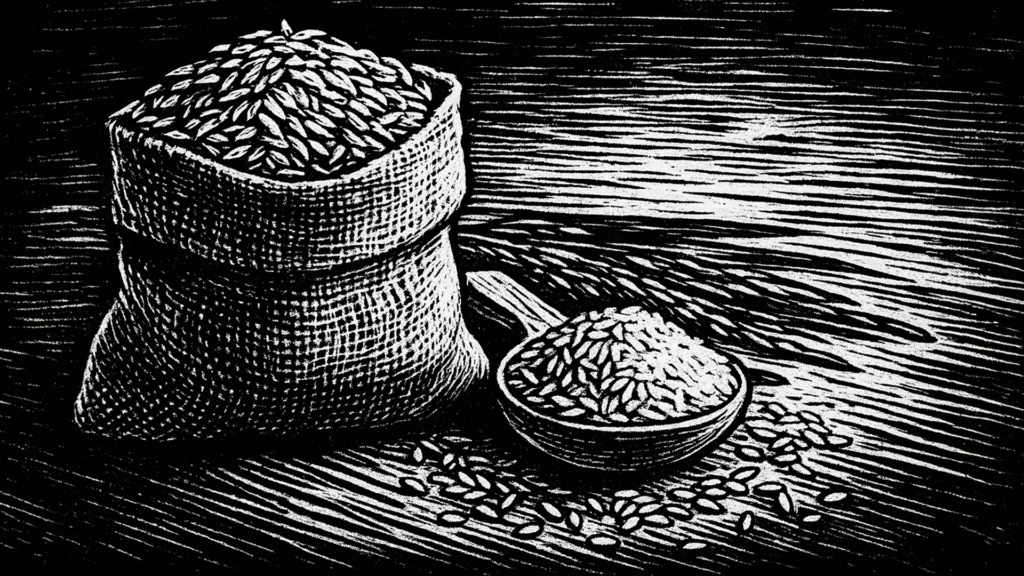
Second, Zakat on Crops and Fruits, which applies to produce meant for personal use or consumption by the owner and those financially dependent on him, and includes what can be measured and stored, such as wheat, barley, corn, rice, dates, and raisins.
There is no zakat on vegetables or fresh fruits because they cannot be stored for a full year — unless they are dried, in which case zakat becomes obligatory (e.g., raisins made from dried grapes). Crops and fruits intended for trade fall under a separate category (discussed later under “trade goods”).
The nisab for crops is five wasqs, where one wasq equals 60 sa‘s — approximately 653 kilograms of dry, clean produce. As reported by Al-Nasa’i from Abu Sa‘id al-Khudri, the Prophet ﷺ said: “There is no charity due on less than five awaq of silver, no charity on less than five camels, and no charity on less than five wasqs (of crops).”
The rate of zakat depends on the method of irrigation: 10% (one-tenth) for crops irrigated naturally by rain, rivers, or springs. 5% (half of a tenth) for crops irrigated artificially, by machinery or animals, due to the cost involved. This is based on the hadith reported by Al-Bukhari from Abdullah ibn Umar, where the Prophet ﷺ said: “For what is watered by the sky or springs or has natural water, the zakat is one-tenth; for what is irrigated by manual effort, the zakat is half of one-tenth.” Zakat on crops and fruits is due once at the time of harvest, not annually. As Allah says in Surah Al-An‘am (6:141): “Eat of its fruit when it ripens, but give its due on the day of harvest, and do not be excessive. Indeed, He does not like those who commit excess.”
This category of zakat applies to livestock (camels, cattle, sheep, and goats) that are not intended for trade. Its detailed regulations are preserved in one of the most important legislative documents in Islamic history — a text written by Caliph Abu Bakr al-Siddiq when he sent his collectors to the provinces to gather zakat after the death of the Prophet ﷺ. The document lays out in precise detail the prescribed amounts and thresholds of zakat as ordained by Allah and implemented by His Messenger ﷺ.
The text begins by affirming that zakat is a divine obligation that must be fulfilled exactly as prescribed, with no additions or reductions. Whoever is asked to pay zakat correctly must comply, and whoever is asked for more than what is due is not required to pay.
The text details the scales of zakat on camels: For fewer than 25 camels, the zakat is one sheep for every five camels. At 25 camels, the due is a one-year-old she-camel (bint makhad). If such an animal is unavailable, a two-year-old male camel (ibn labun) may be given instead.
From 36 to 45 camels, the due is a two-year-old she-camel (bint labun). From 46 to 60, a three-year-old she-camel (hiqqah) that is fit for mating. From 61 to 75, a four-year-old she-camel (jadh‘ah). From 76 to 90, two bint labun camels. From 91 to 120, two hiqqah camels. Beyond 120, the rule continues: for every 40 camels, one bint labun; and for every 50 camels, one hiqqah.
The text also explains the rules of compensation when there is a difference in the ages of camels owed for zakat. If a four-year-old she-camel (jadh‘ah) is due but the payer only has a three-year-old she-camel (hiqqah) — which is younger — it is accepted provided that he adds two sheep or pays twenty dirhams. Conversely, if a hiqqah is due but the payer only has a jadh‘ah (older and more valuable), it is also accepted, and the zakat collector compensates him with twenty dirhams or two sheep in return.
Likewise: If one owes a hiqqah but only has a two-year-old she-camel (bint labun), it is accepted if he adds two sheep or twenty dirhams. If one owes a bint labun but only has a hiqqah, it is accepted, and the collector gives him two sheep or twenty dirhams as compensation. This same rule applies to other similar cases. However, if one owes a one-year-old she-camel (bint makhad) but only has a two-year-old male camel (ibn labun), it is accepted without any addition or reduction.
The text then clarifies that no zakat is due on someone who owns four camels or fewer, unless he chooses to give voluntarily. As for freely grazing sheep (those that feed naturally without purchased fodder), there is a fixed zakat: For forty to one hundred and twenty sheep, one sheep is due. If the number increases to one hundred and twenty-one to two hundred, two sheep are due. If it reaches two hundred and one to three hundred, three sheep are due. Beyond three hundred, one sheep is due for every one hundred.
It is required that old, defective, or male breeding goats not be taken as zakat unless the collector agrees. It is also forbidden to combine separate herds or divide a single herd to avoid paying zakat, since zakat is calculated based on the rightful total of one’s wealth. The text further outlines the ruling on shared ownership (partnership) — if two people share a single flock, their zakat threshold (nisab) is calculated jointly, and they split the zakat equally between them.
It also specifies that anyone who owns fewer than forty sheep, even by one, owes no zakat unless he wishes to give it voluntarily.
Finally, the text explains the zakat on money, which is one-quarter of a tenth (2.5%) of the total amount if it reaches the nisab and a full lunar year has passed. If the total wealth is less than two hundred dirhams (about 190), no zakat is due — unless the owner wishes to give it voluntarily.
This is the text narrated by Al-Nasa’i in his Sunan, on the authority of Anas ibn Malik: “Abu Bakr, may Allah be pleased with him, wrote for him the following statement: These are the prescribed duties of charity (zakat) which the Messenger of Allah ﷺ made obligatory upon the Muslims, as commanded by Allah to His Messenger ﷺ. Whoever among the Muslims is asked to pay it correctly should give it, and whoever is asked for more than what is due should not give it. For fewer than twenty-five camels, one sheep is due for every five camels. When the number reaches twenty-five, the due is a one-year-old she-camel (bint makhad) up to thirty-five. If a one-year-old she-camel is not available, then a two-year-old male camel (ibn labun) may be given instead. When the number reaches thirty-six, the due is a two-year-old she-camel (bint labun) up to forty-five. When it reaches forty-six, the due is a three-year-old she-camel (hiqqah) suitable for breeding, up to sixty. When it reaches sixty-one, the due is a four-year-old she-camel (jadh‘ah) up to seventy-five. When it reaches seventy-six, the due is two two-year-old she-camels (bint labun) up to ninety. When it reaches ninety-one, the due is two three-year-old she-camels (hiqqatan) suitable for breeding, up to one hundred and twenty. When the number exceeds one hundred and twenty, for every forty camels, one bint labun is due, and for every fifty, one hiqqah. If there is a discrepancy in the ages of the camels due for zakat, then: Whoever owes a jadh‘ah but only has a hiqqah may offer the hiqqah along with two sheep or twenty dirhams. Whoever owes a hiqqah but only has a jadh‘ah may offer the jadh‘ah and receive twenty dirhams or two sheep from the collector as compensation. Whoever owes a hiqqah but only has a bint labun may offer it along with two sheep or twenty dirhams. Whoever owes a bint labun but only has a hiqqah may offer it and receive twenty dirhams or two sheep in return. Whoever owes a bint labun but only has a bint makhad may offer it along with two sheep or twenty dirhams. Whoever owes a bint makhad but only has a male ibn labun may offer it, and nothing more is required of him. Whoever owns four camels or fewer owes nothing, unless he chooses to give voluntarily. Regarding zakat on sheep: For forty to one hundred and twenty, one sheep is due. For one hundred and twenty-one to two hundred, two sheep are due. For two hundred and one to three hundred, three sheep are due. For anything above three hundred, one sheep is due for every hundred. Old or defective sheep and male breeding goats are not to be taken for zakat unless the collector agrees. Flocks must not be combined or divided to evade zakat. When two people share a flock, zakat is calculated jointly, and they share the due equally. If a man’s flock is less than forty sheep, even by one, no zakat is due unless he wishes to give voluntarily. As for silver (money), one-quarter of one-tenth (2.5%) is due. If the total wealth is only one hundred and ninety dirhams, no zakat is due unless the owner wishes to give voluntarily.”
As for zakat on cattle, it was explained by Mu‘adh ibn Jabal when the Messenger of Allah ﷺ sent him to Yemen to teach the people about Islam and collect the obligatory zakat from them. The Prophet ﷺ instructed him on the amounts due based on the number of cows owned: If the owner has 30 cows, the zakat due is one tabi‘ (a one-year-old calf that has entered its second year). If the owner has 40 cows, the zakat due is one musinnah (a two-year-old cow that has entered its third year).
If the number of cows is between 40 and 69, the amount of zakat does not change. Once the number reaches 70 cows, the due zakat is one tabi‘ and one musinnah. If the number reaches 80 cows, then two musinnahs are due. The Prophet ﷺ instructed Mu‘adh ibn Jabal to continue this calculation pattern — for every 30 cows, one tabi‘ is added, and for every 40 cows, one musinnah is added.
This is the narration recorded by Abu Dawud in his Sunan, in which Mu‘adh ibn Jabal said: “The Messenger of Allah ﷺ sent me to Yemen and commanded me to take from every thirty cows a tabi‘ (male or female one-year-old calf), and from every forty cows a musinnah (two-year-old cow). When the number exceeds forty, nothing is due on the excess until it reaches seventy, at which point one tabi‘ and one musinnah are due; when it reaches eighty, two musinnahs are due — and so on.”
As for horses not intended for trade, no zakat is required according to the majority of scholars, with the exception of Abu Hanifa. Al-Bukhari and Muslim both narrated from Abu Huraira that the Messenger of Allah ﷺ said: “There is no charity (zakat) due from a Muslim on his horse or his slave.” However, if horses are held for trade, zakat becomes obligatory on them, and they are treated as trade goods, as mentioned earlier — and by analogy, this same rule applies to cars and similar assets in the modern era.
Fourth, Zakat on Trade Goods, which applies to all items a Muslim acquires with the intention of selling them later for profit — such as crops, fruits, dried or fresh produce, livestock, horses, real estate, jewellery, clothing, machinery, and other goods or products.
Here, the individual’s intention, known only to Allah, plays a decisive role in determining the amount and timing of zakat, for it is based on what the person truly intends in his heart. As narrated by Samurah ibn Jundub, the Prophet ﷺ said: “The Messenger of Allah ﷺ used to command us to give charity from what we prepared for sale.” (*Reported by Ibn Hajar al-Asqalani in Bulugh al-Maram.)
Zakat on trade goods is calculated exactly like zakat on money — at a rate of one-quarter of one-tenth (2.5%), and it becomes due after a full lunar year (12 months) of ownership without decrease in value.
Fifth, Zakat on Extracted Wealth (Buried Treasure and Natural Resources), which applies to anything a person extracts from the earth, such as buried treasures (rikaz) or natural resources, including metals, oil, and coal.
Its payment is due immediately upon discovery, and its rate is one-fifth (20%). However, if the state does the extraction, no zakat is due, as the state is not an individual; its resources belong collectively to the people and serve the public interest.
At Modern Applications there is Zakat on Stocks. With the development of modern economies, scholars have derived rulings for zakat on shares and stocks, dividing them into three main cases: Trading (Speculative) Stocks: If the shares are bought and sold for profit (not held long-term), they are treated as trade goods. They are valued at market price at the end of the lunar year, and zakat is paid at 2.5% of their total market value plus accumulated profits (if any).
Investment (Long-term) Stocks: If the shares are held for dividends rather than resale, zakat is due only on the profits, not on the principal value — provided the company itself pays zakat. If the company does not pay zakat, then the shareholder must pay zakat on his proportionate share of zakatable assets (such as cash, inventory, and receivables), typically estimated at around 10% of the market value if exact details are unknown.
By Company Type: Commercial (trading) companies: zakat = 2.5% of full market value. Industrial companies: zakat = 2.5% on zakatable assets only (cash, raw materials, finished goods). Service-based companies (e.g., telecoms, transport, hospitals): zakat = 2.5% on liquid assets and net income only.
According to the International Islamic Fiqh Academy Resolution No. (143/16/1), when funds remain frozen for many years, some people assume that zakat on them is waived or postponed. However, Islamic jurisprudence views the matter from a deeper perspective — the perspective of ownership and the ability to dispose of one’s wealth.
Wealth that remains under its owner’s possession, even if kept in a frozen account, deposit, or investment project, is still considered growing wealth and therefore subject to zakat every year. Freezing the funds does not cancel ownership; it is merely a temporary restriction on withdrawal, not on the right itself. The continued presence of money within an investment system indicates hidden growth, and zakat is imposed on growth — even if it is dormant or potential.
However, funds that are forcibly withheld or locked in accounts beyond the owner’s reach, such as security deposits or insurance reserves that cannot be recovered until an unknown time, fall outside the scope of full ownership. Thus, zakat becomes due only once, after these funds are released and received. The ruling is tied to the return of control over the money, for only then is complete ownership — the basis of zakat — fulfilled.
Between these two cases lies the wisdom of Islamic law: it neither burdens a person with what he cannot access, nor exempts him from what he truly owns. Zakat remains a means of purification for wealth and a just system that links prosperity with responsibility, restoring balance to economic life — no matter how the forms of wealth evolve or how long accounts remain frozen.
I found that the Kingdom of Saudi Arabia regards zakat collection as an integral part of its constitutional and administrative system, according to the General Zakat Guideline. The Kingdom does not view zakat merely as a religious act of worship, but as both a legal obligation and a sovereign duty of the state, administered through precise systems and regulations designed to ensure its objectives of justice and social solidarity are fulfilled.
The Basic Law of Governance established this principle in Article 21, which states: “Zakat shall be collected and spent in its legitimate channels.” This confirms that the state is responsible for both collecting and distributing zakat. Additionally, Article 7 stipulates that governance in the Kingdom is based on Islamic Sharia, making zakat a legislative pillar with the force of law and legal authority.
Since the reign of King Abdulaziz — may Allah have mercy on him — a comprehensive administrative framework has been established to ensure the effective collection and regulation of zakat. This began with the Royal Decree issued in 1370 AH (1951 CE) and continued through a series of regulations and ministerial resolutions that clarified the methods of collection and accounting. It culminated in the modern executive bylaw of 1440 AH (2019 CE), which clearly defines the responsibilities of taxpayers, as well as the procedures for declaration, inspection, and payment, all integrated within an advanced electronic oversight system supervised by the Zakat, Tax, and Customs Authority (ZATCA).
The Kingdom’s efforts do not stop at collecting zakat — they extend to ensuring it reaches its rightful beneficiaries. The collected funds are deposited into the Social Security Account and distributed to the poor, needy, and eligible recipients, in accordance with the Royal Decree of 1383 AH (1963 CE), which mandated the collection of zakat from companies, institutions, and individuals and its allocation to the groups whom Allah has granted a rightful share in the wealth of the rich.
Unlike modern tax systems, zakat in Islamic countries is imposed only on Muslims. As we have seen from its many details, it is nowhere near as burdensome as the heavy taxes levied in capitalist societies, which often range between 20% and more than 50%, depending on the income bracket.
Moreover, consider the value-added tax (VAT) imposed on goods and services: the producers pay taxes on their profits, then the distributors, then the wholesalers, and finally the retailers — all of whom are taxed on the same product. By the time it reaches the final consumer, he pays yet another tax on a product he bought with his own money, without having gained any income from it.
In contrast to socialist or communist systems, Islam does not place limits on people’s wealth or possessions acquired through lawful means. It places no ceiling on ambition, so long as the activity is permissible and the person pays the zakat due on it.
And unlike ascetic religions that scorn wealth and glorify withdrawal and austerity, Islam honors honest trade and enterprise. The Prophet ﷺ said, as narrated by Al-Tirmidhi from Abu Sa‘id Al-Khudri: “The truthful and trustworthy merchant will be with the Prophets, the truthful ones, the martyrs, and the righteous.”
Indeed, Islam spread across much of Asia — including Indonesia, which today has the largest Muslim population in the world (about 240 million people) — not by conquest, but through the ethics and integrity of Muslim merchants who sailed across the Indian Ocean to Southeast Asia as early as the 8th century CE.
Indeed, Islam spread across much of Asia — including Indonesia, which today has the largest Muslim population in the world (about 240 million people) — not by conquest, but through the ethics and integrity of Muslim merchants who sailed across the Indian Ocean to Southeast Asia as early as the 8th century CE.