





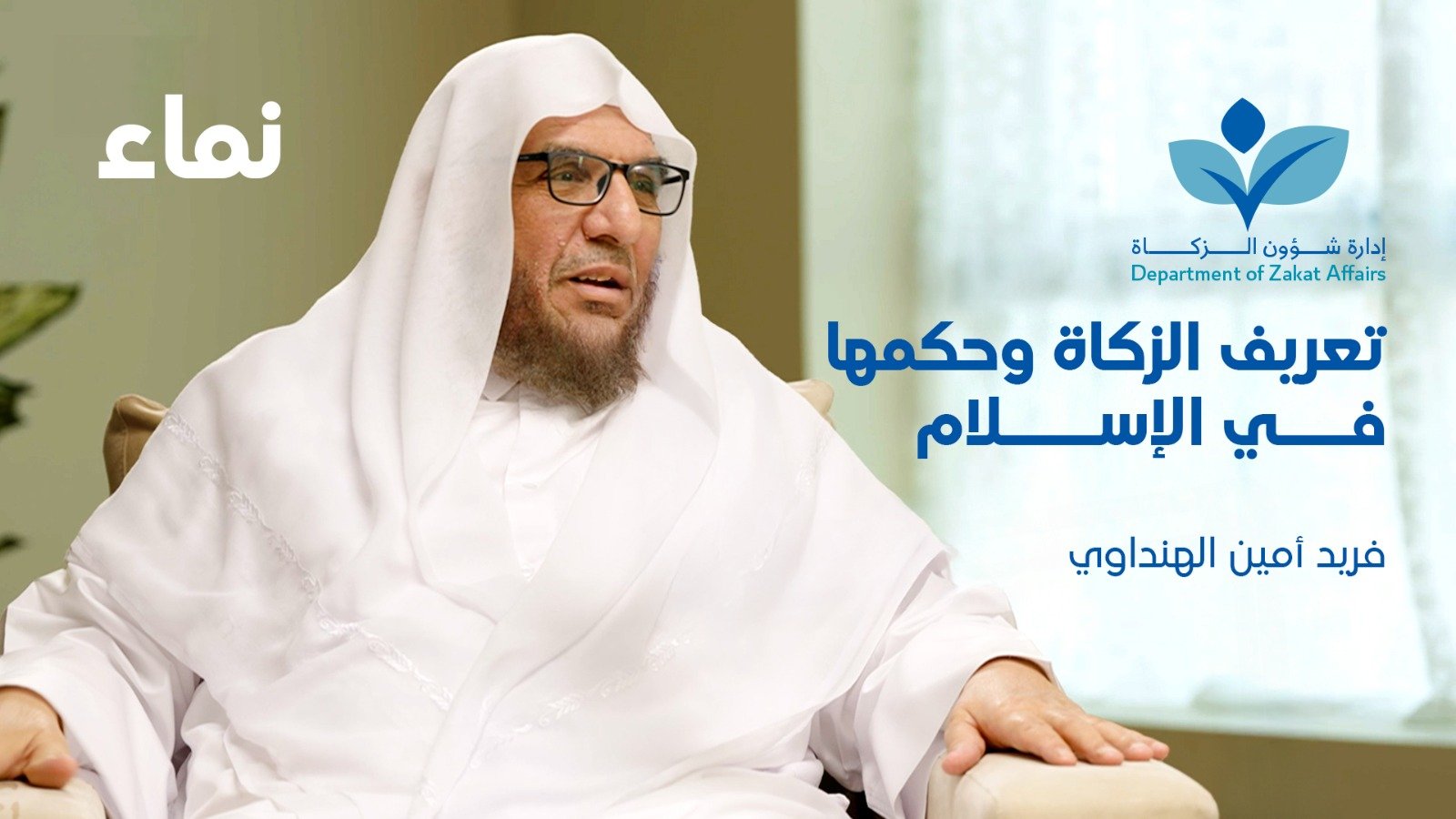
In the first episode of the Namā’ Podcast, produced by the Zakat Affairs Department, Mr. Ahmed Al-Janahi hosted Imam, preacher, and Sharia researcher Dr. Farid Amin Al-Hindawi. Dr. Al-Hindawi joined the Zakat Services Department of the Zakat Fund in 2005, having previously worked as an accountant for several years. He later earned both a master’s and a PhD in Sharia. As he explained, this combination of practical and academic experience enriched his understanding of zakat, blending theoretical knowledge with applied practice.
Dr. Al-Hindawi began by explaining the term zakat linguistically and then legally. Linguistically, zakat carries several meanings, including blessing, increase, growth, and purification, as in the Qur’anic verse: “Successful is the one who purifies himself”—meaning purification from sins and wrongdoing. It may also mean lawful or wholesome, as in: “…so let him look at which food is most pure”, meaning most lawful. It can also mean praise, as in: “…So do not claim yourselves to be pure; He knows best who is righteous.”
All of these linguistic meanings are reflected in zakat in the legal sense, as zakat purifies wealth and brings about its growth and blessing.
A common question arises: how can zakat be described as growth and increase when paying it reduces one’s wealth?
Dr. Al-Hindawi explains that growth is of two types: visible and invisible.
Visible growth refers to tangible increase, such as profit gained from investing capital in trade.
Invisible growth refers to blessing (barakah) placed in wealth, making it sufficient, protected from harm, and a means for unexpected provision.
Legally, zakat is defined by many jurists as a specified obligatory portion determined by Allah from specific wealth, given to specific categories of recipients at a specified time, with the intention of worship.
This comprehensive definition highlights that zakat is primarily an act of worship before it is a financial or social system.
Regarding its obligation, Dr. Al-Hindawi stated that zakat is unanimously agreed upon as obligatory. It is repeatedly paired with prayer in the Qur’an, such as: “Establish prayer and give zakat.” The Qur’an also specifies the eight categories of zakat recipients in Surah Al-Tawbah.
The command “give zakat” indicates obligation, as there is no contextual evidence suggesting it is merely recommended.
The Prophet ﷺ also listed it among the five pillars of Islam. Abu Bakr Al-Siddiq firmly fought those who refused to pay zakat, affirming that neglecting it constitutes neglecting a fundamental pillar of religion.
One common misconception is restricting “wealth” to cash only. However, as Dr. Al-Hindawi explains, in the framework of zakat, wealth is much broader than that. Gold and silver are considered wealth; livestock of various kinds are wealth; agricultural produce and fruits are wealth; and trade goods—merchandise and assets prepared for sale—are also considered wealth on which zakat is due.
However, Dr. Al-Hindawi clarifies that not everything a person owns is subject to zakat. Rather, zakat applies to specific types of wealth defined by clear Islamic criteria. For example, a person may own many cars for personal use, yet they are not subject to zakat because they are for personal use. Even pearls, according to him, are not subject to zakat.
As for the conditions of zakat, Dr. Al-Hindawi explains that they are precise requirements that regulate its obligation. The first is Islam—zakat is not valid from a non-Muslim. The second is that the wealth must reach the nisab, the minimum threshold at which zakat becomes obligatory.
Each type of wealth has its own nisab. For example, the nisab for gold is 85 grams of pure gold, and the nisab for silver is 595 grams of 925-grade silver.
Regarding why these specific thresholds were set, Dr. Al-Hindawi explains that they are divinely prescribed and devotional in nature; human reasoning does not determine them—just like the number of units (rak‘ahs) in prayer.
Although gold and silver are no longer commonly used today for buying and selling, having been replaced by paper currency that is no longer backed by gold, zakat is still obligatory on them, as Dr. Al-Hindawi notes. He also explains that the reason the nisab for silver is lower than that for gold is that it is more beneficial to the poor, since its lower threshold makes zakat obligatory on a larger number of Muslims. As for choosing whether to calculate based on gold or silver nisab, this is a matter of scholarly interpretation.
Regarding how to determine the nisab for cash, he explains that it is calculated according to the amount of gold or silver that the cash can purchase at the time zakat becomes due. This amount varies due to fluctuations in gold and silver prices, and what matters is the value at the date zakat becomes obligatory.
As for trade goods—meaning the merchandise inventoried in the store and warehouses at the completion of one lunar year—if the total value of the goods, together with the cash available in the account, reaches the nisab of gold or silver, then the merchandise is assessed at its current market value, not its purchase price. One-quarter of one-tenth (2.5%) is then paid as zakat.
For service-based commercial activities that do not have physical goods, zakat is due on the remaining amounts in the account if they reach the nisab of gold or silver at the completion of the lunar year. The zakat rate is 2.5%.
Dr. Al-Hindawi added that livestock consists of three types: camels; sheep (including goats); and cattle (including buffalo). Islamic law has precisely defined the nisab for each type. For camels, the nisab begins at five head, and the zakat due is one sheep. For cattle and buffalo, the nisab begins at thirty head, and the zakat due is a one-year-old calf (tabi‘). If they reach fifty head, the zakat becomes a two-year-old cow (musinnah). Larger numbers are calculated according to a specific schedule. For sheep, from forty to one hundred and twenty, one sheep is due; at 121, two sheep; at 200, three sheep; at 400, four sheep; and for every additional hundred, one sheep is due.
As for crops and fruits, not all are subject to zakat. According to the Hanbali school, zakat is due at harvest time if the produce reaches the nisab and is of a type that can be measured and stored, such as wheat, dates, raisins, cumin, chili, and spices. Accordingly, as stated by Shaykh Ibn ‘Uthaymeen, vegetables and fruits are not subject to zakat because they are neither measured nor stored. Even if they are dried, such as molokhia or okra, the ruling is based on their original nature.
Another condition of zakat is the completion of one lunar year (hawl) on gold, silver, cash, and trade goods—that is, the passage of a full Hijri year over the wealth.
Whoever is obliged to follow the Gregorian fiscal year in calculating zakat must pay 2.5775%, due to the 11-day difference between the Hijri and Gregorian calendars.
According to the Hanafi school, the beginning of the hawl (lunar year) is determined when the amount reaches the nisab. Zakat is then paid at the end of the year on the amount present at that time, provided it still reaches the nisab—regardless of what entered or left the funds during the year. A separate hawl is not calculated for each individual amount, and this is the view preferred by the Zakat Affairs Administration.
Dr. Al-Hindawi adds that the Shafi‘i school assigns a separate hawl for each amount that independently reaches the nisab, which may create accounting difficulty for the zakat payer.
The completion of a year is not required for crops and fruits; rather, their zakat is due at the time of harvest. Likewise, buried treasure (rikaz) and extracted minerals are subject to zakat immediately upon extraction from the earth.
Another condition for zakat on wealth is full ownership without restriction. According to the stronger opinion, zakat is not due on the debtor but on the creditor, as the creditor is the rightful owner of the wealth. However, if the debtor delays payment, zakat is only due once upon recovery of the debt—provided a year has passed over it and it reaches the nisab.
A juristically disputed condition is whether the wealth must be capable of growth—either actual growth, such as crops and livestock, or constructive growth, such as gold, silver, and trade goods.
Al-Janaahi expressed surprise that zakat is not linked to the age or mental capacity of the owner. As Dr. Al-Hindawi explained, zakat is due on the wealth of a minor and an insane person, and it is paid on their behalf by their guardian or trustee according to the majority of jurists (except the Hanafis). This is because zakat is a financial act of worship concerned with the wealth itself and the necessity of returning its benefit to society—unlike prayer, which is a bodily act of worship tied to the accountable individual personally.
Dr. Al-Hindawi further added that anyone who did not pay zakat on their wealth for several years during childhood must pay it for each previous year, because zakat does not lapse with the passage of time.
Regarding how a zakat payer determines who is eligible to receive zakat, Dr. Al-Hindawi stated that the payer must fear Allah and, to the best of their ability, verify the circumstances of the person to whom they are giving zakat, ensuring that the payment does not fall outside the eight categories of recipients mentioned in the noble verse of Surah At-Tawbah. Zakat is a trust. If the payer does not exercise due diligence and later discovers that the person who received the zakat was not eligible, they must pay it again to someone who qualifies. However, if they exercised proper care and later found that the funds went to someone ineligible, then nothing is required of them.
For this reason, the Zakat Affairs Administration carefully examines assistance applications through its social specialists department. This scrutiny may go so far that some accuse it of being overly strict or requiring excessive documentation and data. However, it is excused in that it strives diligently to ensure zakat reaches those who truly deserve it, thereby fulfilling the command of Allah and earning the trust of zakat payers.
Al-Janaahi concluded the podcast by thanking Dr. Al-Hindawi for an episode that was both rich in information and engaging. Dr. Al-Hindawi responded with thanks and added that zakat is a topic full of details and cannot be covered in a single episode, but rather requires many episodes.


In the first episode of the Namā’ Podcast, produced by the Zakat Affairs Department, Mr. Ahmed Al-Janahi hosted Imam, preacher, and Sharia researcher Dr. Farid Amin Al-Hindawi. Dr. Al-Hindawi joined the Zakat Services Department of the Zakat Fund in 2005, having previously worked as an accountant for several years. He later earned both a master’s and a PhD in Sharia
This guide is very informative and well-timed
Departement of Sharia
Departamento de Sharia
https://www.univ-msila.dz/site/shs-ar/
https://www.univ-msila.dz/site/shs/
Very nice post. I just stumbled upon your blog and wanted to say that I’ve truly enjoyed surfing around your blog posts.
Departement of Sharia
Departamento de Sharia
https://www.univ-msila.dz/site/shs-ar/
https://www.univ-msila.dz/site/shs/