





Talking about money is a topic to which ears keenly listen and toward which attention is drawn, for people’s fascination with everything related to it is almost without limit, even if it is nothing more than a picture of a pile of banknotes on a passing table. Human beings are naturally disposed to love it, since it is the pillar of living and the support of life.
Allah the Exalted says in Surah Al Imran: “Beautified for people is the love of that which they desire—of women and children, heaped-up sums of gold and silver, fine branded horses, cattle and tilled land. That is the enjoyment of worldly life, but Allah has with Him the best return.”
Despite this innate love of wealth in human beings, this verse is immediately followed by a divine call in the form of a question followed by a decisive answer, in which Allah says: “Say, ‘Shall I inform you of what is better than that? For those who are mindful of Allah, with their Lord are gardens beneath which rivers flow, wherein they will abide eternally, and purified spouses, and the pleasure of Allah.’ And Allah is All-Seeing of His servants.” From the doors of this good that leads, by Allah’s grace, to His pleasure is the obligation of zakat.
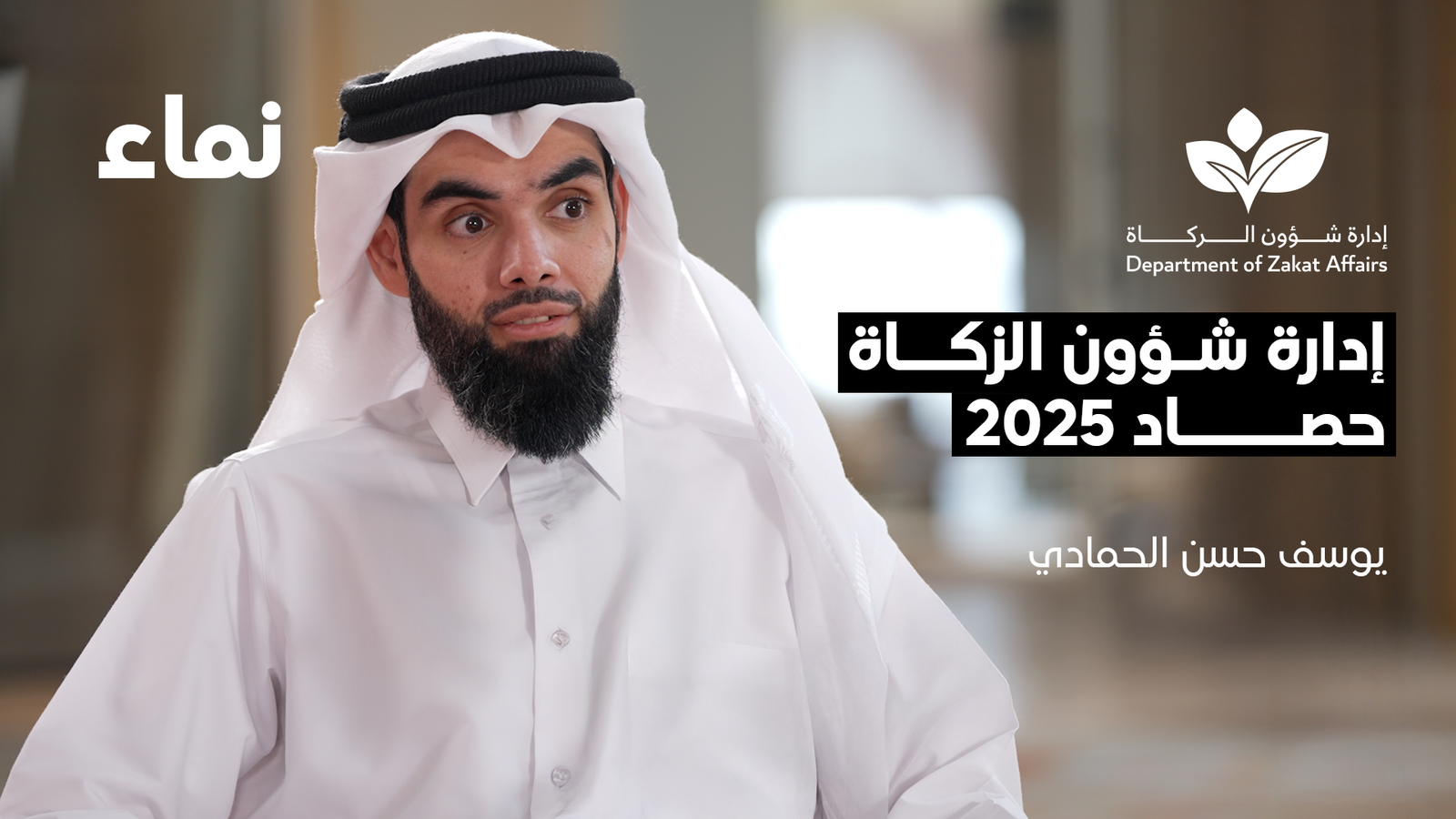
In the “Namaa” podcast, Mr. Ahmed Al Janahi hosted Mr. Yousuf bin Hassan Al Hammadi, Assistant Director of the Zakat Affairs Department for Public Services in the State of Qatar, in a conversation that revealed many features of the institutional work that upholds this obligation.
The first thing Al Hammadi emphasized at the beginning of the episode, with a calm, contented smile that did not leave his face throughout the interview, was that the revenues of the Zakat Affairs Department increased in 2025, and so did the expenditures on those entitled to zakat, exceeding in that year alone 300 million Qatari riyals.
But the question that imposes itself, as Al Janahi said, is: Is this amount enough to cover all applications?
With one confident word, Al Hammadi said that all the applications submitted in 2025 and carried over from 2024 were literally “closed,” explaining that every one of them was processed, either by approval and delivering zakat to those entitled to it, or by rejection due to lack of legal eligibility, with a message sent explaining the reason for ineligibility.
Only about 300 assistance requests were carried over to the following year, and these were applications submitted in the last two weeks of the 2025 fiscal year, out of a total of about 18,000 applications, and these in turn were decided quickly during January 2026.
In responding to what is sometimes said about the department being strict regarding the required supporting documents, Al Hammadi used an eloquent analogy, saying: just as the Kaaba is the qiblah of the worshiper in prayer, the truly eligible recipient of zakat is the qiblah of the zakat payer.
Zakat does not clear one’s liability if it is given to someone not entitled to it when no effort has been made to verify their situation. Hence the meticulous procedures: as a trust before Allah first, and as a safeguard of the department’s credibility before those who have entrusted it with paying their zakat on their behalf, second.
In 2025 the department worked to simplify these procedures, reducing the stages of the application process from sixteen to seven, within an institutional framework that balances facilitation with verification, since outward eligibility is the basis of judgment, while Allah knows best what is in the hearts.
Explaining the criteria for eligibility, Al Hammadi referred to what is mentioned in the Prophetic hadith, as reported by Shuayb Al Arna’oot in his verification of “Mushkil Al-Athar” from Ubaydullah ibn Adiyy ibn Al Khiyar, who said: “Two men from my people told me that they went to the Prophet ﷺ while he was distributing charity and asked him for some of it. He raised his eyes and lowered them, and when he saw that they were strong and able-bodied, he said: ‘If you wish, I will give you, but there is no share in it for a rich person nor for a strong person who can earn his living.’”
He clarified that zakat is not permissible for someone who already possesses what covers his basic needs, whether in the form of saved money or the ability to earn, and he reviewed real examples of rejected applications, such as someone who has bank savings, or financial assets he can liquidate, or commercial records that generate profits, or properties that exceed his actual needs.
Among the noteworthy cases he mentioned was a woman who called asking about the ruling on taking her father’s zakat despite her financial sufficiency. The answer was that she is not eligible, and that she must distribute her father’s zakat to those who meet the legal conditions of eligibility.
Zakat, as Al Hammadi stressed, is not a gift but an obligation and a trust. It should not be fragmented into small amounts randomly distributed among the poor, but rather directed to those whose avenues have been closed before them and who are unable to secure the basic necessities of life for themselves and their dependents.
He explained that the type of eligibility is determined according to the eight categories mentioned in verse 60 of Surah At-Tawbah, which the “Namaa” podcast discusses in several episodes with esteemed scholars.
When Al Janahi asked whether the Zakat Affairs Department could offer financial advice and counseling to someone whose application was rejected due to mismanagement of his wealth and assets, Al Hammadi answered that there are multiple specialized bodies in Qatar for such matters, and that the Zakat Affairs Department is not expected to devote itself to tasks other than collecting and distributing zakat in accordance with the rulings of Islamic law, in addition to promoting awareness of zakat among both payers and eligible recipients.
Among the issues the Zakat Affairs Department wishes to highlight are not only the conditions and rulings of zakat, but also proactive awareness on how to avoid falling into debt—for example, someone burdening himself with debts resulting from non-essential luxuries, such as digging a swimming pool in his house and the subsequent maintenance costs and so on,
or someone wanting to enter the world of commerce without knowledge or experience, borrowing an amount and then losing it through poor management of that business, thus becoming indebted.
Regarding the items making up the 175 million riyals in assistance provided by the Zakat Affairs Department to deserving families in 2025, Al Hammadi said that they are divided into one-off lump-sum aids given once to relieve a crisis after which the person no longer needs assistance, versus other cases where monthly assistance is given for half a year, after which the department re-examines the case to reassess eligibility.
The drawback of this type of monthly aid is that some people may become dependent on it and content themselves with zakat, without seeking a source of income that covers their needs. Therefore, after six months the department gradually reduces the amount given, to motivate the person to look for a sufficient source of income.
On how the eligible amount is determined, Al Hammadi said that the department has set categories aimed at achieving a minimum level of sufficiency for one year. The minimum amount is determined according to nationality—whether Qatari, Arab, or non-Arab—and there is also a link between the Zakat Affairs Department and the Qatar Credit Bureau to know each applicant’s income and obligations.
Regarding the payment by the department in 2025 of more than 102 million riyals that benefited more than 4,800 cases, Al Hammadi said that the average assistance per case was around 20,000 riyals to cover tuition fees in private schools from the primary stage up to university level for those of limited income who cannot enroll in government education.
He noted that the department does not monitor the academic level of the beneficiaries because it is not a scholarship-granting body; its role is only to provide termly assistance to those who are legally eligible, not to assess them academically.
When Al Janahi asked about the rest of the eight zakat categories, Al Hammadi replied that contemporary terminologies may cause confusion, but what matters is that the eligibility criterion for zakat within the department is always tied to one of the eight categories mentioned in the noble verse. For example, medical treatment expenses or education costs fall under the category of the needy for those who are unable to pay them, while the poor person is one who cannot secure his daily food, and of course the debtor category is clearly defined in the Qur’an.
On the variation in the share of each category from zakat, Al Hammadi said that the orientation is linked to the overall direction of the country. Therefore, the Zakat Affairs Department focuses on needy families inside the country because it is almost the only body concerned with them, whereas some medical treatment expenses are covered by dedicated funds at Hamad Hospital.
Field visits play an important role in raising awareness, as they are visits conducted by the department to wealthy individuals to remind them of the obligation of zakat and encourage them to fulfill it. Most individuals pay their zakat in Shaaban, Ramadan, and Dhu al-Hijjah, while companies usually pay their zakat at the end of the fiscal year.
Among the important achievements is the launch on the department’s website of a corporate zakat calculator application at the beginning of 2026, the preparation for which began in mid-2025. Before that, the calculation process to determine what enters the zakat base while observing the legal conditions was done manually, especially since the Zakat Affairs Department is affiliated with the Ministry of Awqaf, which is responsible for Islamic religious work and fatwas, and any jurisprudential disagreement is referred to the Sharia committee under His Excellency the Minister of Awqaf to decide upon it.
One of the goals of the Zakat Affairs Department in 2026 is to disburse all zakat funds received, as happened in 2025—of course after ensuring recipients’ eligibility in a way that clears, in the sight of Allah Almighty, the liability of the zakat payers and also of the department’s employees as their agents.
Another goal of the department in 2026 is to raise awareness of zakat for both payers and recipients, and to promote awareness of the need to avoid debts incurred for purchasing luxuries—this podcast itself is part of that awareness effort.
The department also seeks in 2026 to facilitate self-services related to calculating and paying zakat, and aims for all its services to be available through terminals accessible to the public, whether zakat payers or eligible beneficiaries, while maintaining traditional services through department employees out of consideration for the elderly who are not comfortable with modern technological tools.
In conclusion, Al Hammadi added that there are many details related to zakat that the department takes into account which require research, study, and jurisprudential and scholarly discussions. He asked the Almighty Allah for guidance and success for every zakat payer in ensuring that his zakat reaches those entitled to it, for his zakat is a trust.


