





Recently, there has been increasing discussion about governance, sustainability, and measurable social impact—concepts that have become familiar in the contemporary charitable work environment.
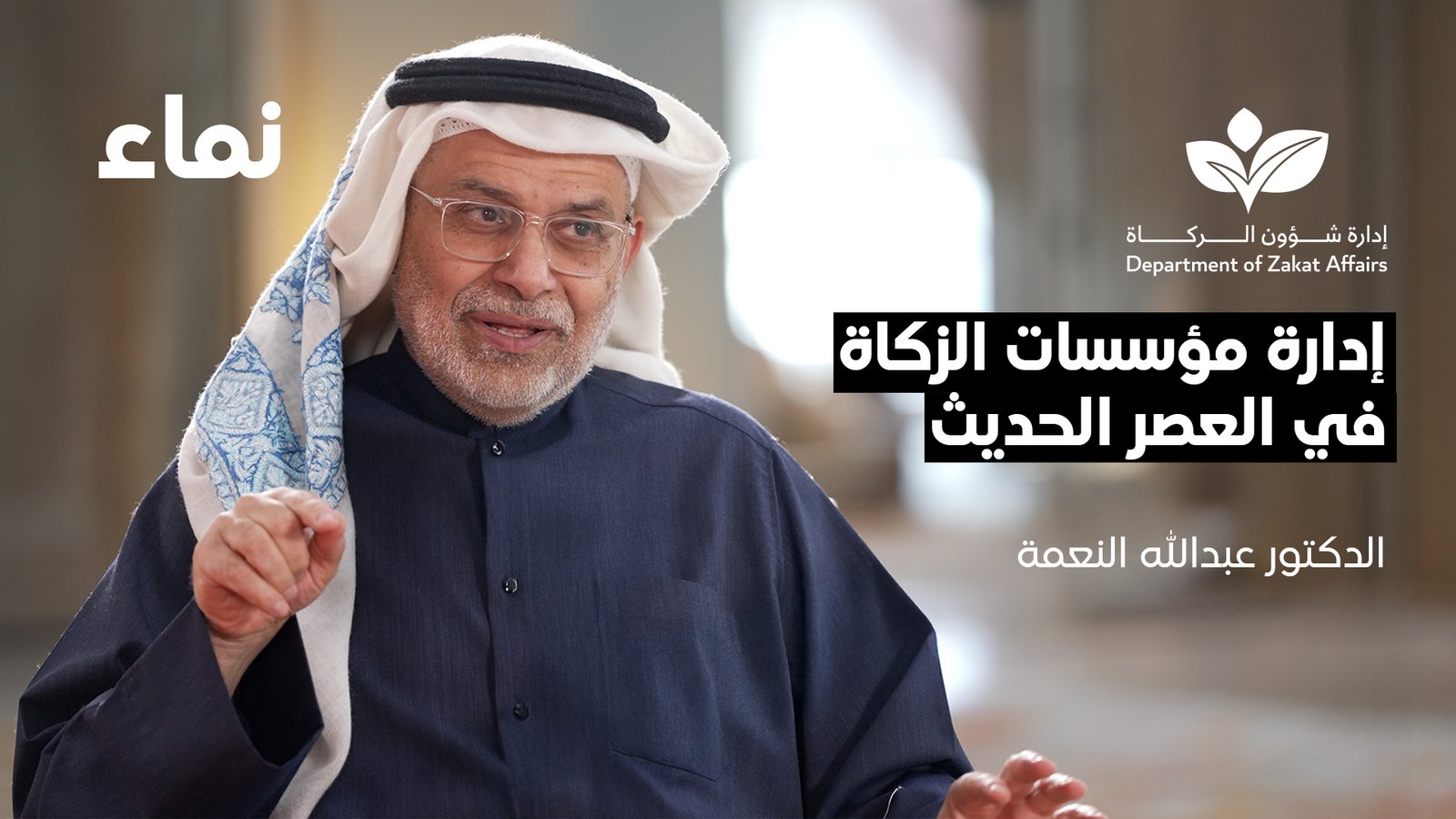
Here, the Nama Podcast, produced by the Zakat Affairs Department in the State of Qatar, raises an old question in a new formulation: Is zakat merely an individual act of worship performed by a Muslim before moving on, or is it an integrated institutional system that should be managed under state supervision?
The episode’s host, Mr. Ahmed Al-Janahi, opened his dialogue with Dr. Abdullah Al-Naama, consultant and expert in humanitarian sector development, by referring to his long experience in charitable work. Dr. Al-Naama attributed all success to God, thanking Him for concealment, noting that no human effort—no matter how refined—is free of mistakes and can never reach perfection.
He began with a striking observation about institutional culture in the charitable sector: institutions should reconsider how they write their annual reports, focusing on shortcomings, failures, and mistakes rather than merely listing achievements. Achievements, however impressive, may carry elements of biased self-assessment, whereas acknowledging deficiencies directs the compass toward genuine improvement and enables institutions to learn from their errors.
This vision is rooted in Dr. Al-Naama’s more than twenty years of experience working with Japanese institutions, where employees immediately convene when a problem occurs, treating it as a top priority. This is followed by another meeting to assess the causes of the issue, prevent recurrence, and evaluate the effectiveness of proposed solutions. Over time, these meetings evolve into working papers and institutional literature that form a knowledge base safeguarding the institution against repeating the same mistakes.
The discussion then shifts to a fundamental question about the nature of zakat and whether it is merely an individual act of worship as some assume. Dr. Al-Naama points to the zakat verse in Surah Al-Tawbah:
“Alms are only for the poor and the needy, and those employed to collect them, and those whose hearts are to be reconciled, and for freeing captives, and for those in debt, and in the cause of Allah, and for the traveler—an obligation from Allah. And Allah is All-Knowing, All-Wise.”
He notes that this verse carries profound epistemological significance, as it refers to zakat as “alms.”
From an epistemological perspective, wealth fundamentally belongs to God, and humans are merely trustees. Yet some wealthy individuals are sensitive to the term “zakat beneficiaries,” as though wealth were their absolute property rather than a temporary trust through which God tests their conduct.
In this sense, zakat is not merely a duty whose neglect incurs sin; it is a pillar of Islam without which one’s Islam is incomplete. This explains the stance of Caliph Abu Bakr Al-Siddiq, who fought those who withheld zakat.
This raises the question of whether zakat is an act of worship that may be collected compulsorily within an institutional framework. Dr. Al-Naama explains that zakat originated during the time of the Prophet ﷺ within an organized system, as he sent workers to collect and distribute it. This role continued under subsequent states before gradually becoming an individual responsibility as state functions grew more complex.
Today, by the grace of God, zakat is gradually regaining its institutional character—an encouraging sign indicating a broader revival of Islam.
The discussion also addresses zakat’s distinctiveness compared to other acts of worship, such as prayer, in that it has a clear institutional dimension. Dr. Al-Naama explains that the Qur’anic text lists those employed to administer zakat among its rightful categories, meaning that the existence of an administrative apparatus for collecting and distributing it is part of its legal structure.
Zakat paid individually may suffer from limitations in scale and impact, as individuals may not always accurately identify eligible recipients, and payment may become merely a discharge of obligation rather than a tool for real social change. Institutional work, by contrast, enables more precise targeting, greater sustainability, and deeper societal impact.
Dr. Al-Naama emphasizes that zakat is not an isolated financial system in Islamic law but part of an integrated framework that includes voluntary charity, endowments (waqf), interest-free loans, and family and educational value systems. Any imbalance in one of these components affects the effectiveness of zakat.
In strengthening trust in zakat institutions, transparency emerges as a key element of governance—especially among a younger generation that demands data, statistics, and measurable impact.
However, Dr. Al-Naama warns against equating transparency with complete disclosure of all details. The privacy of zakat recipients must be protected to preserve their dignity, and the privacy of donors must be safeguarded to prevent ostentation. True transparency lies in measurability, not informational exposure.
The dialogue reviews successful international experiences in institutionalizing zakat, such as Malaysia, where zakat is deducted from employees’ salaries through state institutions, and Kuwait, where 1% of corporate profits is legally allocated to a zakat fund, generating continuous financial surplus.
Academic research and artificial intelligence technologies are also playing an increasing role in resource allocation and identifying intervention priorities to combat poverty.
Qatar, meanwhile, adopts a learning approach—drawing inspiration from other experiences while adapting them to its societal context without fully replicating existing models. It remains cautious about direct salary deductions for zakat due to potential negative reactions.
In conclusion, Dr. Al-Naama affirms that keeping pace with modern technologies is inevitable, yet humanizing these technologies remains a priority, as the human dimension cannot be replaced by technology. It is manifested in individuals’ participation with zakat institutions in distribution efforts, sponsorship of orphans, and visiting them.
He further notes that confining zakat administration to a single ministry may not be the optimal approach. Rather, cooperation among various institutions is needed to sustain and develop this obligation—reframing zakat not merely as an individual act of worship, but as an integrated financial and social system capable of generating sustainable developmental impact.


