





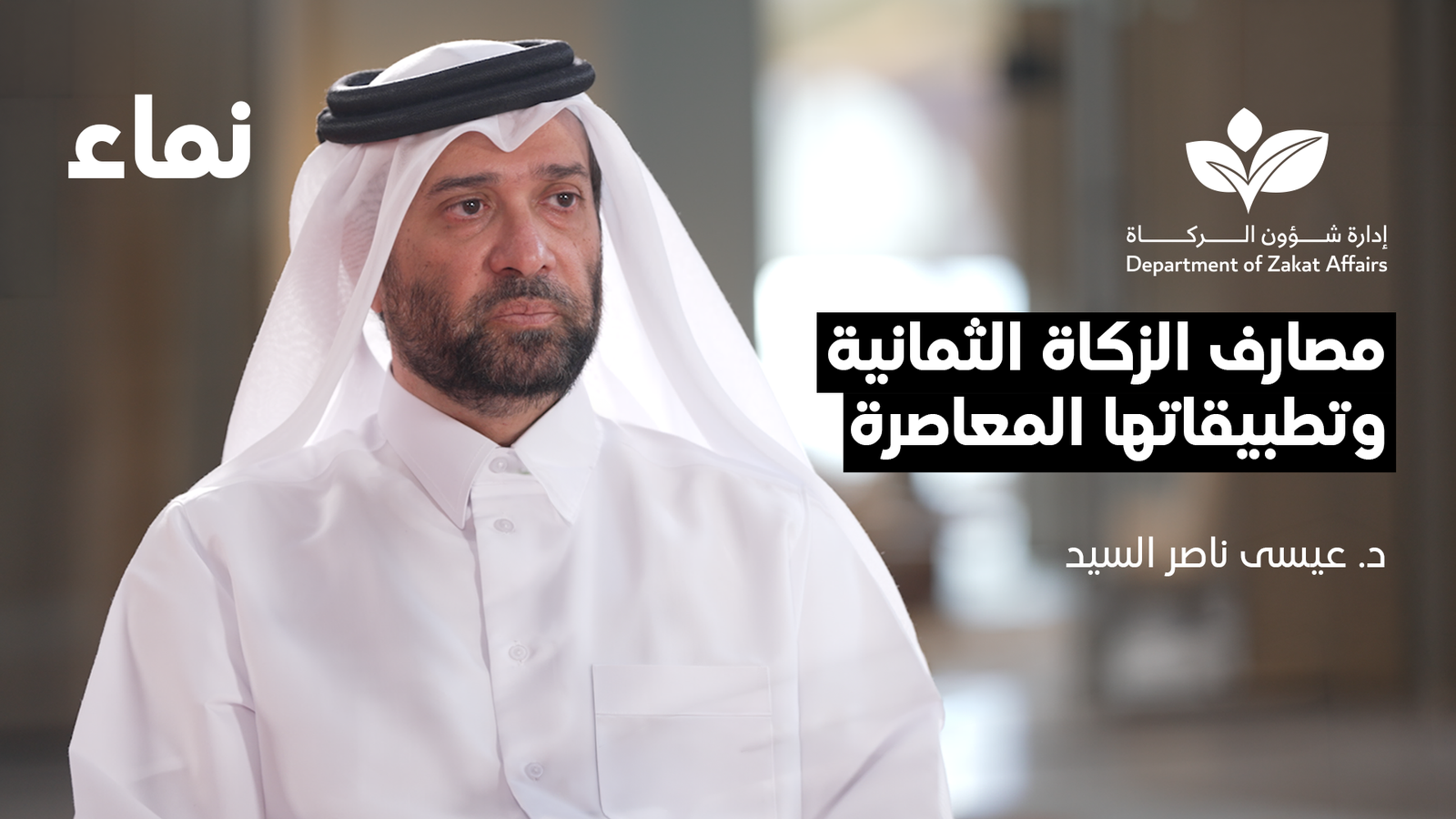
In a new episode of the Namaa podcast hosted by Ahmed Al Janabi, the program hosted Dr. Issa Nasser Al Sayed, Head of the Quality Unit at the Zakat Affairs Department, in a discussion centered on the eight categories of zakat and how they are applied to contemporary societal needs, in light of the accumulated field experience within Qatar’s Zakat apparatus.
Al Janabi began the dialogue by focusing on the research aspect of zakat jurisprudence, asking how a researcher can draw from his practical position topics worthy of study and analysis. Al Sayed pointed out that his doctoral thesis indeed addressed practical issues in the Zakat Affairs Department, reflecting his conviction that jurisprudence should not remain confined to theorizing, but must connect with people’s needs and societal issues.
He explained here that field work opens wide doors for the researcher, as many contemporary issues may not be clearly understood in traditional theoretical presentations, but rather unfold through direct interaction with people, follow-up of real cases, and monitoring of social and economic changes.
The conversation then moved to an important principle of zakat jurisprudence, namely Allah’s saying in Surah At-Tawbah: “Charities are only for the poor, the needy, those employed to administer it, those whose hearts are to be reconciled, to free captives, for those in debt, in the way of Allah, and for the traveler—a decree from Allah. And Allah is Knowing and Wise.” Al Janabi paused to question the Quran’s description of zakat as “charities” (sadaqat).
Al Sayed clarified that what is meant here is the obligatory charity, i.e., the prescribed zakat, not voluntary charity in the general sense. He emphasized that the Quranic text itself specified and defined it as a decree from Allah, thereby distinguishing it from other forms of benevolence that may be given to non-Muslims or spent on general righteous causes outside the framework of obligatory zakat.
Among the key topics covered was the issue of the order of the eight zakat categories: Are they given equally? Should priority be given to the poor over others? Here, the Head of the Quality Unit at the Zakat Affairs Department stressed that the matter is essentially practical, governed by need and benefit, not merely the verbal order in the verse. The zakat categories, as he explained, are not distributed according to a rigid rule, but according to what reality demands.
If the needs of debtors (al-gharimīn) in a country are more pressing, support can be directed to them more, and if the need is greater among the poor and needy, priority is given to those categories. In this sense, zakat becomes a flexible tool for responding to societal needs, not merely a fixed mathematical division.
In explaining the difference between the poor (al-fuqarā’) and the needy (al-masākīn), Al Sayed addressed the well-known jurisprudential disagreement among schools of thought regarding which of the two is in greater need. He explained that some schools consider the poor to be in a more severe state than the needy, while others hold the opposite view, but the final outcome is one: both categories fall within the circle of need and eligibility.
He then linked this jurisprudential foundation to practical application in Qatar, noting that determining the sufficiency threshold is not done in isolation from the social environment, standard of living, and nature of society. The Zakat Affairs Department considers these factors when reviewing cases, ensuring funds are directed to those truly deserving according to realistic, not formalistic, standards.
The discussion lingered at length on the category of “those employed to administer it,” as it reveals the institutional dimension of zakat legislation. The guest explained that when Sharia allocated a share of zakat to its workers, it intended to ensure the sustainability of the zakat apparatus itself, enabling it to collect funds, organize them, and deliver them to those entitled.
He reviewed the historical evolution of zakat collection, from the agents (suwwāh) sent to gather zakat in early Islam to the modern administrative and organizational systems. He affirmed that the eight zakat categories mentioned in the noble verse of Surah At-Tawbah are not matters for individuals, but rather pertain to institutional work managed by competent authorities under state supervision.
As for the category of “those whose hearts are to be reconciled” (al-mu’allafatu qulūbuhum), the episode addressed it from two angles: historical and contemporary. Historically, Al Sayed explained that this category was linked in the Prophet’s time ﷺ to winning over tribal leaders, warding off their harm, or drawing them closer to Islam, noting that this was necessitated by the Sharia policy during the establishment of the Islamic state.
In practical terms today, he clarified that this category is no longer commonly applied like those of the poor and needy, but it remains valid in principle whenever its cause arises. He cited as an example the use of zakat funds to support new converts to Islam whose living conditions are difficult, facing social or economic challenges resulting from their conversion, providing them support for reconciliation and stabilization.
In discussing the category of “freeing captives” (fī al-rīqāb), the guest explained that its direct historical form was linked to ransoming prisoners or assisting those in bondage or captivity, and that this meaning has receded in the modern era due to major contemporary changes in international politics.
Nevertheless, he noted that the door of ijtihad in understanding some contemporary applications remains a matter of jurisprudential consideration, even though the original context in which the text was revealed is no longer realized as it was in early times. Here, the guest’s caution in distinguishing between the fixed essence of the text and areas open to ijtihad based on the presence or absence of the underlying cause was clearly evident.
The meeting also devoted significant space to discussing debtors (al-gharimīn), as one of the most common categories in contemporary reality. Al Sayed clarified that not every debtor qualifies, but specifically one who is overwhelmed by debts and truly unable to repay them, such that they threaten his stability or expose him to pursuit and imprisonment. Someone with sufficient income to meet his financial obligations is not considered a debtor in the Sharia sense eligible for zakat.
He affirmed that the Zakat Affairs Department examines the cause of the debt itself; mere existence of a financial obligation is not enough for eligibility. Instead, it considers whether the debt arose from a necessary need, such as treatment, housing, or other essentials, or from spending on non-essentials that do not warrant zakat eligibility.
This understanding reflects a balance between compassion for the needy and protecting zakat funds from unregulated expansion in disbursement.
In addressing the category of “in the way of Allah” (fī sabīl Allāh), Al Sayed pointed out that early jurists often limited it to jihad and defense of the Islamic state. However, the contemporary application by Qatar’s Zakat Affairs Department tends toward a broader interpretation in some cases, including certain public welfare aspects clearly related to serving the faith and Islamic society—such as building mosques, Islamic centers, or supporting da’wah activities—provided this is done after disciplined study and does not lead to neglecting priorities or competing with more urgent categories in Muslim society.
The conversation did not overlook the category of “the traveler” (ibn al-sabīl), where the guest explained that it refers to the stranded traveler who has lost his means and money and is unable to reach his homeland or complete his journey. He noted that this category may seem limited today, but it remains applicable in some cases, such as when a person’s paths are truly cut off and he cannot even find what to return home with.
He also pointed out that some forms of asylum and displacement may fall under more than one category depending on the case—a person may be poor, needy, or a traveler—which once again confirms that zakat categories are not rigid labels but Sharia determinants understood in light of reality and need.
A striking aspect of this meeting was the guest’s discussion of procedural and administrative challenges facing zakat work, foremost among them verifying case eligibility. He highlighted the importance of electronic and automated linkages between various entities to reduce the burden on beneficiaries, shorten the hardship of gathering documents and moving between institutions, and give the zakat apparatus greater ability to verify financial and living data accurately and quickly.
This point seemed particularly significant, as it reveals that developing zakat work today does not rely solely on the jurisprudential aspect, but also requires a modern institutional structure that leverages technology to improve quality, facilitate services, and preserve the dignity of the needy.
In another part of the dialogue, the guest emphasized that zakat represents, in its essence, a comprehensive social security system, as its impact does not stop at aiding an individual here or a family there, but extends to protecting the entire society from the effects of poverty, incapacity, and disintegration.
Zakat, as Al Sayed said, meets people’s needs, enables families to fulfill their roles, curbs social deterioration, and even contributes to preventing deviance and crime. For when the needy finds someone to provide for him and preserve his dignity, his life stabilizes, allowing him to perform his role in society properly. Thus, he views zakat as a fully integrated societal project, not merely a financial act of worship detached from the objectives of civilization and stability.
The meeting also touched on the issue of transferring zakat outside the country, explaining that there is a well-known jurisprudential disagreement on the matter. Zakat on wealth is originally tied to the location of the wealth, while zakat al-fitr follows the body, i.e., the person’s location at the time it becomes due. Dr. Issa clarified that these issues require precise jurisprudence, but in all cases, they confirm that zakat is inseparable from administrative organization, and its direction should be closest to where need is realized and benefit is evident.
In closing the episode, Al Sayed addressed a direct message to everyone facing a real need, urging them to apply and benefit from the zakat apparatus established to serve those entitled. He affirmed that Allah legislated zakat, and the state has provided a standing apparatus for it since 1992 as a gateway for aid, concealment of faults, and support.


