Each of our cells contains a diploid gene inherited from both a father and a mother. Moreover, most of us have an innate desire to explore our genetic origins, tracing back deep into the distant past. We do this with a passion for mapping out our ancestors’ lineage through the centuries and a readiness to […]
Each of our cells contains a diploid gene inherited from both a father and a mother. Moreover, most of us have an innate desire to explore our genetic origins, tracing back deep into the distant past. We do this with a passion for mapping out our ancestors’ lineage through the centuries and a readiness to take pride whenever we discover an ancestor of great virtue or noble character. It’s as if there’s an unspoken promise that merely belonging to a distinguished lineage foretells a promising personal future.
When discord arises between parents, resulting in a bitter separation, the child experiences a severe psychological earthquake, leaving him with lifelong self-doubt.
This voluntary separation between parents might be even more devastating for the children than the death of one parent, as they perceive it as one parent morally eliminating the other. This can cause one to feel trapped in a pendulum swing between the two, resulting in emotional dizziness.
Such condemnation of the roots uproots any sense of self-worth, and these feelings of inherited inferiority lead the person to seek approval from every stranger desperately. However, this appreciation quickly becomes tainted by the ghost of their being, composed of conflicting elements.
The child’s internal conflict does not stop at the home that was destroyed over his head through no fault or wrongdoing of his own. Unfortunately, because of those closest to him, this conflict – despite the separation – ignites for many more years due to a fierce battle between the parents over custody rights, as if he were a piece of furniture pulled by contentious hands, deeply wounded by his parents’ claws, with a bitter feeling of orphanhood, even though they are still alive.
Therefore, Arab societies sought to end this dispute over the custody of children of divorce, their maintenance, guardianship, and the right to see them by the non-custodial parent through provisions in family laws derived from Islamic Sharia, along with the existence of parallel laws that suit non-Muslims.
All Arab laws agree on several matters, including that the priority of child custody after divorce or annulment goes to the mother, but with certain conditions, as she is considered more nurturing than others. The child’s maintenance and guardianship are the father’s responsibility.
However, these laws differ on other issues, such as the order of custody entitlement after the mother. Some laws prioritize the child’s female relatives over the father for custody, while others place the father as the second custodian directly after the mother. Arab laws also have minor differences regarding the reasons for custody termination, the child’s right to choose their custodian, and the visitation duration for the non-custodial parent.
A controversial issue in the Arab street is the feminist movement’s demand not to terminate a divorced woman’s custody when she marries a man who is a stranger to her child.
All Arab laws terminate the mother’s custody if she marries a stranger, with minor exceptions based on Islamic jurisprudence. As reported by Abdullah bin Amr in Sahih Abu Dawood, a woman said, “O Messenger of Allah, this son of mine was carried in my womb, suckled at my breast, and comforted in my lap, and his father has divorced me and wants to take him from me.” The Messenger of Allah, peace and blessings be upon him, said to her, “You have more right to him as long as you do not remarry.”
One of the benefits of this legislation is that the best interest of a male child requires that he should not find his mother in the arms of her husband, who is a stranger to him, especially since his father is still alive. This could negatively affect the development and maturation of the child’s masculinity, unlike an orphan who psychologically accepts his mother’s husband as a substitute for his deceased father.
If the child is a female, it is not in her interest as she approaches adolescence in a few years to live under the same roof with her mother’s husband, who might view her with lust, especially if he lacks integrity and morals.
Also, not revoking custody from a divorced woman if she remarries a man who is a stranger to her children reduces the chance of her returning to her ex-husband, which usually is not in the interest of their children.
God Almighty says in Al-Baqara: “Divorced women shall keep themselves waiting for three periods, and it is not permissible for them to conceal what Allah has created in their wombs if they believe in Allah and in the Last Day. Their husbands are best entitled to take them back in the meantime if they want a settlement. Women have rights similar to what they owe in a recognized manner, though there is a step above them for men. Allah is Mighty, Wise.”
One example of the double standards is the alimony legislation in Arab laws, which obligates a father to provide housing and education at the same level as before the divorce. This financially drains the man, and he does not consider that his previous income often cannot sustain the same living standard for his children and himself at the same time, especially if he remarries and has more children.
It is as if divorcing a woman he couldn’t live with, or who couldn’t live with him, is a punishment that should haunt him for the rest of his life, not to mention the substantial financial losses from what he spent on his previous marriage, often accompanied by borrowing and debt to finalize it.
Despite the rising voices of Arab feminist movements demanding equal rights for women and men, they insist on obligating men to fully provide for their children’s expenses without the slightest acceptance of women sharing half or part of these expenses. Alongside this, there are common complaints from men about the difficulty and rarity of seeing their children under legislation that could lead to imprisonment in some Arab countries if a man fails to pay these expenses.
On the other hand, the threat of revoking custody is fraught with legal loopholes if a woman prevents a man from seeing his children. This situation not only damages the relationship between the child and the father but also affects the uncles and grandparents on the father’s side.
For example, Article 293 of the Egyptian Penal Code states that “anyone who has been issued a judicially enforceable judgment to pay alimony to his spouse or relatives or in-laws or for the cost of custody or breastfeeding or housing, and refrains from paying despite having the ability to do so for three months, after being notified to pay, shall be punished by imprisonment for a period not exceeding one year and a fine not exceeding five hundred pounds, or by one of these two penalties”.
There is an increasing reluctance among men in the Arab world to marry, as it has become akin to an uncalculated financial gamble with unforeseen consequences. This has resulted in higher rates of spinsterhood among women and the emergence of other forms of marriage, such as customary marriage that is not officially registered with the state and misyar marriage, which absolves the man from providing housing for his wife, spending on her, or staying with her daily as if it were an intermittent illicit relationship outside the framework of marriage.
All these challenges have led to a decline in birth rates in the Arab world, which could potentially threaten a future demographic crisis that affects the entire society.
With the spread of materialistic views in Arab societies influenced by Western capitalism, the bar for requirements has risen. For most men, a woman’s beauty has become a more critical condition than her morals, and a man’s wealth has become the most important criterion for many women. This results in a shared life devoid of cooperation, patience, and giving.
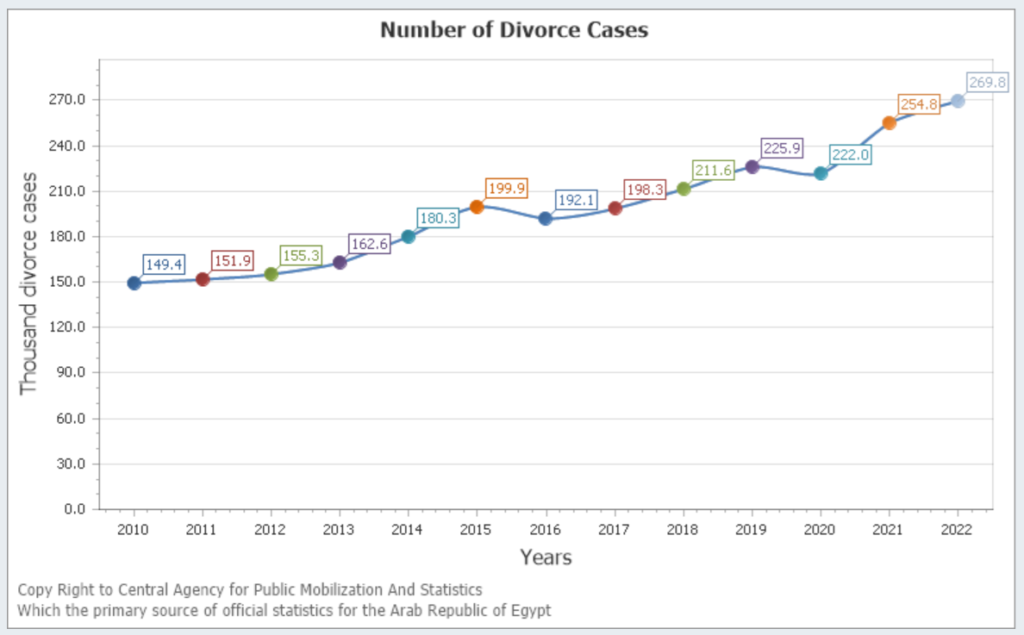
In 2022, the Central Agency for Public Mobilization and Statistics in Egypt announced that a marriage takes place every 34 seconds, a birth every 14 seconds, and a divorce every 117 seconds.
In an article on Al Jazeera Net, Abdullah Hamed mentions that 14 million divorce cases were looked at in courts in 2015, representing 28 million people, a quarter of Egyptian society. The figure becomes even more terrifying if we take into account the children of divorce, as 12 million children fell victim to their parents’ separation in 2016.
Number of Divorce Cases in Egypt since 2010 – www.capmas.gov.eg
The issue is not limited to Arab countries grappling with economic challenges; for example, an oil-rich country like Kuwait experienced a 48% divorce rate from the total marriages in 2016.
Before delving into some aspects of Arab family law, it is worth noting that at the time of writing this article, Egypt, in particular, is experiencing heated societal debate regarding family laws. The year 2024 witnessed discussions on a unified family law bill to be presented to the People’s Council for consideration.
Article 167 of the Qatari Family Law mentions one of the essential conditions for custody mentioned in most Arab laws: reaching maturity, sanity, trustworthiness, and the ability to care for, maintain, and nurture the custodial child in a way that secures their best interest and safety from serious infectious diseases. A close relative is forbidden from marrying the custodial child in case of a gender difference.
One of the most important reasons for the termination of custody mentioned in most Arab laws can be found in Article 144 of Federal Law No. (28) of 2005 of the United Arab Emirates concerning family status. It stipulates additional requirements for the custodian beyond those mentioned in the previous Article: the custodian must meet gender-specific requirements. A female custodian should not be married to a foreign husband with whom she has consummated marriage unless court-approved for the child’s benefit, and she must share the child’s religion. A male custodian needs a qualified female for custody, must be an unmarriageable relative to a female child, and must share the child’s religion.
Articles 174, 175, and 176 of the Moroccan Family Code of 2016 list reasons for terminating custody mentioned in most Arab laws. Article 174 states: “The marriage of a custodian who is not the mother results in the termination of her custody unless in the following two cases: if her husband is a close relative who is legally forbidden to marry the custodial child, or if she is a legal representative of the custodial child.”
Article 175 states that the custody of the divorced woman does not lapse if she remarries in cases where the marriage of the custodial mother does not affect her custody rights in cases where the child is under seven, separation could harm the child, the child has a condition complex for others to manage, her husband is a close kin or legal representative, or she is the legal representative. Additionally, upon her remarriage, the father is exempt from paying for the child’s accommodation and custodial fees but must continue to pay child support.
Article 176 also states that “Silence on the part of the person entitled to custody of the child for a period of one year after she or he has knowledge of the marriage shall result in the forfeiture of his or her right to custody, except in cases of force majeure.”
For comparison between the main custody clauses in some Arab laws, the clauses related to the maximum age for custody and those related to custody arrangements after the mother, the legislation of a custody age exceeding ten years has contributed to an increase in divorce rates for trivial reasons.
With this high custody age, women have become less fearful of divorce because it does not deprive them of the custody of their children for many years, with the law mandating the father to provide full support for her and her children. Even if she remarries someone else, many Arab legislations ensure that custody can transfer to her biased mother, who usually dislikes her daughter’s ex-husband, which, in practice, will not prevent their mother from having custody in reality.
The Maximum Age for Custody
The laws governing custody age limits in various Arab countries share some common characteristics. Generally, these laws reflect a concern for the child’s welfare, often allowing the continuation of custody under the mother or a designated guardian until the children reach adolescence or young adulthood.
In contrast, Moroccan law stipulates that custody continues until legal adulthood for both genders, with a choice given to the child at 15 to select their custodian. This indicates a more extended period of potential custodial care in Morocco compared to Egypt.
For example, Egypt and Morocco have laws allowing children to choose who they wish to stay with once they reach a certain age, typically around 15 years old. In both countries, the law allows the child to remain under the guardian’s care, emphasizing the child’s preference and welfare as pivotal factors.
Moreover, these laws highlight a gender-sensitive approach to the end of custody, with specific provisions that extend the period for girls in certain circumstances, emphasizing protection and support during their transition to adulthood.
On the other hand, significant differences are evident in the specific age limits and conditions under which custody ends. In Egypt, the amended law of 2005 allows custody until the child reaches 15 years of age, after which the child can choose to stay with the custodian until adulthood.
Additionally, while the provisions for extending custody due to exceptional circumstances such as illness or disability are common across jurisdictions, they vary in their implementation and the discretion given to courts, illustrating different approaches to handling complex custody issues related to the child’s well-being.
Arranging the Priority of the Right to Custody
The family laws in Egypt, Morocco, Saudi Arabia, Qatar, and the UAE exhibit similarities primarily based on their shared grounding in Islamic Sharia, which significantly influences the rules regarding child custody. In all these countries, the mother is generally given priority for the custody of young children. This reflects a common understanding across these jurisdictions that the mother’s role is central to the early years of a child’s upbringing.
Furthermore, all these laws outline a precise hierarchical sequence for custody eligibility, extending to include various relatives of the child from unmarried women unrelated to the child if custody by the mother is not possible. They emphasize the preference for custody to remain under the care of women within the family scope.
Despite these similarities, there are notable differences in how each country’s laws detail the custody hierarchy and the conditions under which male relatives might assume custody.
For example, Egyptian law lists an extensive sequence of female relatives before custody shifts to male relatives, reflecting a solid preference for maternal family custody.
In contrast, Moroccan law provides a specific arrangement but adopts a more flexible approach. The court can award custody to any relative it deems more suitable based on the child’s best interest without strictly adhering to a predefined order.
Saudi Arabian and Qatari laws similarly prioritize mothers and maternal relatives but offer courts the discretion to alter the order based on the child’s best interests.
The UAE law also prioritizes the mother but uniquely emphasizes providing proper housing as part of the custodian qualifications.
These Legislative differences in the Arab world illustrate the varying rigidity and judicial discretion in applying custody laws across these nations.
Proposed Legislative Reforms
Delaying childbirth for three years after marriage may be a reasonable solution to avoid divorce consequences when there are innocent children involved. Also, the period of custody for women should end before the child reaches puberty, as the child at this stage needs the father’s firmness more than the mother’s tenderness.
Furthermore, facilitating the child’s overnight stays for two days a week with the non-custodial parent and sharing the annual school vacation is essential so the child can have beautiful memories during their school holiday with both parents despite the separation.
Furthermore, facilitating the child’s overnight stays for two days a week with the non-custodial parent and sharing the annual school vacation is essential so the child can have beautiful memories during their school holiday with both parents despite the separation.