
One of the most ridiculous documentaries I have ever watched was a 2019 film produced by Al Jazeera Documentary Channel titled "The Yellow Fleet", directed by the Egyptian filmmaker Mohamed Qanawi, who resides in Italy. I tried to find some excuse or justification for the film’s shallow content and weak direction, so I looked into his background and some of his other works. What I found only reinforced my impression: a man who studied Italian literature at Ain Shams University and later worked as a tour guide in Egypt, carrying a camera with him, seems to have assumed that emigrating to Italy and learning a few editing software shortcuts was enough to make him a documentary filmmaker and director.
For example, there are scenes in the film that are supposedly about the 1967 Arab-Israeli War, but are in fact footage from the 1973 War. Moreover, the interview format—guests occupying half the screen against a black background while archival footage fills the other half—reflects a level of directorial bankruptcy that should have been unacceptable in the second decade of the twenty-first century.
Returning to the German documentary produced ten years earlier, in 2009, titled "Stuck in the Bitter Lakes: The Ships Trapped in the Suez Canal," we encounter a different kind of absurdity—this time at the level of content, marked by a striking naïveté. Despite its strong archival footage, the film is built around the simplistic notion that human beings are inherently good once they are freed from their political ideologies and national affiliations.
The only conclusion I drew from this unique historical episode is that conflict among human beings is unavoidable, and that unity and cooperation emerge only when people face a common existential threat that does not distinguish between them—such as an alien invasion of Earth or a global pandemic that threatens all human life.
Indeed, competition, conflict, and intrigue among members of the same camp are often the normal path for those seeking leadership, climbing institutional ladders, or pursuing privilege and advantage.
Returning to the story of the Yellow Fleet, it remains one of the strangest, most compelling, and most inspiring episodes in the history of the Suez Canal. Not because it involved a decisive battle or a dramatic shift in the balance of power, but because it tells the story of how fifteen merchant ships became trapped in the heart of a war and, over the course of eight years, evolved into a small world of their own—one that resisted isolation through solidarity.
None of those sailors could have imagined, on the morning of June 5, 1967, that what was supposed to be a routine voyage through the Suez Canal would turn into a prolonged, involuntary stay in the midst of one of the most politically and militarily tense environments of the twentieth century.
The ships had been proceeding along their normal route as part of a maritime convoy transiting the Suez Canal northbound when the calm of the morning was shattered by the roar of Israeli aircraft striking Egyptian airfields. Thus began the war that would later become known as the Six-Day War or, in the Arab world, the Naksa (Setback).
In that moment, the merchant vessels ceased to be mere carriers of goods between continents. They suddenly became eyewitnesses to the eruption of war across the region—objects trapped between two fires, unable either to move forward or turn back.
When the initial shock subsided and the major battles ended, Egypt’s decision to close the Suez Canal left those ships in complete isolation.
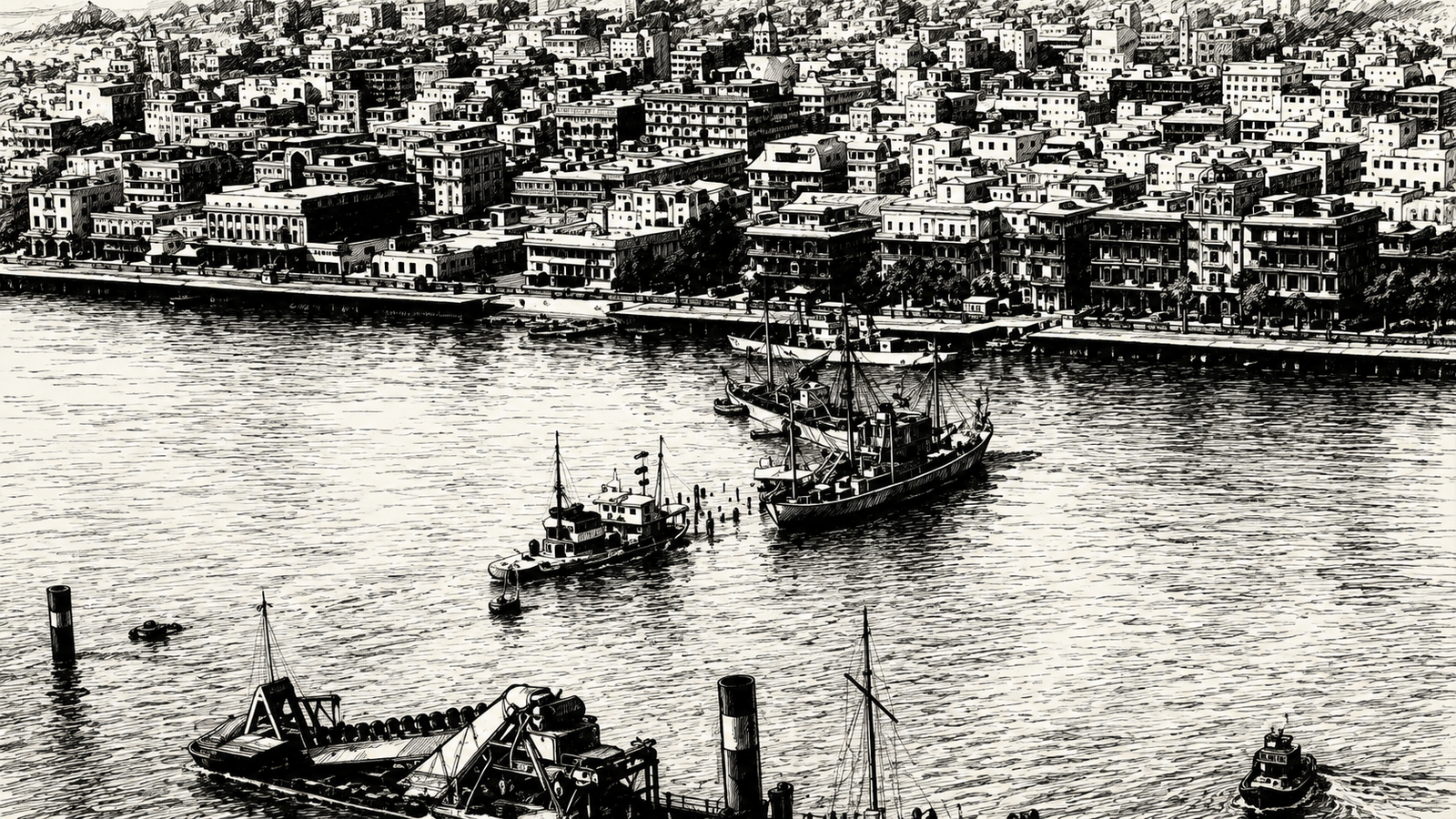
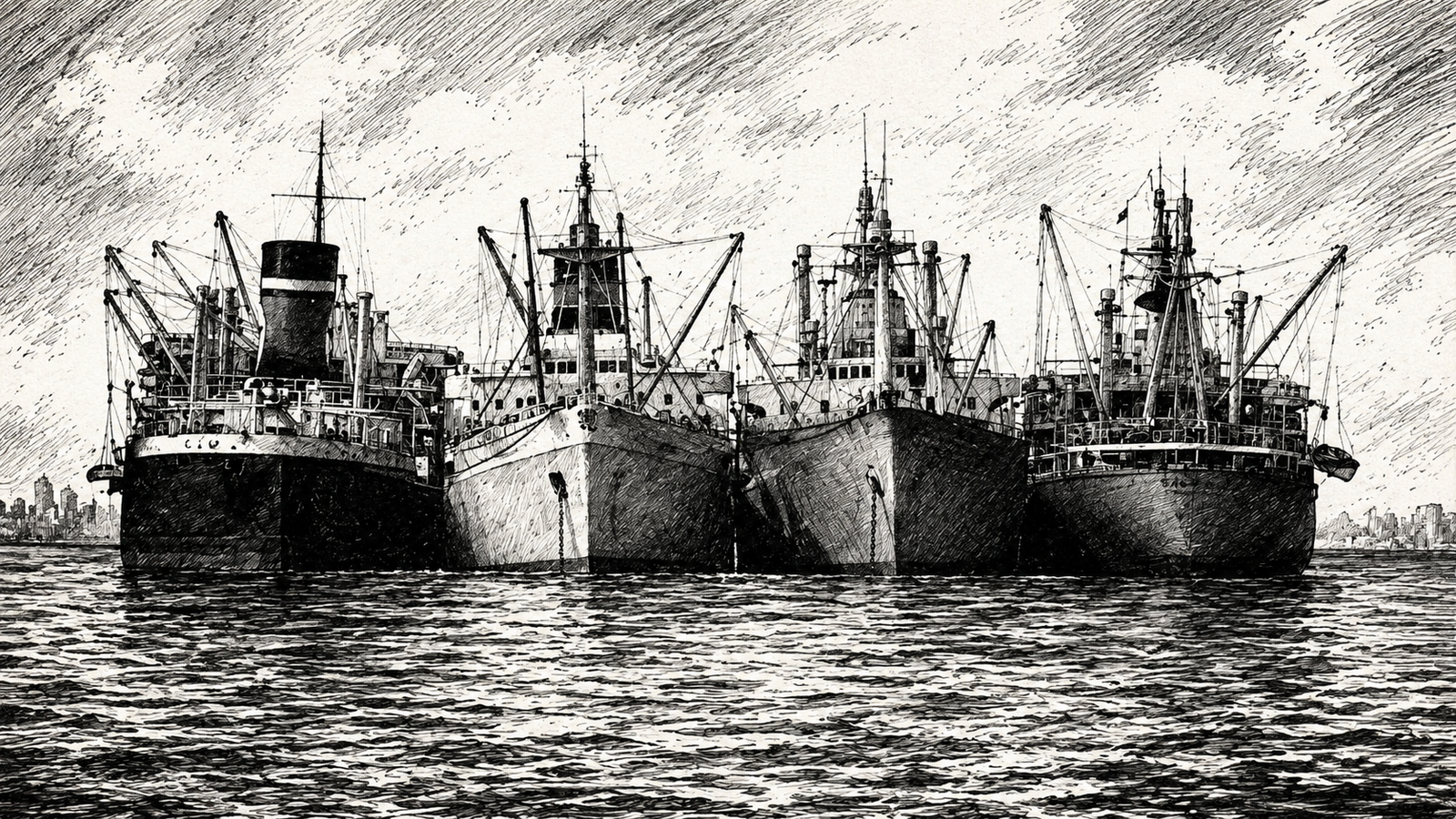
At first, the situation appeared to be a temporary delay imposed by wartime circumstances. Yet the temporary stretched into eight years, three months, and five days. Fifteen ships from Britain, West Germany, Poland, Sweden, France, Czechoslovakia, Bulgaria, and the United States found themselves confined to the same body of water, caught within an international landscape divided by the Cold War into rival camps. Yet this very geography of tension would give rise, upon the water’s surface, to one of the purest examples of human coexistence.
Those aboard the ships were merchant sailors, not soldiers or military officers. Their familiar world revolved around navigation, engines, cargo holds, and schedules of departure and arrival—not artillery fire, warplanes, and the open terror of armed conflict. Their experience therefore resembled an existential shock more than a mere unfortunate incident.
Peter Richmond, who was nineteen years old at the time, captured that feeling when he said that he found himself literally in the front row. He witnessed war not as news, analysis, or cinema, but as a reality unfolding directly overhead. From the decks of stranded ships, war appeared less heroic and far more terrifying.
Yet the true significance of this story lies not merely in the isolation itself, but in the sailors’ response to it. Very early on, they realized that a long wait without structure or purpose would transform their ships into floating spaces of fear, boredom, and psychological deterioration.
Rather than surrendering to passive endurance, they set about creating a form of shared life. Thus was born the Great Bitter Lake Association, which was far more than a social club or a mechanism for exchanging news. It became the nucleus of a miniature society born out of necessity and gradually evolving into a community with its own customs, relationships, symbols, and spirit.
The association brought together men from countries separated by great distances and aligned with opposing sides of the Cold War and their respective allies. Some carried deeply conflicting political traditions. Yet they succeeded in creating a daily environment in which international rivalries receded before a simpler and deeper reality: everyone was stranded, and survival depended upon cooperation.
The association developed its own symbols with remarkable spontaneity and meaning. A buoy marked with the number 14 was placed in the middle of the lake, referring to the ships gathered there. Over time, this buoy became something like a public square or symbolic center for their small world. During holiday seasons, an illuminated Christmas tree was mounted upon it, appearing like a spark of life amid still waters and a silent desert.
The sailors adopted the Beatles’ “Yellow Submarine” as their unofficial anthem—a fitting irony in which bitter humor blended with resilience and good spirits. These rituals were not merely psychological comforts; they formed part of a much deeper struggle.
As the days turned into months, and the months into years, those ships gradually developed their own self-contained daily economy. Their cargo holds remained filled with goods that were originally destined for distant markets, but the war froze everything in place. As a result, the cargo itself became a source of survival. Bartering emerged—not as a clever novelty, but as a practical necessity.
One ship carried eggs, another meat, while others were loaded with fruit, shrimp, or canned food. A vibrant exchange network soon developed among the vessels. Some ships effectively became communal warehouses, and food itself became a daily language of cooperation. In this way, bartering did more than satisfy material needs; it deepened the crews’ sense of a shared destiny.
Section Title
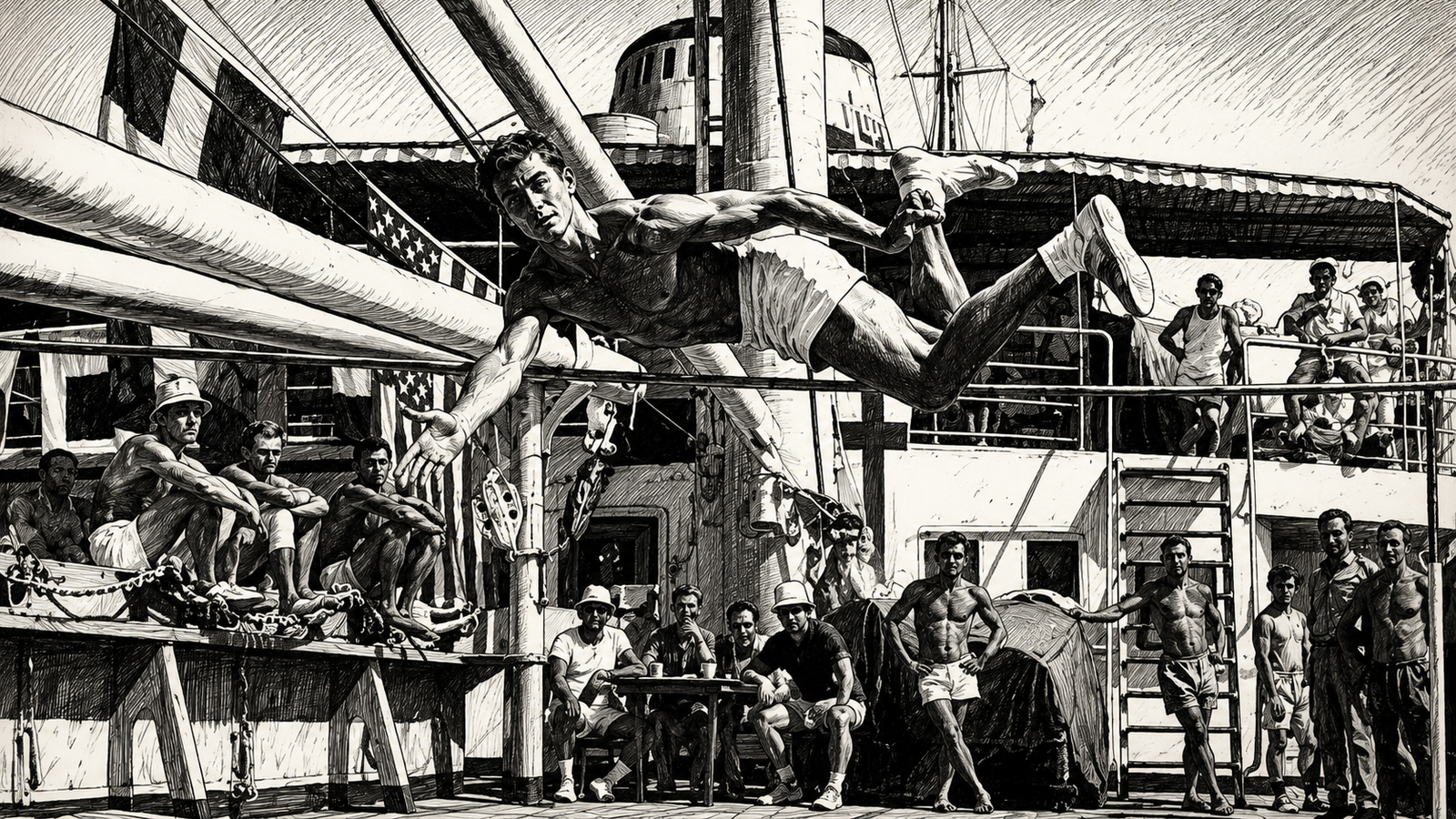
At that moment, the sailors were doing far more than filling empty hours. They were reclaiming their right to exist as complete human beings rather than mere hostages of waiting. In one sense, the games represented a symbolic recovery of freedom within a confined space and a declaration that war should not deprive people of their ability to celebrate, organize, and play.
This awareness of identity extended beyond recreation and into communication. The sailors even created their own postage stamps by hand, engraving them on simple materials and attaching them to letters sent home alongside official Egyptian stamps to ensure delivery.
Over time, these stamps became one of the most famous symbols of the Yellow Fleet, a name derived from the desert sands that gradually coated the ships with a yellow hue as winds swept across the lake month after month, year after year.
Despite all this, life on the Great Bitter Lake was neither romantic nor entirely safe. The ships remained trapped within an active conflict zone, and the sounds of war continued to echo from both shores, particularly during the War of Attrition and later the October War of 1973. Aircraft regularly flew overhead, artillery fire could be seen, and explosions occurred within visible distance. At one point, Israel attacked the American vessel SS Observer, which was anchored in Lake Timsah, though fortunately no casualties were reported.
The sailors’ testimonies vividly captured this stark contrast between the life they struggled to build upon the water and the violence that surrounded them on all sides.
The sailors’ testimonies vividly captured this stark contrast between the life they struggled to build upon the water and the violence that surrounded them on all sides.
From a technical perspective, maintaining the ships proved almost as challenging as maintaining morale. Years of exposure to highly saline water, desert winds, and extreme heat were more than enough to reduce any vessel to a corroded shell if left unattended. For this reason, small crews remained aboard several ships, tasked with periodically running the engines, maintaining rudders and propellers, monitoring electrical systems, and preserving a minimum level of operational readiness in case an unexpected breakthrough occurred.
As the years dragged on, the shipping companies began reorganizing their presence on the lake to reduce costs. Crews were downsized, some vessels were grouped together under shared maintenance arrangements, and practical cooperation among sailors of different nationalities intensified.
When the political and military changes that followed the October War finally opened the possibility of reopening the canal, time had already left its harsh mark on everything. Clearing mines, removing sunken vessels, and restoring the navigation channel took two full years. The condition of the trapped ships also varied greatly: many were no longer capable of sailing under their own power, and most ultimately had to be towed away by tugboats.
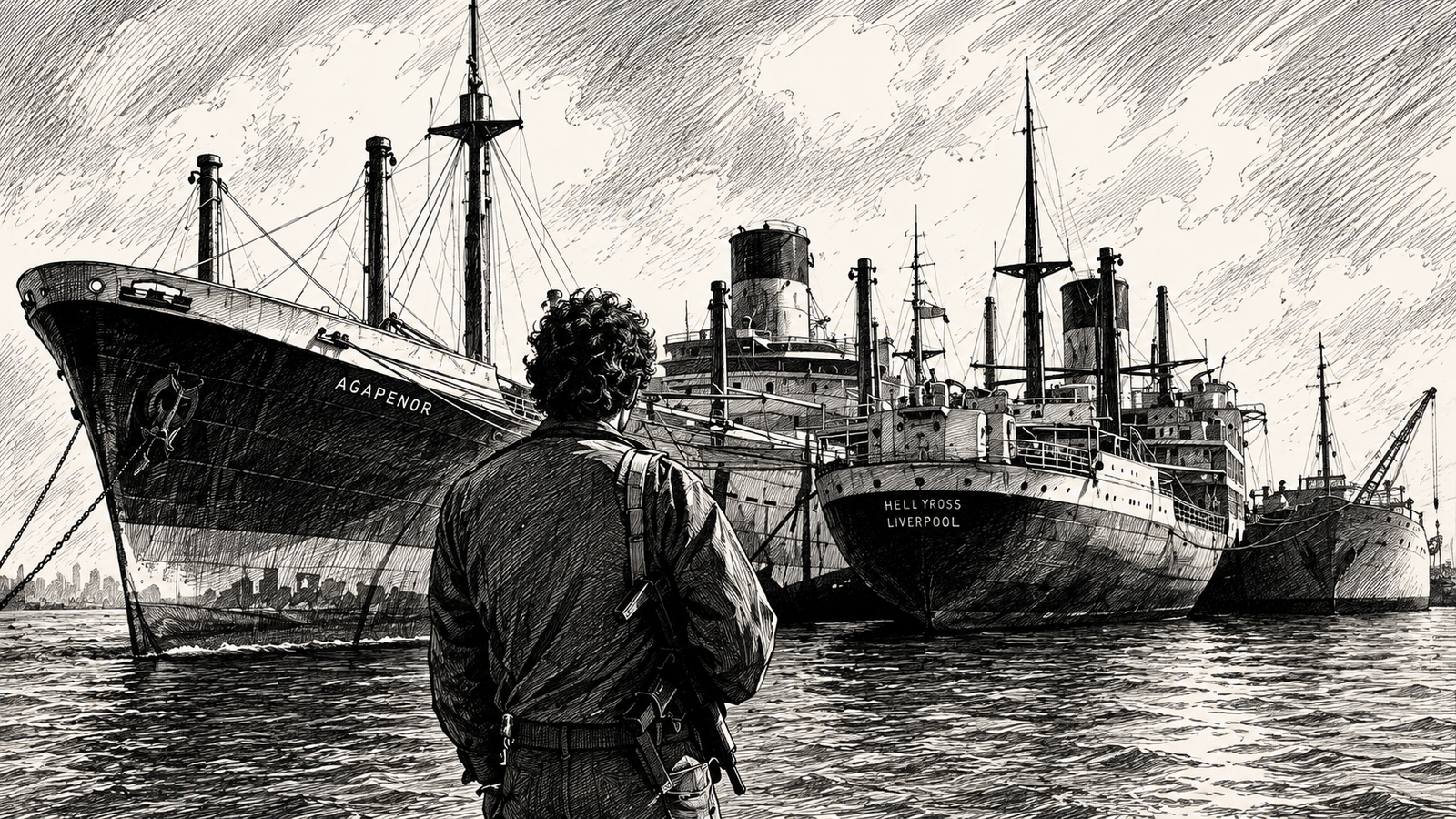
The only irony was that the two German ships, Münsterland and Nordwind, managed to restart their engines and sail away under their own power. It seemed almost like a belated reward for years of patient maintenance and disciplined daily care.
When the Münsterland finally arrived in Hamburg in 1975, the scene resembled the homecoming of a legend. The vessel had completed one of the longest cargo voyages in maritime history—a journey that lasted eight years, three months, and five days.
For all these reasons, the story of the Yellow Fleet remains one of the most extraordinary chapters in the history of the Suez Canal. It would not be rivaled in public memory until more than forty-five years later, when the Ever Given, owned by the Japanese company Shoei Kisen Kaisha, ran aground in the canal in 2021, disrupting global shipping for six consecutive days. According to Grace Kay, writing for Business Insider in an article titled “The Giant Ship Stuck in the Suez Canal Is Costing the Global Economy an Estimated $400 Million an Hour,” the incident cost the world economy billions of dollars.