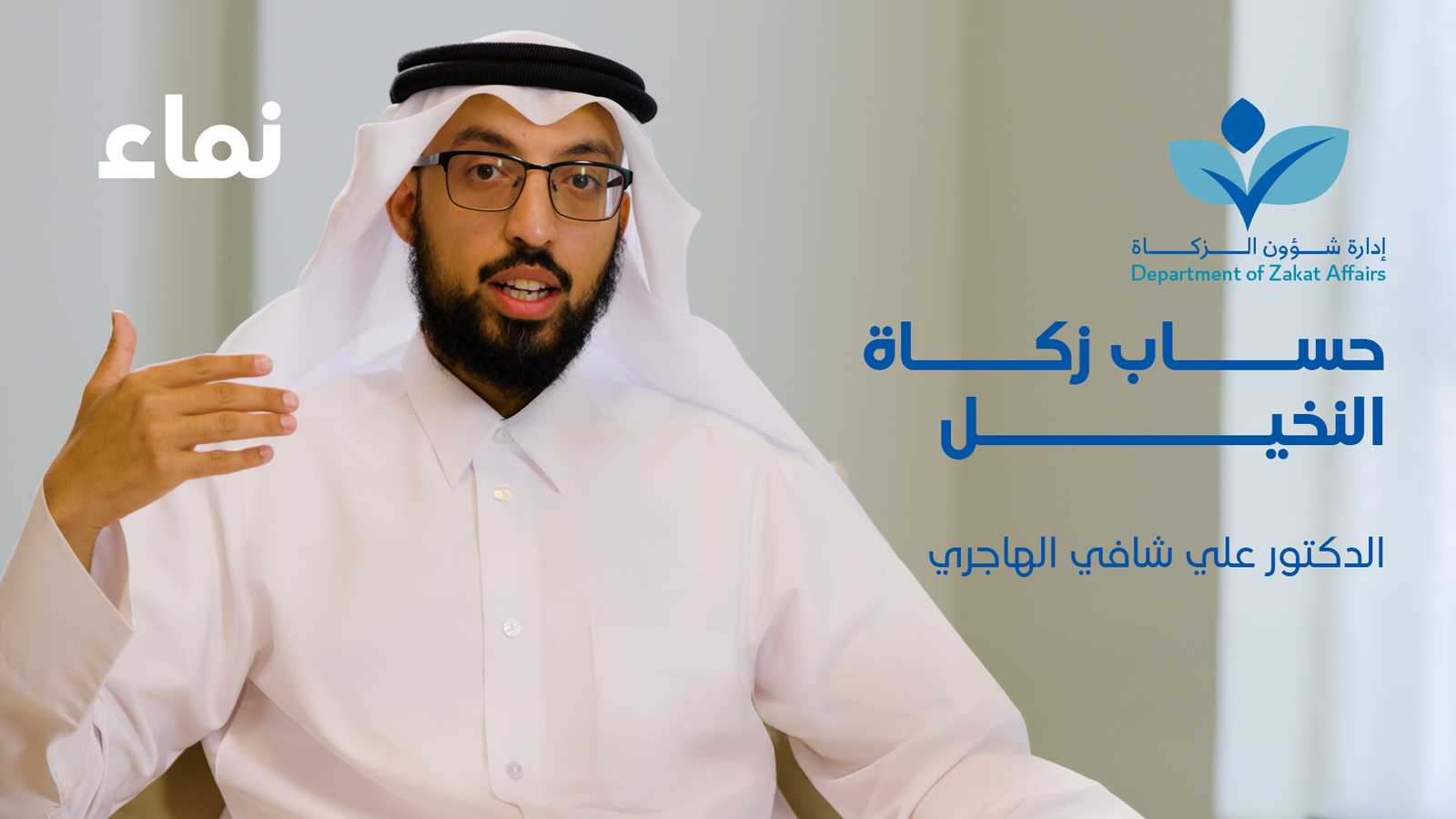
Dr. Ali Shafi Al-Hajri, Assistant Director of the Zakat Affairs Department for Public Services, spoke at length during an episode of the Nama’a Podcast, hosted by Ahmed Al-Janahi, about Qatar’s experience in calculating zakat on date palms. He presented it as a living example of Islamic jurisprudence’s ability to engage with reality, keep pace with its transformations, and move Sharia rulings from theoretical texts and traditional applications into a practical, accessible service capable of reaching the public through contemporary language and tools.
As the discussion demonstrated, zakat on date palms is not merely an abstract jurisprudential issue confined to whether it is obligatory. Rather, it lies at the intersection of Sharia, society, institutional expertise, and modern technology. A farm or household owner needs not only to know that zakat is due on the fruit of their palms, but also how much must be paid, when it becomes due, how it should be given, whether it should be paid in dates or in cash, and how the crop may be assessed at a time when the traditional kharis—the experienced crop assessor—is no longer as readily available as in earlier times.
Al-Hajri begins with a general classification of zakatable wealth, explaining that the assets on which zakat is due may be grouped into four principal categories: gold and silver, together with paper currency measured by analogy to them; trade goods; crops and fruits; and grazing livestock. The subject of the episode therefore falls within the third category, namely crops and fruits, a broad field requiring a jurisprudential criterion to determine what is included and what is excluded.
Al-Hajri explains that the applicable criterion is, in his words, “everything that is measured by volume and can be stored.” When this criterion is applied to Qatar’s agricultural reality, the date palm emerges as the clearest and most practical example, and the one most closely connected to people’s lives. Other crops that might fall within this category are not cultivated as widely in the country and do not possess the same broad social and economic significance as the date palm.
This highlights the special place of date palms in the Qatari context. The date palm is not merely a fruit-bearing tree that provides people with fresh dates and dried dates; it represents an enduring memory rooted in the land, a component of local environmental identity, and a feature of the inherited relationship between people and the soil. Al-Hajri notes that many people in Qatar, when building their homes, think first of planting date palms—not necessarily as a commercial venture, but because the tree is part of local custom, sentiment, and environment.
Interest in date palms has not been limited to individuals. The State, represented by the Ministry of Municipality, has given the tree considerable attention through agricultural care, support for cultivation, and the organization of festivals associated with fresh dates and dried dates. Zakat on date palms therefore cannot be regarded as a marginal or minor matter; it is connected to an agricultural, heritage, and social sector that remains present in Qatari society and touches a part of people’s everyday lives and collective memory.
Al-Hajri points out that interest in zakat on date palms increased significantly as public awareness of the value of the tree grew, particularly during years that witnessed greater official and social interest in palm cultivation and reliance on local produce. With this increasing awareness, the Zakat Affairs Department began receiving a growing number of inquiries from members of the public asking how much zakat was due on specific numbers of date palms. Such questions had not previously been common, but became increasingly frequent as awareness expanded and people became more connected to their farms, palms, and harvests. The Department therefore found itself facing a clear practical need: the public did not want a complicated theoretical answer, but an easy method, a clear figure, and a reliable mechanism through which they could be confident that they had discharged their religious obligation.
At first, as Al-Hajri explains, the Department dealt with these cases in a traditional manner resembling the old approach. Some researchers visited farms, asked owners about the number of palms and their output, and then attempted to apply the rulings of jurists to each case. However, this method was neither sufficient nor capable of being applied broadly. Some farm owners cooperated and possessed the necessary information, while other farms had only workers who did not know the precise details of production. Moreover, reliance on individual questioning and personal estimates could not create a comprehensive institutional service or establish a unified standard from which everyone could benefit.
This created the need for a more disciplined study that would not treat every case as an isolated matter, but would instead establish a general standard capable of reflecting Qatar’s circumstances and serving society as a whole. This shift from individual thinking to community-level planning is one of the central features of Qatar’s experience with date palm zakat. Al-Hajri emphasizes that the Zakat Affairs Department does not view the matter as a service for one individual or one farm, but as a public responsibility. As he stated: “We think at the community level, not at the individual level, in order to serve the various segments of society.” Although zakat is an individual act of worship in terms of personal obligation, facilitating it, organizing its payment, and educating the public about it require collective and institutional effort.
This led to the idea of cooperating with a specialized body possessing agricultural expertise and practical data: the Ministry of Municipality. The central question presented by the Zakat Affairs Department was clear and specific: How many varieties of date palms are found in Qatar, and how many kilograms of dates does a single palm of each variety produce? The aim was not merely to determine the output of fresh dates, but specifically the output of dried dates, because zakat ultimately concerns the yield of the fruit after assessment. The Ministry of Municipality welcomed the cooperation and supplied a detailed study and data concerning date palm varieties and their production. This demonstrated the value of integration between the Sharia institution and the technical institution: the Zakat Affairs Department possesses the jurisprudential foundation, while the Ministry of Municipality possesses agricultural expertise and field data.
To explain the importance of this development, Al-Hajri returns to the traditional method of calculating zakat on date palms. In the past, there was a person known as the kharis, an individual with extensive experience in date palms. He would enter the farm when the fruit began to ripen, examine the palms with an expert eye, and estimate the size of the crop. The kharis did not rely on electronic tools or mathematical tables, but on accumulated experience acquired through long-term exposure and practice passed down from one generation to the next. Through observation and estimation, he could determine whether the crop had reached the nisab threshold.
The nisab for zakat on crops and fruits is five awsuq, based on the report of Abu Sa‘id Al-Khudri that the Messenger of Allah ﷺ said: “…There is no zakat on anything less than five awsuq.” According to the contemporary measurements adopted by the Department, this is equivalent to approximately 653 kilograms of dates. However, khars was not merely an estimate of the entire crop; it also embodied Sharia consideration and practical mercy toward farm owners. The kharis would deduct one-third or one-quarter of the crop, based on the report of Sahl ibn Abi Hathmah: “The Messenger of Allah ﷺ instructed us: When you estimate the crop, assess it, but leave one-third; and if you do not leave one-third, then leave one-quarter.”
The wisdom behind this is that the owner may give some dates as gifts, donate some in charity, or allow people to eat from the crop. In addition, some palms may produce abundantly, while others may yield less or fall below expectations. The calculation therefore did not apply to the whole crop without regard to its circumstances. Rather, it incorporated a degree of leniency and realism, reflecting the mercy of Islamic legislation and its capacity to accommodate people’s lives and everyday circumstances.
The contemporary challenge, however, is that experienced kharis assessors have become extremely rare in Qatar. Khars is not a skill acquired through a short course or a simple certificate; it requires many years of direct experience and detailed knowledge of the land, palms, climate, and production. The Department considered bringing in kharis assessors from other countries, but this option was not without difficulty. An assessor coming from a different agricultural environment might not produce an accurate estimate in Qatar, because the land, conditions, climate, and production characteristics differ from one country to another.
The most appropriate solution was therefore to make use of local institutional expertise, represented by the Ministry of Municipality, its engineers, and its studies. Al-Hajri summarized this development by saying: “We adopted the essence of khars and made estimates based on the study of specialists.” In this way, the underlying spirit of khars was not abandoned; rather, it was reformulated in a contemporary institutional form based on data and technical expertise instead of reliance on a single individual.
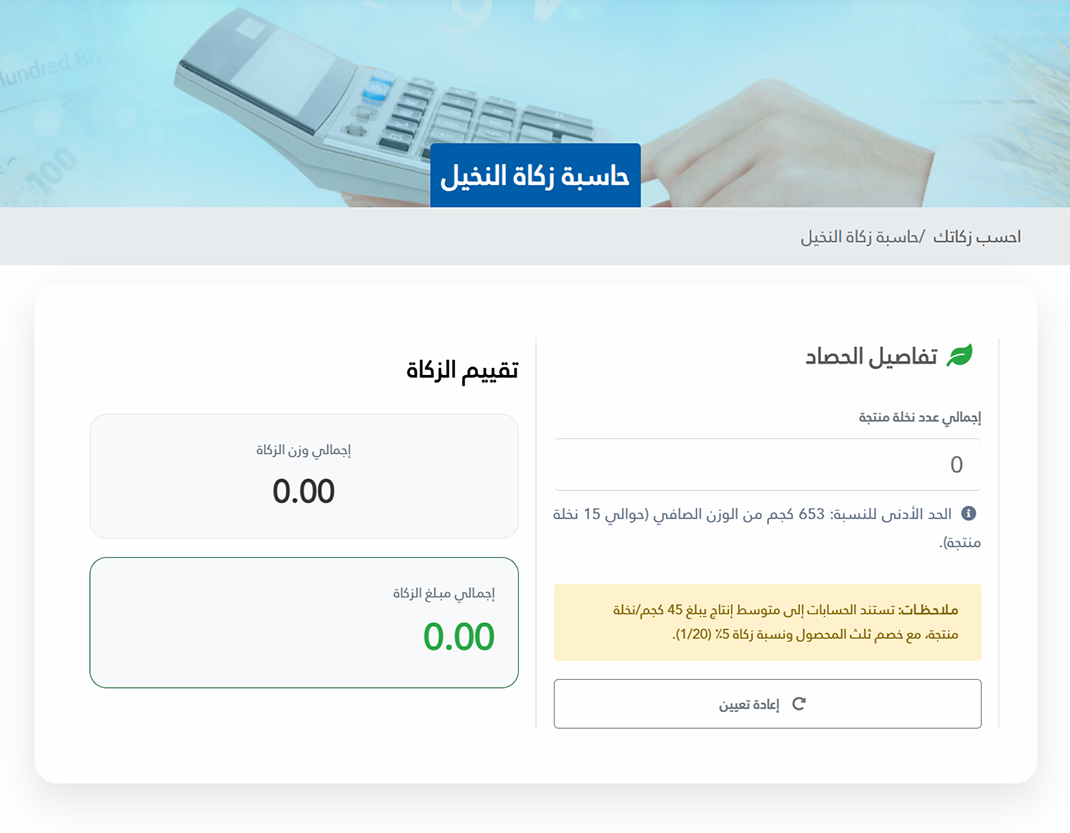
This gave rise to the idea of an electronic date palm zakat calculator. As Al-Hajri explains: “For us at the Zakat Affairs Department, all our transactions are conducted electronically and in monetary form.” The calculator was therefore not developed as an isolated digital tool, but as the outcome of a study combining Islamic jurisprudence, agricultural realities, and the needs of the public. It was based on a set of clear criteria: the nisab according to modern measurements, the average yield of a single palm, the deduction of one-third of the total in accordance with the hadith on khars, and the calculation of zakat at a rate of 5%, since date palms in Qatar are generally irrigated using equipment, machinery, and other incurred costs, making the amount due one-half of one-tenth. The calculator also allows the monetary value to be determined for those who wish to pay zakat in cash.
The study provided to the Department by the Ministry of Municipality showed that Qatar has several varieties of date palms. However, the Department focused on the commonly cultivated varieties rather than the rare ones. The Ministry identified three widely grown varieties: Khalas, Shishi, and Khenaizi. Khalas was found to be the most common. In accordance with the jurisprudential principle that rulings are based on what is prevalent rather than what is rare, the Department adopted the most widespread variety when constructing the calculation formula.
The study found that a Khalas palm produces between 30 and 60 kilograms of dates, depending on the level of productivity and the care provided by the farm owner. To achieve a balanced and fair estimate, the Department adopted the average yield of 45 kilograms per palm. This average became the central component of the electronic formula.
Al-Hajri provides a practical example demonstrating the simplicity of the calculator. If a person owns 100 fruit-bearing palms, the calculator multiplies 100 by 45 kilograms, producing a total estimated yield of 4,500 kilograms. After deducting one-third, 3,000 kilograms remain. Zakat is then calculated at 5%, resulting in 150 kilograms of dates. Since the calculator adopts a price of 10 Qatari riyals per kilogram, the monetary value of the zakat is 1,500 Qatari riyals. In this way, the matter becomes clear and straightforward, transforming a question that once caused uncertainty into a simple calculation.
Regarding the adopted price of 10 Qatari riyals per kilogram, Al-Hajri explains that this does not refer to the retail price in markets or consumer cooperatives, where a kilogram may be sold for 20 or 25 riyals. Rather, it refers to the price at which the farm owner sells directly to the public, or the price estimated through festivals and relevant specialized bodies. Here too, the Department benefited from the Ministry of Municipality’s data and its practical experience in fresh-date and date festivals, where appropriate selling prices for farm owners are well understood.
Al-Hajri also addresses an important jurisprudential question: may zakat on crops and fruits be paid in cash instead of being given from the produce itself? He explains that the general rule among jurists is that zakat should be paid from the same category of wealth on which it is due: crops and fruits from their own produce, livestock from livestock, and so on. However, because the Zakat Affairs Department in Qatar operates through electronic and monetary systems, it does not receive dates in kind, as doing so would require storage facilities and logistical arrangements that are not currently available.
The Department therefore adopted a recognized juristic opinion permitting payment of the monetary value where there is a need or a prevailing public interest. Nevertheless, it does not prevent a date palm owner from personally distributing zakat in the form of dates to the poor. The owner is given a choice: either distribute the required number of kilograms of dates with the intention of zakat, or pay the equivalent cash amount through the Zakat Affairs Department. This reflects the philosophy of the service provided by the Department. The calculator does not restrict the payer’s choice; rather, it informs them of what is due. Those who wish to give dates will know the required quantity, while those who wish to pay in cash will know the amount payable. In both cases, what matters is that the zakat is paid with the correct intention and reaches its rightful recipients.
Another important point raised in the episode is that zakat obligations do not lapse with the passage of time. Al-Hajri mentions the case of a man who owned approximately 150 palms, of which 100 were productive. When the current season’s zakat was calculated through the calculator, the amount came to 1,500 Qatari riyals. The man then asked about the previous twenty years. Al-Hajri explained that zakat does not become time-barred and that he should estimate the past years to the best of his ability in order to discharge his obligation. This is particularly important for farm and household owners who were unaware that zakat was due on their palms, or who believed the ruling did not apply to them because they were not engaged in a large commercial activity.
At the conclusion of the discussion, Al-Hajri addressed a special message to farm owners and to residents of houses and villas with date palms. He urged them to give this matter proper attention and to know when zakat becomes due during the fresh-date season, as the fruit begins to ripen. When the owner sees the harvest and rejoices in what Allah has provided, they should remember that Allah has a right in that produce. The required steps are simple: determine the number of fruit-bearing palms, use the calculator, seek guidance when necessary, and pay the zakat in a manner that fully discharges the obligation.
Al-Hajri also highlighted an important practical figure for homeowners: zakat calculations should begin when the number of fruit-bearing palms reaches 15 or more. Based on the adopted average yield of 45 kilograms per palm, 15 palms approach or exceed the applicable nisab. Anyone who owns 15 or more productive palms should therefore pay attention to this obligation and should not assume that zakat applies only to large farms. Some homes may contain 20 or 30 palms, and their produce may reach the nisab, making zakat obligatory.
Qatar’s experience with the electronic date palm zakat calculator offers an important model of contemporary institutional ijtihad. The process began with questions from the public, followed by the difficulty of applying the traditional method, the scarcity of experienced kharis assessors, the need for accurate agricultural data, cooperation with the Ministry of Municipality, and finally the development of a simple electronic formula. This entire process demonstrates that Islamic jurisprudence is not detached from reality and that contemporary issues require Sharia researchers who understand the texts, comprehend real-world conditions, and cooperate with specialists.
The experience of date palm zakat may also inspire further studies in other contemporary areas of Islamic jurisprudence, whether concerning crops or other matters. However, analogy should not be applied arbitrarily. Each case must be studied according to its own nature and characteristics, since every reality raises its own questions and every environment has its own data. Sound ijtihad is that which connects the text with reality, the ruling with public interest, and Sharia knowledge with technical expertise.
The central message of the discussion is that zakat is a trust and that ensuring its delivery is a responsibility. Date palms, with their deep presence in Qatar’s environment, are not outside this responsibility. The fruit in which the owner takes pride, and the dates they give, distribute, or sell, contain a right that must be observed once the nisab is reached. Al-Hajri therefore advises farm and household owners in Qatar: “I urge them not to forget Allah’s right in this zakatable wealth, namely date palms.”
This reminder carries a meaning that extends beyond calculations and figures. Paying zakat does not diminish wealth; rather, it opens the door to blessing, clears one’s religious liability, and connects the joy of the harvest with gratitude and righteous action. The date palm zakat calculator is therefore more than an electronic service. It is a tool for awareness and facilitation, bringing together Sharia rulings and agricultural realities, the heritage of Islamic jurisprudence and modern technology, and Allah’s right with the needs of the present age.