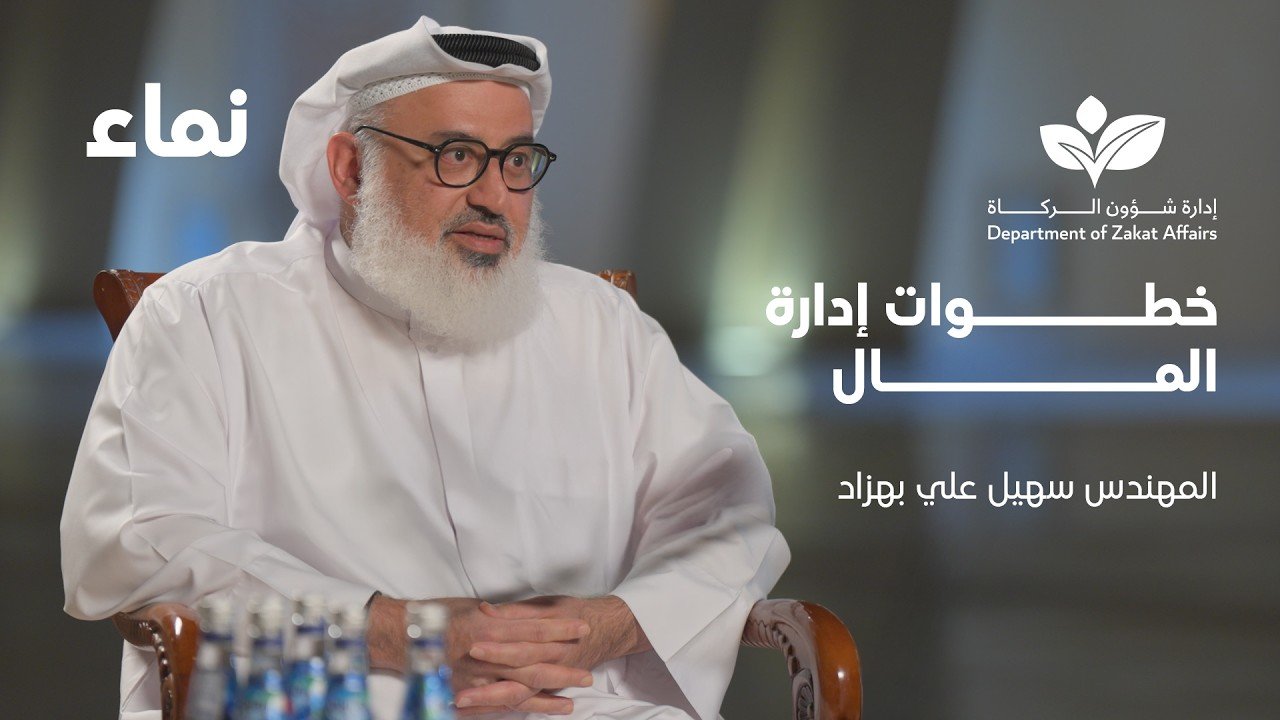
In an episode of the Nama Podcast, Ahmed Al-Janahi hosted engineer Suhail Ali Behzad in a discussion on the practical management of money. Drawing on his personal experience, he offered advice on the fundamentals of handling money and business, and explained how concepts such as saving, investing, avoiding debt, and paying zakat can become part of a comprehensive lifestyle that preserves and grows wealth.
The problem begins when a person enters the world of business without a financial foundation, without knowledge, and without a habit of saving, then relies on debt or bank facilities to establish a venture that may not survive its first challenge. Behzad summarized this idea by saying that business comes at a later stage; the real beginning starts from zero: saving first, investing second, and business later.
Ali Behzad comes from a background quite different from the stereotypical image of a traditional merchant. He grew up in a household where his father strongly believed in scientific education and therefore directed him and his brothers toward scientific studies. He became an engineer, and none of them had been involved in the family business before their father's death in 1999. Suddenly, they found themselves responsible for established companies and financial, administrative, and commercial obligations for which they had never been trained.
At this point, the episode takes on a deeply human and practical dimension. Behzad does not speak as a financial theorist, but as someone who entered business out of necessity and learned through experience, mistakes, and direct engagement with employees, tenders, and banking facilities. He recalls that one of the first realities he faced was dependence on a British bank and interest-based financing, something that deeply troubled him because of his religious convictions. Consequently, his first goal was not to expand or develop the business, but to free it from reliance on that interest-based bank.
The guest illustrated this with an example explaining how banking facilities operate in commerce. A trader may win a tender worth one million riyals and require a bank guarantee, followed by financing to purchase goods or spare parts. He may then wait months before the client settles the payment. Throughout these stages, the money involved effectively belongs to the bank rather than the trader, and interest charges begin to accumulate, reaching, according to his example, as much as 13–14%.
The question remains: How can a young person enter financial life correctly? Here, Behzad presents a gradual approach that begins with a simple yet decisive habit: setting aside 10% of one’s salary from the very first month of employment and placing it in a separate account that is not used for daily expenses. The idea is not merely the size of the amount, but the establishment of the habit itself. In his view, saving is not what remains after spending; it is an initial decision made before consumption.
Behzad goes further by explaining that this percentage should be dynamic rather than fixed. If income increases, the amount saved should also increase. A person should not start by saving one thousand riyals and continue saving the same amount after receiving a higher salary. Instead, the same percentage should be maintained so that the savings base grows over time.
The guest does not present saving as deprivation, but as training for freedom. Someone who cannot set aside 10% of their income today may find themselves unable to make larger financial decisions tomorrow. To illustrate this, he uses a simple example familiar to many young people: the cost of a daily coffee may equal or exceed the required savings percentage. The issue, therefore, is not always low income, but rather spending habits and priorities.
After the saving stage comes the investment stage. Here, Behzad rejects rushing directly into business. Not everyone who accumulates capital should immediately enter the market, and not every opportunity that appears profitable is worth pursuing. He explains that once a person has built a suitable reserve, they can begin with stocks that offer reasonable returns and gradually move toward larger investment instruments through trustworthy institutions, while emphasizing his personal preference for investments that comply with Islamic principles.
Perhaps one of the most distinctive aspects of the episode is its clear distinction between an investment opportunity and a financial disaster. Behzad offers a practical rule for evaluating investment offers: if a deal promises extraordinarily high and unrealistic returns—such as 500%—it is not an opportunity but a trap. With this simple principle, he provides a basic standard for healthy skepticism, noting that exaggerated profits often conceal hidden risks.
At the same time, the guest does not sell a romanticized vision of business. He states clearly that business involves both profit and loss, and that anyone who claims to have profited throughout their entire life is, in his words, not telling the truth. The problem is not making mistakes but failing to learn from them. A trader may lose money, encounter setbacks, or make poor judgments, but the real danger lies in repeating the same mistake over and over without reflection.
The discussion then shifts from money and commerce to zakat, a central theme of the Nama Podcast’s message. Behzad explains that commercial zakat differs from individual zakat. An individual may calculate their wealth at the end of the lunar year and pay zakat accordingly, whereas companies face more complex calculations involving balance sheets, assets, liabilities, receivables, and the nature of the financial year. He therefore praised the role of the Zakat Fund in offering training courses for accountants and business professionals to help them calculate corporate zakat correctly.
As the guest explains, zakat is not money that disappears from the market into a void; it is a force that stimulates the market itself. When zakat reaches the poor or those in need, they spend it on essential needs such as food, clothing, goods, and services. In doing so, the money returns to the economic cycle, benefiting the state, society, and even the merchant.
Within this framework, zakat becomes more than a religious obligation. It is a social and economic mechanism that prevents wealth from stagnating, redistributes resources, and protects society from widening gaps between those who have and those who need.
As for charity, Behzad encourages people to think beyond temporary assistance and focus on sustainable impact. While he does not diminish the importance of feeding the poor or helping those in need, particularly during emergencies and disasters, he advocates supporting projects that improve people’s incomes and enable them to work. Examples include providing a taxi, a small fishing boat, a shop, or any developmental project that helps a person escape the cycle of recurring need.
In this way, the guest offers a practical roadmap for young people: begin with saving, develop into investing, avoid becoming trapped by debt, fulfill zakat obligations, and think seriously about charitable initiatives that create lasting impact.
These recommendations may appear simple on the surface, but at their core they represent a comprehensive philosophy of money. Wealth is not meant solely for spending, nor solely for saving, nor certainly for reckless speculation. Rather, it is a trust that requires knowledge, discipline, good habits, and the fulfillment of both religious and social obligations.