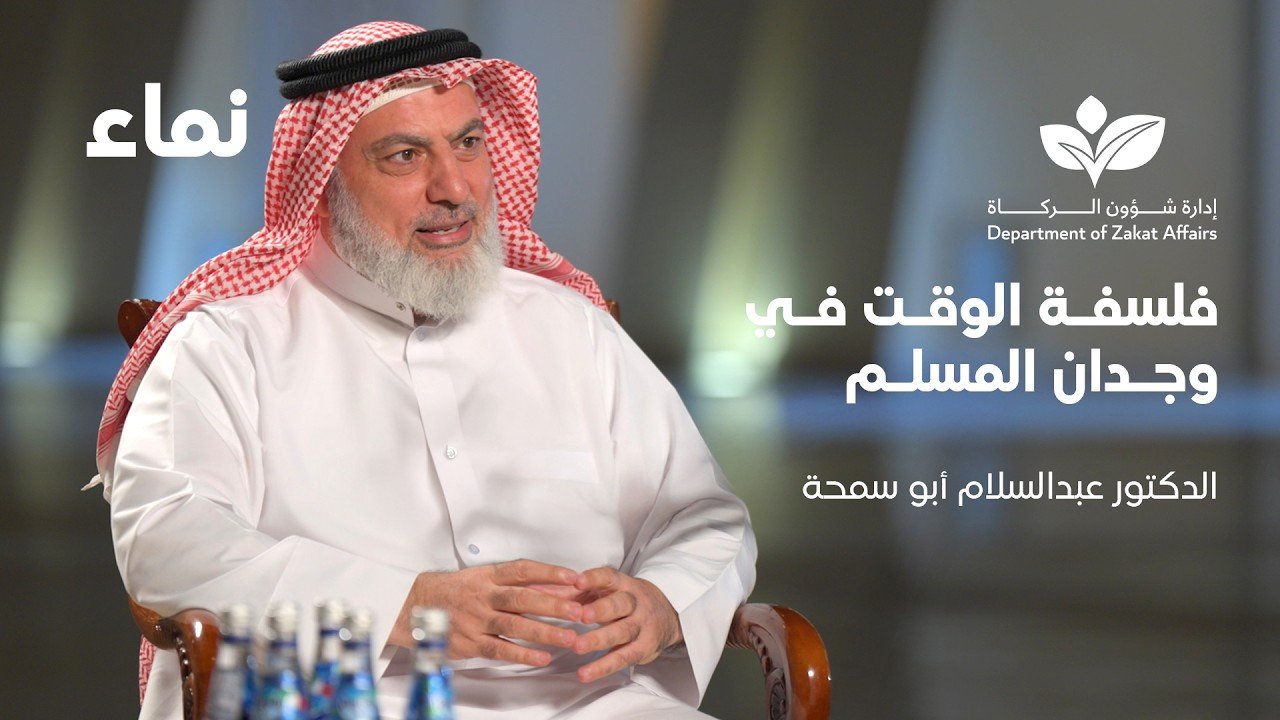
In the Nama Podcast, Ahmed Al-Janahi hosted Dr. Abdul Salam Abu Samhah, Associate Professor of Prophetic Hadith at Qatar University, for a discussion on the concept of worship and its timing in general, and zakat and its annual cycle (hawl) in particular.
When the Holy Qur’an swears by time—by the afternoon (Al-Asr), the dawn (Al-Fajr), the morning light (Ad-Duha), the night, and the day—the matter goes beyond eloquence and literary expression to the construction of an entire awareness of the value of time in human life. In the Islamic worldview, time is not an empty space that people fill however they wish, nor is it a marginal area beyond the sphere of responsibility. Rather, it is the vessel of life, the field of testing, the record of deeds, and the scale upon which a person’s seriousness in their relationship with God, themselves, and their society becomes apparent.
Dr. Abu Samhah believes that revelation addresses a nation that needed to rebuild its relationship with time. Before Islam, the Arabs were not an organized civilization of institutions in the broader sense, and time did not represent a major administrative or productive value in their lives. Islam came to transform them from a condition of spontaneous, unstructured living into a nation with a mission—one that understands the value of time.
For this reason, the Qur’anic oaths by time in numerous verses and chapters serve as a civilizational warning before they are merely rhetorical devices. They place human beings before the reality that time is not neutral. Every passing moment is either for them or against them. Every day that passes either brings them closer to the purpose of their existence or adds to their loss.
At the heart of this reminder are the prescribed acts of worship, all of which are tied to specific times. Prayer, the pillar of religion, was not left to personal preference but linked to designated times. This connection serves as daily training in discipline and order. A Muslim who knows they must rise for Fajr, pause at midday for Dhuhr, reflect upon themselves at Asr, and conclude the day with Maghrib and Isha learns that life is not without structure and that each day should be organized around stations of spiritual renewal.
Here, worship does not isolate a person from life; rather, it reconnects them to it in a more organized and meaningful way. Prayer is not a series of movements without effect. Fasting is not merely physical abstinence from food, drink, and desires. Zakat is not simply a financial expenditure devoid of meaning. Every act of worship in Islam carries both spiritual and behavioral effects. Prayer prevents indecency and wrongdoing, fasting nurtures piety and self-control, and zakat purifies both wealth and the soul. Therefore, linking worship to time is, at its essence, linking human behavior to order and discipline.
Dr. Abu Samhah emphasizes that time is itself part of the act of worship in prayer. A Muslim may perform voluntary prayers whenever they wish, but the obligatory prayers have fixed times. Yet this timing is neither harsh nor burdensome. Islamic law does not bind people to exact minutes and seconds; instead, each prayer is assigned a broad time window that accommodates people’s circumstances. Every obligatory prayer has a beginning and an end. This flexibility reveals a delicate balance within Islamic legislation: discipline without hardship, organization without suffocation, and responsibility without undue burden.
One of the most notable observations made by the guest is the distinction between the solar and lunar systems in acts of worship. Prayer is a daily act of worship and is therefore connected to the sun, because the sun is best suited to regulating the rhythm of the day. This makes prayer harmonize with the cycle of night and day. Human beings live their days according to the sun, work according to the sun, and sleep and awaken according to the rhythm of light and darkness. Consequently, prayer is linked to this daily cosmic order.
Seasonal acts of worship, such as the fasting of Ramadan and Hajj, are linked to the lunar system in their beginnings and endings. As a result, they move through all seasons of the year—summer, winter, spring, and autumn. The beginning and end of Ramadan are determined by the sighting of the crescent moon, that is, by lunar months, and the same applies to Hajj.
However, the details of performing these lunar-based acts of worship return to the solar system. In Ramadan, breaking the fast occurs at sunset, while abstaining from food begins at dawn. Many details of Hajj rituals are connected to midday, sunset, night, and day. Thus, Muslims live within two cosmic systems, not confined to one of them, but interacting with the entire universe as the visible Book of God, as Dr. Abu Samhah describes it.
Dr. Abu Samhah also paused to reflect on a common expression used by some people: “I want to kill time.” This phrase reveals a profound flaw in awareness. Time is not an enemy to be killed; it is a blessing for which people will be held accountable. Leisure is not something to be eliminated but an opportunity for learning, righteousness, and productive work. The hours a person spends aimlessly scrolling on a phone or engaging in empty entertainment are not merely wasted time—they are portions of life that will never return.
The time spent with one’s parents will never return. The years of study will never return. The early years of work will never return. The years of youth will never return. Therefore, investing time is a human and civilizational necessity. A nation that wastes the time of its youth wastes its energy and future. Individuals who do not learn to manage their time early in life often struggle to create meaningful impact in their lives and communities.
This integration of solar and lunar timekeeping in worship carries both civilizational and intellectual significance. The need to determine prayer times, observe crescent moons, identify the qiblah, and calculate months stimulated scientific thinking among Muslims and encouraged the early development of astronomy, mathematics, and geography.
Worship was not an opponent of science; it was a catalyst for it. Muslims need to understand the movement of the sun in order to pray, follow the moon in order to fast and perform Hajj, and use precise calculations in order to pay zakat. In this way, religion became an organizing force for the intellect rather than a purely emotional relationship detached from reality.
Within this context comes zakat as a timed financial act of worship. Yet it differs in nature from prayer, fasting, and Hajj. Prayer is obligatory daily for every accountable Muslim. Fasting is obligatory during a specific month for all capable Muslims. Hajj is obligatory at a designated time for those who are physically and financially able.
Zakat, however, according to Dr. Abu Samhah, is linked to wealth, the nisab threshold, and the passing of a lunar year (hawl). It is not obligatory upon all Muslims at the same moment. Rather, each individual has their own zakat year based on the date they first acquire wealth equal to the nisab. Once a person’s wealth reaches the nisab, the zakat year begins, and when a full lunar year has passed, zakat becomes due.
Here, the genius of the hawl appears in building financial awareness. The concept of a year passing over one’s wealth is not merely a technical detail. It is a method of teaching annual accountability long before the emergence of modern budgeting systems. When wealth reaches the nisab, a person begins monitoring it: what came in, what went out, what remained, what grew, and what declined. At the end of the zakat year, they are required to review their financial position. In essence, this process predates the concept of the annual budget used by institutions, corporations, and governments.
For this reason, Dr. Abu Samhah believes that the concept of the hawl preceded many modern accounting philosophies. Every respectable institution today prepares a budget, reviews its revenues and expenditures, and calculates its profits and losses. Yet zakat taught Muslims centuries ago to do the same in their personal lives. The objective is not to become miserly or obsessed with numbers, but to be conscious of income and expenditure, capable of managing wealth responsibly, and aware that a portion of one’s wealth belongs to others once it reaches the nisab and a lunar year has passed.
One of the important meanings of zakat is that it does not regard wealth as an absolute individual possession free of obligations. In Islam, wealth is a trust, and the poor have a known right within it. Dr. Abu Samhah therefore distinguishes between a debt borrowed from people and the obligation resulting from unpaid zakat. Ordinary debts are witnessed by people, but the rights of the poor are witnessed by God. This is a profoundly significant statement because it moves zakat from the category of optional charity into the category of obligatory rights. A zakat recipient is not a beggar waiting for the generosity of the wealthy, but a rightful claimant to wealth that has reached the nisab and completed its hawl.
For this reason, the guest emphasizes the seriousness of negligence in calculating zakat. Some people may believe that the matter is broad enough to permit carelessness, or that delaying zakat requires little attention. The reality, however, is that once zakat becomes due, it becomes a debt upon the individual. If someone wishes to delay payment until Ramadan, for example, seeking the virtue of the season or for a reason they consider beneficial, they must understand that the amount is no longer entirely theirs. It has become a right owed to zakat beneficiaries. Therefore, it is wise to inform family members or record it in one’s will if there is concern that death may occur before payment, because the matter concerns the rights of other human beings.
Dr. Abu Samhah also highlighted an important issue concerning lunar and Gregorian calculations. The fundamental principle is that zakat is calculated according to the lunar year, because the Hijri year is approximately eleven days shorter than the Gregorian year. While the difference may seem small over a single year, it accumulates over time, particularly in companies and institutions with substantial assets. If a company relies solely on the Gregorian calendar without accounting for the difference, significant zakat liabilities may accumulate over the long term. For this reason, Dr. Abu Samhah noted that fatwa authorities and zakat specialists have developed formulas for dealing with companies whose financial statements are based on the Gregorian calendar, ensuring that the rights of zakat beneficiaries are not diminished due to differences between calendars.
Regarding monthly salaries, Dr. Abu Samhah explained that the hawl does not require a person to calculate a separate zakat year for every small amount of money received, which would create confusion and make life unnecessarily difficult. Once wealth reaches the nisab, the zakat year begins. Savings and surpluses added afterward are incorporated into the same cycle without requiring separate calculations for each additional amount above the nisab. At the end of the zakat year, a person calculates their total wealth and pays zakat accordingly.
The episode also addressed the issue of changing the form of wealth. For example, a person may possess gold or cash and then use it to purchase real estate. In such cases, intention becomes decisive. If the property is purchased for personal residence or family needs, no zakat is due on it. However, if it is purchased for trade, resale, and profit, it becomes part of trade inventory, is evaluated at the end of the zakat year, and zakat is paid on its value. If the property is acquired for rental purposes, the predominant scholarly opinion is that zakat applies to the accumulated rental income that remains and reaches the nisab after a full lunar year, rather than to the value of the property itself.