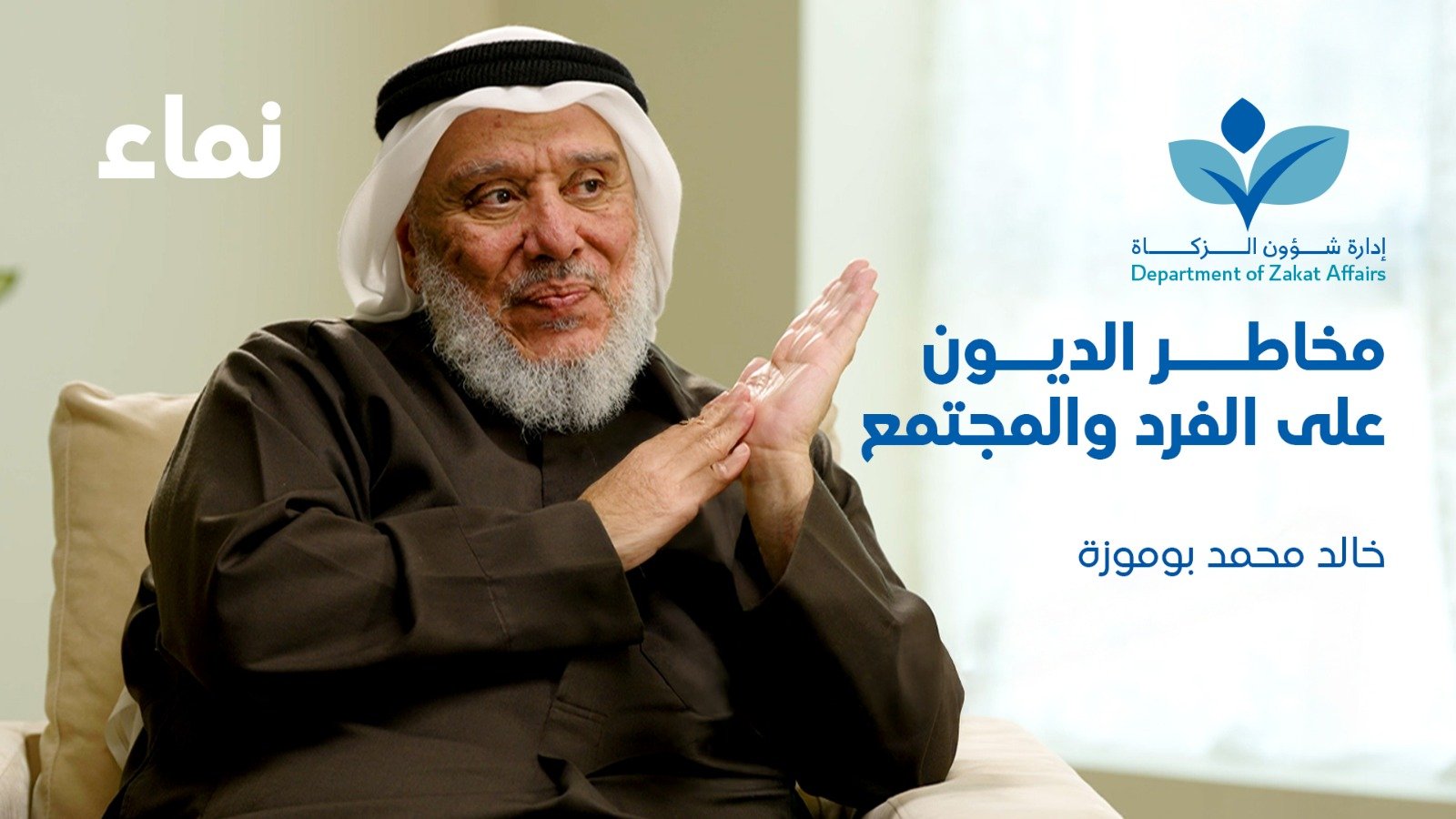
In a new episode of Nama Podcast, produced by the Zakat Affairs Administration in the State of Qatar, Mr. Ahmed Al-Janahi hosted family consultant Khalid Mohammed Boumoza to discuss the growing phenomenon of consumer debt and why it has become an urgent issue that warrants public discussion.
Recent data indicate that consumer debt in Qatar reached approximately QAR 159 billion in 2024, a significant figure relative to the country’s population and economic size. It reflects a growing reliance on borrowing to cover daily living expenses rather than merely essential needs.
This increase cannot be viewed in isolation from the social and economic transformations taking place in the country. Living standards have risen, consumption patterns have expanded, and access to bank financing has become easier.
So what drives individuals, particularly young people, into the debt trap?
Boumoza explains that one of the primary causes is a lack of financial literacy. Many individuals do not possess the basic skills required to manage their income and set priorities. This is evident in the tendency to spend on luxuries before necessities and to make financial decisions based on immediate desires or social influence rather than long-term planning.
Social pressure also plays a major role, as some people seek to emulate certain lifestyles even when those lifestyles exceed their actual financial capabilities.
This phenomenon can be described through the profound Qur’anic concept of financial obliteration, derived from the supplication of Prophet Moses (peace be upon him) against Pharaoh in Surat Yunus:
“And Moses said, Our Lord, indeed You have given Pharaoh and his establishment splendor and wealth in the worldly life, our Lord, that they may mislead from Your way. Our Lord, obliterate their wealth and harden their hearts so that they will not believe until they see the painful punishment.”
The discussion emphasized that the problem is not always linked to low income. More often, it is related to poor financial management. An individual may earn a relatively high income yet spend it entirely—or exceed it through borrowing—without allocating any portion to savings or investment.
This situation is described as financial obliteration, meaning the possession of wealth without deriving real benefit from it, either because of poor planning or unwise spending. It has become increasingly common among broad segments of society, especially in the absence of a deeply rooted financial culture. Money then loses its essential function as a means of achieving stability and a decent life and becomes merely a resource that is consumed without meaningful return.
This concept takes two main forms. The first is when an individual has a good income but is unable to save or invest. The second is when money is spent on things that provide no real added value, such as excessive consumption or extravagant luxury. In both cases, the outcome is the same: resources are depleted without building a stable financial future.
But how can one distinguish between necessities and luxuries?
Boumoza explains that necessities include basic expenses such as housing, food, education, and healthcare, whereas luxuries encompass anything that can be postponed or dispensed with without directly affecting one’s quality of life.
The problem, however, is that many people confuse the two categories. They may regard certain luxuries as necessities, such as leisure travel or frequent dining out. This confusion leads to inflated expenses and, consequently, irrational borrowing to finance them.
According to the guest, the contemporary lifestyle also plays a significant role in reinforcing consumer culture. Numerous spending options—from restaurants to online shopping—make it easy to exceed one’s budget without realizing it. Excessive reliance on restaurants, for example, can consume a substantial portion of income, while home-based alternatives are far less costly. Moreover, advertising and social media contribute to creating artificial consumer desires.
Boumoza does not view debt as inherently negative. Rather, he distinguishes between consumer debt and investment debt. Consumer debt, used to finance non-productive expenses, often becomes a financial burden. Investment debt, on the other hand, can be beneficial when used to fund businesses, education, or income-generating assets. Investing in education is among the clearest examples of productive debt because it opens opportunities for higher future income.
Regarding the concept of reverse saving, which he introduced during the discussion, Boumoza describes it as a financial approach in which a person obtains a loan equivalent to the amount they expect to save over a certain period and then invests it immediately to achieve a higher return. The idea is to accelerate the investment process instead of waiting years to accumulate savings gradually. However, this approach requires a high level of financial awareness and the ability to manage risk. It may be useful in specific circumstances but is not suitable for everyone.
When discussing safe borrowing limits, the podcast guest advises that loan installments should not exceed 35% of monthly income, ensuring that essential expenses can still be covered without financial strain. If the percentage exceeds 50%, it becomes a serious indicator of potential financial distress. He therefore recommends allocating approximately 65% of income to essential expenses and reserving the remainder for savings and investment.
Boumoza believes that zakat is one of the important social tools for supporting financially distressed individuals, particularly the category of debtors (gharimeen)—those who borrowed for legitimate reasons and later became unable to repay. He emphasizes that directing a portion of zakat funds toward this group can help alleviate financial hardship, provided that the debt resulted from genuine necessity rather than unjustified consumer spending. He also notes that improving zakat collection and distribution mechanisms can enhance its effectiveness.
Social culture also directly influences individual decisions by shaping what is considered acceptable or desirable in terms of lifestyle. In some cases, society imposes high spending expectations, such as hosting lavish celebrations or purchasing luxury goods, which pushes individuals to borrow in order to meet these expectations. Changing such cultural norms therefore requires continuous awareness efforts.
Boumoza highlights the Japanese model as a notable example, particularly the Kakeibo system, which involves meticulously recording daily expenses. This helps individuals understand their spending habits and reduce unnecessary expenditures. The model demonstrates that financial awareness is not merely a matter of income but the result of upbringing and culture developed from an early age. Simplicity in lifestyle is also a fundamental component of this approach.
To get out of debt, Boumoza advises gradually increasing monthly installment payments to shorten the repayment period and using any increase in income to pay down debt rather than raise spending levels. He also recommends diversifying income sources, reducing unnecessary expenses, and seeking professional financial advice to develop a clear plan. He stresses that consistent commitment to these steps is the key to success.
More important than paying off debt, however, is avoiding it in the first place. This can be achieved by building a balanced financial culture in which income is thoughtfully allocated among spending, saving, and investing. Recording expenses, reviewing consumption habits, and setting financial goals are all tools that help prevent falling into the debt trap. Early financial education is among the most important preventive measures.
Boumoza believes that the phenomenon of consumer debt reflects deeper transformations within society, where consumption increasingly becomes a means of achieving personal satisfaction or social status. It also reveals a gap between available resources and actual financial behavior—a gap that can be addressed through awareness, planning, and supportive policies.
He concludes that change is possible, but it requires the combined efforts of individuals and institutions. By strengthening financial literacy, improving planning tools, and providing support for those in need, society can reduce its reliance on debt and build greater economic stability. The real challenge lies in transforming awareness into sustainable daily behavior that restores money to its true function: a means of achieving stability rather than a source of anxiety.