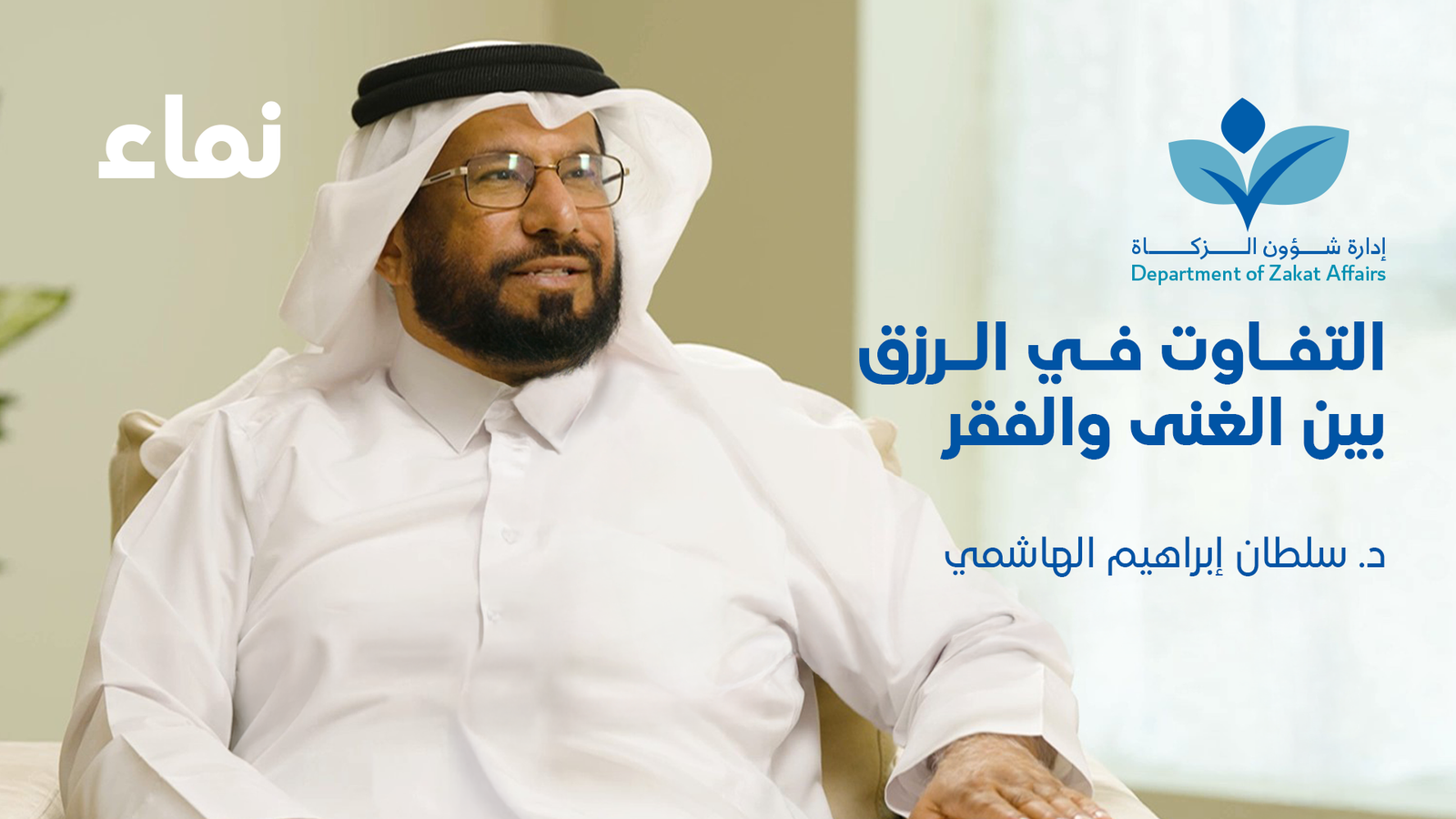
In a new episode of the Nama Podcast, hosted by Ahmed Al-Janahi, Dr. Sultan Ibrahim Al-Hashemi, Professor of Islamic Jurisprudence at Qatar University, was invited to discuss a question that appears simple on the surface but, in reality, puzzles many people: Why do poverty and wealth exist in the world? Why are some people born into comfortable circumstances while others struggle with financial hardship?
This question, which frequently arises in people's minds, opens the door to a deeper understanding of the nature of life itself. Al-Hashemi explains that differences in people's provisions are neither a flaw nor an injustice. Hardship is not necessarily a punishment, nor is abundance necessarily a reward. Rather, both poverty and wealth are part of a precise divine system founded upon wisdom and mercy.
In this context, Al-Hashemi emphasizes the need to redefine concepts that people often associate with value. Wealth is not necessarily a sign of honor, nor is poverty necessarily intended as humiliation. Both are forms of trial and testing. While they differ in nature, they share the same purpose: revealing the true nature of the human soul.
From this perspective, the guest does not link material success with divine approval. As a result, individuals are freed from constant comparison with others and instead confronted with a personal responsibility regarding how they deal with what they possess, rather than focusing on what others own.
It thus becomes clear that wealth may, at times, be a more difficult test than poverty. Money carries hidden temptations, grants its owner the ability to delay and procrastinate, and may lead a person to neglect obligations or become absorbed in desires.
During the discussion, Al-Hashemi cites a real-life example of a wealthy man who was informed that his zakat obligation amounted to a substantial sum. He decided to postpone paying it but passed away before fulfilling the obligation. The example illustrates the danger of procrastination and demonstrates how wealth can transform from a blessing into a trial.
This story is not presented merely as an isolated incident but rather as a symbol of a common psychological condition. People often assume that opportunities remain available and that time is under their control, when in reality the truth may be entirely different.
The podcast therefore connects wealth with time and links the ability to give with an awareness of life's limited duration, emphasizing that taking the initiative to do good is not a deferred option but an urgent necessity.
One of the most important themes discussed in the podcast concerns the ownership of wealth. It presents a perspective that differs fundamentally from common understanding by explaining that human beings do not possess wealth in an absolute sense. Rather, they are trustees entrusted with it. Wealth, in its true essence, belongs to God, while human beings merely act as custodians.
This concept changes the way people think about spending and ownership because a trustee does not act according to personal desires but according to the instructions entrusted to them. Consequently, a person's freedom to use wealth is not absolute but is restricted by ethical and religious guidelines, including avoiding unlawful earnings, refraining from extravagance, and fulfilling obligatory financial duties.
Such restrictions should not be understood as limitations but as a system that ensures justice and prevents wealth from becoming a tool for corruption or oppression.
At the same time, the guest stresses the importance of correcting a widespread misconception that Islam promotes asceticism in the sense of poverty or withdrawal from worldly life. He explains that Islamic law does not prevent a person from becoming wealthy. On the contrary, it opens the door to lawful earnings and encourages work and effort, provided they remain within a disciplined framework.
In this regard, Al-Hashemi cites examples from Islamic history, noting that some of the Prophet’s companions were among the wealthiest individuals of their time, yet they were also among the greatest examples of asceticism because of the generosity with which they spent their wealth. This demonstrates that the issue is not wealth itself, but rather how it is acquired and spent.
This perspective creates a balance between material ambition and ethical commitment, giving individuals room to achieve success without losing their spiritual dimension.
Another important point emphasized in the discussion is that zakat does not represent the end of one’s financial obligations; rather, it is merely the minimum requirement. There are other rights associated with wealth that are equally important, including supporting one's family, assisting those in need, providing aid during emergencies, and contributing to charitable causes.
This broader understanding of financial responsibility reflects the comprehensiveness of Islamic law and confirms that social solidarity is achieved not only through zakat but through an integrated system of values and practices.
From Al-Hashemi’s perspective, zakat thus becomes a comprehensive social and economic system rather than merely an individual act of worship. He explains that it contributes to reducing class disparities, prevents the concentration of wealth in the hands of a limited group, strengthens solidarity among members of society, and reduces feelings of class resentment and the crimes that may result from it.
When a poor person feels entitled to a share of a wealthy person's wealth—not as charity but as a recognized right—feelings of envy and injustice are reduced, creating a state of psychological and social balance. At the same time, the wealthy individual comes to realize that wealth is not entirely private property but a responsibility, encouraging generosity and discouraging arrogance.
One of the most notable aspects of the podcast is its emphasis that zakat should not be viewed merely as a means of meeting basic needs, but also as a tool for empowerment. It can be used to support small businesses, develop skills, and provide means of production, thereby helping individuals escape the cycle of dependency. This developmental dimension reflects a profound understanding of zakat’s role and transforms it into an effective instrument for building a productive society.
The discussion also addresses the issue of striving and work, rejecting the notion of surrendering to poverty under the pretext that sustenance is predetermined. Al-Hashemi emphasizes that human beings do not know the unseen and must therefore exert effort, since that very effort may become the means through which their lives change.
He compares this to a student who refuses to sit for an examination because he expects to fail. The outcome, however, cannot be known without making the attempt. This analogy illustrates that reliance upon God (tawakkul) does not mean passivity, and that belief in divine decree does not eliminate the responsibility to act.
Al-Hashemi presents a balanced understanding of the relationship between divine decree and human effort. He combines belief that everything is predestined with belief that individuals remain responsible for their actions. This balance protects people from both despair and arrogance, enabling them to live with psychological stability: working diligently while leaving the results to God.
Within this framework, poverty may be viewed as a temporary condition capable of change rather than an unavoidable destiny, while wealth becomes a test rather than proof of success.
From this perspective, Al-Hashemi believes that zakat can represent an alternative economic model, particularly amid global crises where the gap between rich and poor continues to widen. If individuals and corporations fulfill their zakat obligations in an organized manner, it can contribute significantly to addressing many social problems and providing a safety net for vulnerable groups.
Zakat is therefore not presented as a theoretical solution but as a practical mechanism that can be implemented whenever the necessary awareness and commitment exist.
In this way, zakat is transformed from an annual obligation into a way of life, and from a financial burden into an opportunity to rebuild the relationship between human beings and their Creator, as well as between individuals and their communities. This vision makes zakat a means of reforming both the individual and society simultaneously, giving it a civilizational dimension that extends beyond worship into the realms of development and justice.
Wealth is not an end in itself but a means of achieving good. Success is measured not by what we possess but by what we contribute. Zakat is therefore not merely a religious obligation but a comprehensive system that reshapes awareness and builds a society founded upon justice, solidarity, and the creation of opportunities for individual ambition without allowing selfishness to dominate the wider community.