When a person fails to achieve what they desire, they begin to seek a force greater than themselves. Some turn to influential figures or vast wealth to fulfil their needs, while others instinctively turn to the unseen, seeking a force beyond human perception. Here, minds and hearts diverge. The believer accepts the unseen as a [...]
When a person fails to achieve what they desire, they begin to seek a force greater than themselves. Some turn to influential figures or vast wealth to fulfil their needs, while others instinctively turn to the unseen, seeking a force beyond human perception.
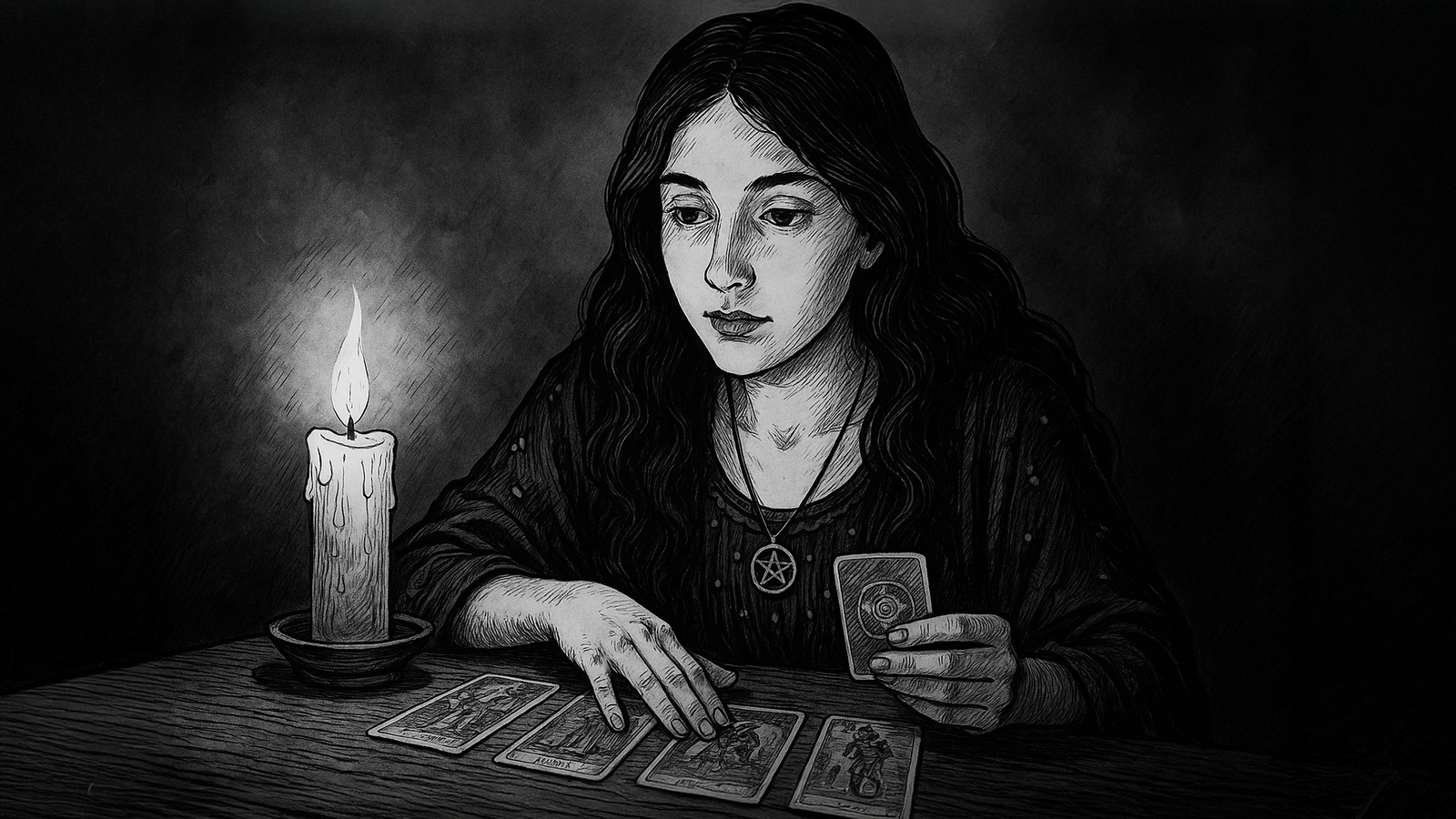
Here, minds and hearts diverge. The believer accepts the unseen as a reality beyond reason, faith in a higher power that was revealed through divine revelation, and what lies beyond the visible and tangible. Meanwhile, the non-believer places their faith in what lies beyond reason, chasing after the superstitions of fortune-tellers and trusting tarot cards or palm readings, despite claiming to only believe in what is scientifically proven.
Ironically, secular societies that often chant “science first” are the same ones that embrace horoscopes and fuel the markets of sorcery. When certainty is lost, people cling to any illusion that promises salvation.
The Muslim, however, is commanded not to pass judgment without clear evidence. They are encouraged to seek knowledge and respect scholars, while also acknowledging the power of the unseen, which is grasped not by intellect alone, but through the light of divine revelation.
Today, in an age of artificial intelligence, molecular medicine, and travel to Mars, talismans still find their way into the palaces of politicians, the pockets of the poor, and the hearts of the fearful. Magic in all its forms continues to seep into every corner of the globe—from Iraq to Morocco, from Washington to Mumbai—reshaping the domains of power, wealth, love, and illness, just as it did thousands of years ago.
A friend of mine never ceases to recount stories of what one woman did to her husband, or another to her lover—ranging from separation spells that plant doubt, hatred, and resentment, igniting the flames of domestic conflict, to love spells that render a man utterly obsessed, unable to part from the woman who now controls him entirely—whether out of greed, possessiveness, or sheer manipulation.
Both forms of magic are mentioned in the Qur’an and Sunnah. The first appears in the story of the two angels, Harut and Marut, in Surat Al-Baqarah: “They learn from them that by which they cause separation between a man and his wife.” As for the second, the Prophet ﷺ named it at-Tiwalah, a form of love magic, and said: “Incantations, amulets, and Tiwalah are shirk (associating partners with Allah).” It takes the form of a string or paper inscribed with magical texts meant to attract affection.
Aisha (may Allah be pleased with her) narrated that the Prophet ﷺ was once bewitched by a man named Labid ibn al-A’sam, a Jew from Banu Zurayq, who used a comb, strands of the Prophet’s hair, and palm tree fibers to perform the spell, hiding it in the well of Dhiwan. The Prophet ﷺ began to imagine he had done things that he had not done, though the spell did not affect his mind or revelation. Eventually, he prayed until two angels came and revealed the location of the spell. It was retrieved, and the knots were untied using the Mu’awwidhatayn (the last two chapters of the Qur’an), lifting the effects of the magic.
And who can forget the story of Moses (peace be upon him) with the magicians of Pharaoh, when they gathered on the Day of Festival and cast their ropes and staffs, enchanting the people’s eyes and making them believe they were slithering snakes. Moses felt afraid, but Allah reassured him, “Do not be afraid; indeed, you are the superior.” He cast his staff, and it swallowed what they had produced. The magicians immediately fell into prostration, turning from adversaries to believers in the Lord of Moses and Aaron.
These examples show that magic is not, as some think, mere superstition or illusion, but an unseen truth confirmed in Islamic texts, mentioned in the Qur’an and unanimously acknowledged in the Sunnah. It only affects the body and mind by Allah’s permission, much like viruses and bacteria affect the human body, and it manifests in various forms.
A study by Dr. Abdel Maqsoud Mohamed Shuaib, published in the Journal of Legal Studies, outlines the severe harm caused by magic across the Arab world on multiple levels.
Psychologically and socially, magic contributes to family breakdown and the erosion of relationships, leading to obsessive thoughts, chronic anxiety, distrust among spouses and relatives, and transforming homes into spaces of tension and isolation.
On the health front, many victims turn to charlatans who prescribe unknown herbs or dangerous rituals that may cause poisoning or serious physical harm, especially when impure or harmful substances are used under the guise of “spiritual healing.”
The economic impact is no less alarming. The obsession with breaking spells or attracting love pushes people to spend large sums on sorcerers and frauds, who often market items at outrageous prices, such as the infamous “red mercury”,—leading to financial strain for individuals and families.
The troubling part is that my friend speaks as if most people around her are engaged in these practices, as if sorcerers are widely available and offer their services freely without oversight or accountability. It’s as if they have shops scattered like grocery stores, opening their doors publicly and welcoming lines of eager customers. Her words make one seriously question the laws that criminalise such acts and the deterrent punishments that are supposed to be enforced against the perpetrators.
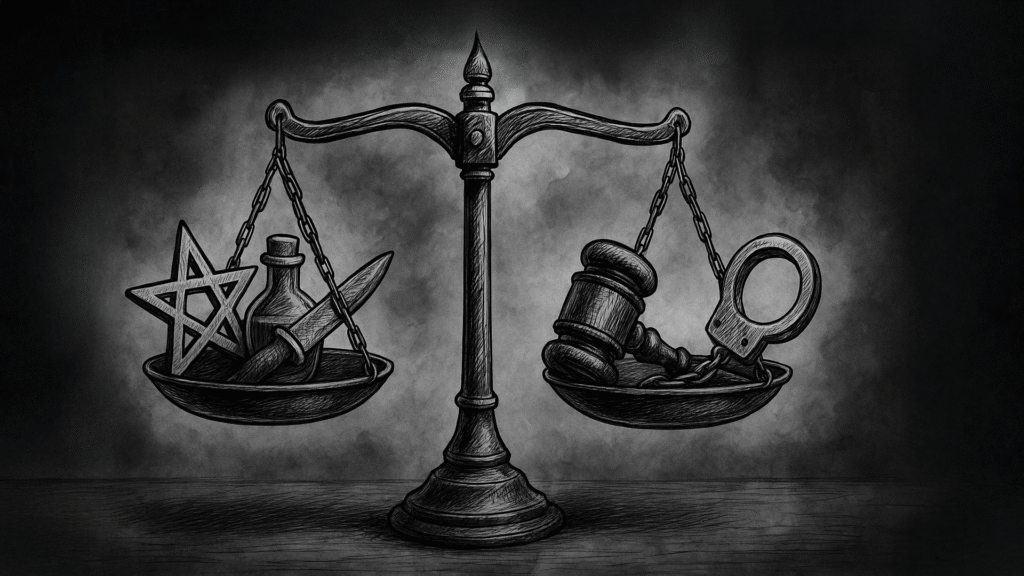
In reality, Qatari law explicitly addresses the criminalisation of acts of magic and sorcery through an amendment introduced by Law No. (22) of 2015 to the Penal Code issued under Law No. (11) of 2004. A dedicated chapter titled “Crimes of Sorcery and Deception” was added, clearly defining the penalties.
According to Article 299 of the Penal Code, anyone who deceives others by claiming powers of sorcery, fortune-telling, knowledge of the unseen, or the ability to bring benefit or avert harm is subject to imprisonment for up to 15 years and a fine of up to 200,000 Qatari riyals, or one of the two penalties.
The punishment is not limited to those who directly engage in these acts but extends to anyone who provides a venue for them, manages or promotes them, or covers up for those who do, thereby cutting off all forms of support and facilitation. Tools and money involved in the crime are to be confiscated, and the place where the crime was committed may be closed down.
The legislator has allowed for an exemption from punishment for anyone who reports the crime before it is discovered. While anyone who attempts such acts, even if the crime is not completed, can be punished with up to half the maximum penalty. This may create a loophole allowing perpetrators of magic and fraud to escape punishment when the pressure mounts, or perhaps it opens a door for repentance and remorse.
What requires further scrutiny is the inherently elusive nature of magic—intangible, invisible, and often lacking material evidence. Proving it in court is extremely difficult; there are rarely fingerprints to lift or video recordings to document the events—only vague statements, hidden intentions, and suspicions that are hard to measure by legal standards.
Additionally, the law leaves room for individual interpretations and inconsistent application. It does not clearly distinguish between outright deception, spiritual healing, or social practices passed down through generations, nor between legitimate Islamic ruqyah, energy healing, and claims of knowing the unseen. The overlapping nature of these practices makes judgment complicated.
The inconsistency in how such acts are classified poses another challenge. A person who claims to bring lovers together or open paths to marriage may be charged with fraud rather than sorcery, resulting in a lighter sentence, a different investigative authority, and ultimately, the closing of a case that should have been prosecuted under its true nature.
Just as my friend has a list of sorcerers and their clients, she also has another list of men she claims collaborate with the Ministry of Endowments and Islamic Affairs, possessing the ability to break spells, remove spiritual afflictions, and undo their effects. This suggests the existence of a parallel market of those claiming piety and sainthood—figures who, supposedly, heal the afflicted and restore clarity to the disturbed.
The website of the Ministry of Endowments and Islamic Affairs in Qatar provides a list of authorised Islamic healers (ruqya practitioners) as part of its various services. One such healer listed on the site describes himself as an imam, no different from any other mosque imam. He does not consider himself remarkable or saintly, but instead believes that all believers are awliya (close to God). The ministry nominated him to perform ruqya for free.
He explains that he uses Quranic verses and prophetic supplications to treat those who come to him. Most of the cases he sees are psychological disorders, illusions, or obsessive thoughts. He uses nothing more than water over which verses of the Quran have been recited. He then advises the afflicted to drink it, wipe it over their face and hands, or apply it to the area of pain, if any. One session may not be enough, depending on the case.
He also advises those who believe they are afflicted by envy or magic to seek help from individuals listed in the official registry of approved healers, warning that many impostors demand payment for their recitation and may even request personal items, such as clothing. In contrast, the genuine healer recites the Quran, blows gently over the patient, and prays for them, without demanding any money, purely for the sake of God.
In this regard, Sheikh Mohamed Abu Bakr, speaking firmly and without hesitation in an episode of his program Inni Qareeb (I Am Near), aired on Al-Nahar channel, stated that those who summon jinn are characterised by disbelief (kufr). He emphasised that their actions are nothing but misguided behaviour rooted in idolatry and heresy.
He warned that if anyone finds such a person using rituals involving animal sacrifice, impurity, or what is known as “lower methods,” they should immediately recognise that they are dealing with a charlatan. Likewise, suppose someone relies on astrology, palm reading, using personal belongings, mirror divination, spirit summoning, zār rituals, fortune-telling, using numbered dice, zodiac calculations, sand drawing, contacting spirits, rosary counting, or what is known as al-basha‘a (a form of ordeal by fire or iron). In that case, it should be immediately apparent that the person is a fraudulent magician.
The sheikh further emphasised that although he exposed these methods, he refrained from explaining them in detail out of concern that the episode might become a how-to guide for learning magic. His aim, instead, was to raise awareness and empower people to unmask those who cloak themselves in the guise of religion while being far removed from its essence, especially given how widespread magic is in Egypt, where the income generated by sorcerers rivals that of arms and drug trafficking.
In his article Magic, Sorcery, and Deception in the Lives of Arab Leaders, Ibrahim Hashad writesthat “the Arab world spends between 5 to 7 billion dollars annually on breaking spells, attracting love, causing harm between people, gaining favour, warding off harm, the desire for control and malicious intent, as well as acquiring wealth, status, and success in work and life.”
It is therefore not surprising to find magic widespread in our societies, especially when countless stories—many of them well-documented—tell of rulers and leaders who regularly visited fortune tellers and sorcerers, relying on occultists to make decisions or secure their grip on power. This raises serious questions about the influence of fortune tellers on key decisions within the ruling apparatus, revealing a hidden side of the relationship between magic and politics in the Arab world.
Hashad notes that Hosni Mubarak relied on fortune tellers, most notably a clairvoyant named Umm Majid, who visited him in the hospital in Sharm el-Sheikh, where he was staying, to read his fortune and tell him about the uncertain future ahead. Mubarak reportedly believed in predictions about his continued rule and the succession of power to his son Gamal Mubarak.
Mubarak’s relationship with soothsayers and charlatans dates back to the late 1950s, when he was an army officer stationed in Sudan. There, a Sudanese fortune teller predicted that he would one day become president of Egypt, despite his greatest aspiration at the time being to become a provincial governor.
This prophecy, which later came true, laid the foundation for his confidence in fortune tellers. During his tenure as Vice President under Anwar Sadat, he began visiting a fortune teller in Cairo’s Heliopolis neighbourhood, who told him he would rise to power through blood—a prediction that materialised with Sadat’s assassination in 1981.
Mubarak’s interest in fortune tellers extended beyond Egypt. In Paris in 1982, a French astrologer predicted that he would die in the same year he appointed a vice president. This may explain why he resisted naming a deputy for most of his presidency. When he finally appointed Omar Suleiman as his vice president in 2011, speculation intensified that the prophecy was coming true, especially as Mubarak’s health declined. Umm Majid visited him in the hospital.
In an article published in Rai Al-Youm, Dr. Mohamed Abu Bakr reported that an Iraqi magician and sorcerer named Hamed “turned his home into a destination for top officials in the country, including politicians, ministers, and parliamentary election candidates.”
This Iraqi sorcerer, Abu Bakr, adds, “boasts about exhuming graves and using the brain matter of the dead in his spells. He claims to frequently receive high-ranking officials, to the point that he once welcomed the country’s most senior official. He insists that his magical work is highly effective and that many individuals achieved parliamentary success because of his help.”
We praise God that some Islamic countries have taken a clear stance on sorcery and have enacted laws that criminalise it. In contrast, Western and secular countries often regard it as either a form of spiritual practice or a mere fraud.
Mel Keenan, in his study titled The Western Legal Response to Sorcery in Colonial Papua New Guinea, explains that English law evolved over the centuries—from criminalizing sorcery as a pact with the devil or a means to harm others, to completely denying its effectiveness by 1736, which marked the end of witch trials in Britain.
Keenan adds that British and later Australian colonial authorities approached sorcery in Papua New Guinea primarily as a matter of maintaining public order, without fully understanding the cultural and spiritual foundations of local societies. While they enacted laws criminalising claims to magical powers, these laws failed to stop violence related to sorcery.
Keenan appears to highlight a double standard: Papua New Guinea’s Sorcery Act of 1971 implicitly acknowledged the existence of sorcery, yet simultaneously denied its real-world effectiveness. This contradiction led to weak law enforcement and a rise in sorcery-related crimes.
This reveals a Western shortcoming in understanding that belief in sorcery was a vital part of the social fabric in Papua New Guinea. Instead of integrating these practices into culturally sensitive legal frameworks, colonial powers suppressed them. Keenan’s study recommends adopting more culturally aware legal approaches, especially in communities where belief in sorcery remains strong, as Western, evidence-based legal models may exacerbate violence instead of containing it.
We saw a similar sense of trivialization in 2017, when a group of witches and their sympathisers organised an unconventional protest in front of Trump Tower in New York. They performed a magical ritual at midnight aimed at “binding” President Donald Trump and preventing him from causing harm.
According to The Times, the ritual involved burning unflattering photos of Trump, orange candles, and tarot cards. It was part of a broader campaign circulated online, intended to be repeated during every waning crescent moon.
The newspaper described the event as theatrical and bizarre, symbolising the diversity of protest forms, especially amid the deep political polarisation gripping American society at the time.
In contrast, many evangelical leaders viewed the ritual as a sign of a “spiritual battle” between good and evil. They emphasised that their support for Trump was not only political but also religious, believing him to be a tool of divine will. Accordingly, they viewed the witches as enemies of the Christian faith, prompting them to intensify their efforts in prayer and spiritual outreach.
Despite secular laws denying the validity of sorcery, they often simultaneously promote the idea of supernatural forces tied to certain substances.
Sadiq Al-Taie cites one example in his article for Al-Quds Al-Arabi, where he describes “red mercury” as a myth that emerged after the fall of the Soviet Union, amid fears that weapons would leak onto the black market. Rumours linked this substance to extreme danger, claiming it could be found in the throats of mummies or bat nests, with some even calling it “food for the jinn” that could fulfil wishes.
It is also believed that the Soviets developed this substance, allegedly capable of killing the population of a city the size of London without damaging its infrastructure. Despite the lack of scientific evidence for its existence, rumours persisted, especially during the 1990s in South Africa, where intelligence agencies such as Mossad were allegedly involved in shady dealings. There were also claims that the United States secretly promoted the myth to trap terrorists, and rumours circulated about its presence in wells in southern Iraq.
And even if sorcery haunts minds—from the palaces of politicians and rulers to the homes of the poor and the pockets of the desperate—and superstition sneaks in under the guise of religion or is promoted in the name of science, the accurate compass must turn inward, to our homes, our hearts, and the small details of our daily lives.
Perhaps we find that most of these tales feature women, either desperate or greedy, chasing promises of quick salvation or a love that is meant to be. But not all magic is evil, as Sheikh Mohammed Abu Bakr says, nor is every invisible influence suspicious. There is a kind of magic that is neither forbidden nor condemned—one that enters the heart without incantations and captivates the soul without spells. It resides in kind words, good character, warm greetings, a clean space, and a graceful appearance.
Attention to words before they are spoken can heal the ailing, open closed hearts, and win affection without price. A kind word is a key to souls—an enduring magic that cannot be annulled, condemned, or resisted.
I know, my dear friend, that you are well-versed in the labyrinths of this hidden world. You know the names of sorcerers as others know the names of doctors, and you recount stories as if you lived them. But know this: whoever lingers too long on the edge of the unseen without guidance will either fall into misguidance, or surrender their mind to madness.
I know, my dear friend, that you are well-versed in the labyrinths of this hidden world. You know the names of sorcerers as others know the names of doctors, and you recount stories as if you lived them. But know this: whoever lingers too long on the edge of the unseen without guidance will either fall into misguidance, or surrender their mind to madness.